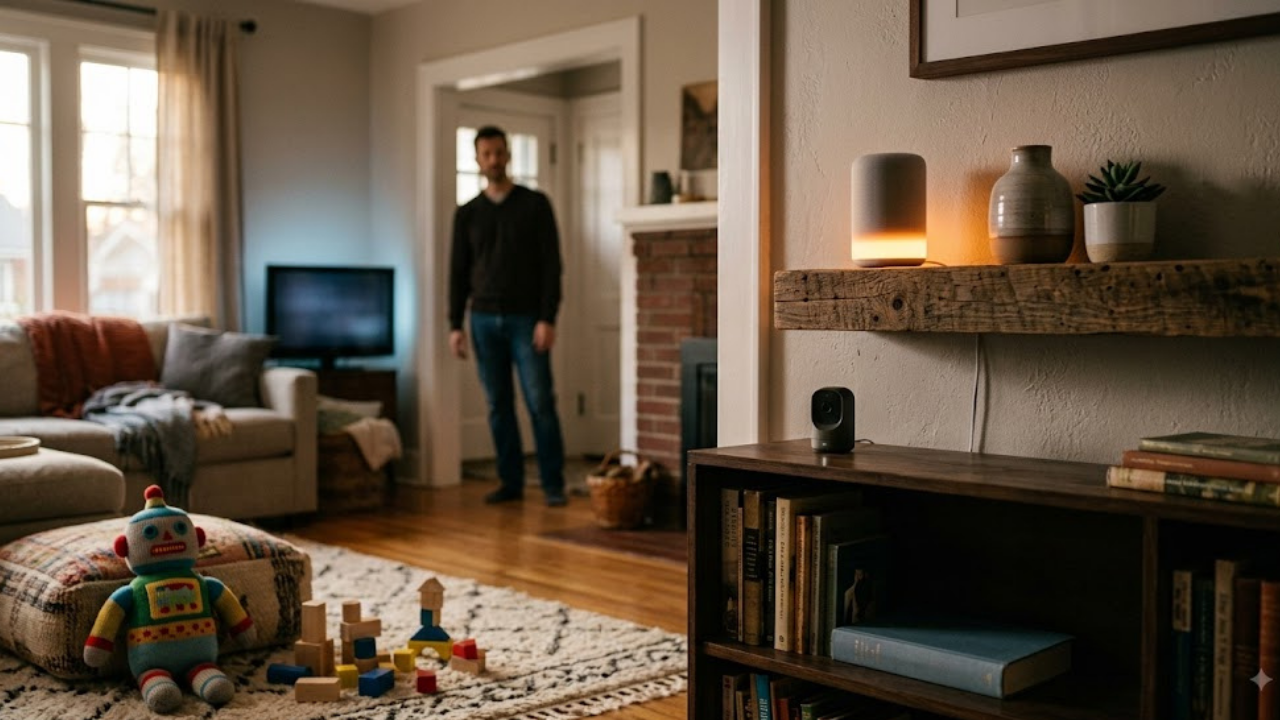
Smart home devices spying on kids sounds like an exaggeration until you start counting the gadgets in a typical American household. A voice assistant in the kitchen listens for a wake word. A video monitor in the nursery streams to an app on a parent’s phone. A talking toy on the shelf “remembers” what a child told it yesterday. None of this feels alarming in the moment – it feels like convenience. But each device is also a small data-collection tool sitting inside a home where kids talk, play, and move around without ever thinking about who might be listening.
Most parents already question how phones and tablets handle their children’s privacy. Far fewer ask the same question about the smart home devices scattered around the house, even though the pattern of smart home devices spying on kids is becoming harder to ignore. That gap matters, because kids are often the household members generating the most sensitive, least guarded data – voice recordings, facial images, movement patterns, even bedtime routines – without ever agreeing to any of it.
How Smart Home Devices Spying on Kids Actually Happens
A voice assistant doesn’t just respond to commands. Depending on its settings, it can store audio clips, build a profile of speech patterns, and keep a running log of requests. When a child asks a smart speaker a question, that interaction is often logged the same way an adult’s would be, even though the child has no idea a recording exists at all.
Connected cameras raise a different concern. A baby monitor or indoor camera pointed at a play area is convenient for checking in remotely, but it also creates a continuous video feed that passes through a company’s servers before reaching a parent’s phone. If that account uses a weak password, or if the manufacturer has a history of security lapses, that footage stops being private family video and becomes a target.
Smart toys are the least scrutinized category of all. Many now include microphones, Bluetooth connections, or companion apps that ask for a child’s name, age, or voice sample to “personalize” the experience. Parents often set these up in a hurry – during a birthday morning or a holiday unboxing – without reading what the toy’s app is actually requesting access to. None of this means every connected gadget is dangerous. It means the data collection is broader and less visible than it looks, and kids are rarely the ones who agreed to any of it.
Why Kids’ Data Deserves a Different Standard
Adults generally understand, at least loosely, that using an app or service means giving up some data in exchange for convenience. Kids don’t operate with that framework. A five-year-old talking to a smart speaker isn’t weighing a privacy trade-off – they’re just talking to a toy that talks back.
That distinction is why federal regulators treat children’s data differently from adult data. Under the Children’s Online Privacy Protection Act, enforced by the Federal Trade Commission, companies that knowingly collect personal information from children under 13 face specific requirements around parental consent and data handling. Enforcement varies in practice, and plenty of connected toys and apps sit in a gray area where it isn’t always clear whether a product is being treated as “child-directed.”
The bigger issue in most households isn’t one bad actor. It’s the sheer number of devices quietly gathering data with no single parent fully aware of what’s being stored, for how long, or who can access it. In practice, this is what smart home devices spying on kids actually looks like day to day – not a single dramatic breach, but a slow accumulation of unmonitored access.
Where the Data From These Devices Goes
It helps to break the risk down by device type rather than treating it as one vague worry, since smart home devices spying on kids doesn’t work the same way across every gadget in the house.
- Voice assistants can retain audio recordings, transcripts, and usage history tied to a household account, unless settings are changed to limit or auto-delete that data.
- Cameras and video monitors store footage in the cloud, and that footage is only as secure as the account password and the company’s own server protections.
- Connected toys and wearables often send data to third-party app developers, not just the toy manufacturer, meaning more than one company may end up holding a child’s voice or activity data.
- Smart TVs and streaming devices can track what’s being watched in the household, including children’s viewing habits, which then feeds into advertising profiles.
The common thread is that this data rarely disappears after use. It sits on a server somewhere, governed by that company’s retention policy and security practices – and in the event of a breach, by its incident response plan. A breach involving adult financial data is bad enough. A breach involving a child’s voice recordings or home video is a different category of exposure, one that can’t simply be reset with a new password the way a compromised bank login can.
A Household Working Through This in Real Life
Picture a family with two kids under ten, a smart speaker in the living room, a video baby monitor for the youngest, and a talking robot toy that arrived as a birthday gift. None of these were bought with privacy in mind – they were bought because they were useful or fun. Over several months, the smart speaker has quietly built a history of questions the kids have asked it. The baby monitor account still uses the default password from setup day. The robot toy’s app was approved for microphone access without anyone reading past the first permission screen.
Nothing catastrophic has happened yet. But the exposure has been building the entire time, and fixing it later takes far more effort than setting it up correctly would have taken at the start. This is a fairly typical example of smart home devices spying on kids in an ordinary household – not through malice, but through settings nobody got around to checking.
How to Stop Smart Home Devices From Spying on Kids
Cutting this risk down doesn’t mean throwing out every smart device in the house. It means treating each one the way you’d treat any other product that touches a child’s personal information – and taking a few concrete steps to limit smart home devices spying on kids in your own home.
- Check the settings on every voice assistant and turn on auto-delete for stored recordings, or disable voice history entirely where that option exists.
- Change default passwords on cameras and monitors immediately after setup, and enable two-factor authentication if the manufacturer offers it.
- Read the permissions a toy’s companion app requests before connecting it, and deny microphone or location access that isn’t necessary for the toy to work.
- Put kids’ devices on a separate guest network where possible, so a compromised toy or speaker can’t easily reach other devices at home.
- Check each device’s data retention policy, even briefly, to see whether recordings are stored indefinitely or deleted after a set period.
- Weigh convenience against data footprint before adding new smart gadgets, especially ones marketed directly at children.
None of these steps eliminate the risk entirely, but together they shrink the amount of exposed, unmanaged data sitting inside a home. It’s the same instinct that helps someone spot common phishing warning signs or catch online banking scams before they cause damage – applied directly to a smart speaker sitting on the kitchen counter.
Treat It as an Ongoing Check, Not a One-Time Setup
Privacy protection isn’t something to configure once and forget, especially when smart home devices spying on kids can resume the moment a setting quietly resets after a software update. It’s worth periodically checking whether a device’s app has changed its permissions after an update, whether a subscription tied to a camera has revised its terms, or whether the National Institute of Standards and Technology’s guidance on IoT device security has flagged new risks for connected home products. These checks take only a few minutes but catch problems early – the same logic behind building strong cybersecurity habits for protecting money online.
Families running a home business or side hustle alongside raising kids have an extra reason to stay alert to smart home devices spying on kids, since a compromised home network can expose more than family photos – it can expose financial and business data too, echoing many of the same small-business cybersecurity mistakes that trip up companies of every size.
The Bottom Line on Smart Home Devices Spying on Kids
Smart home devices spying on kids isn’t a reason to abandon the technology that makes daily life easier – it’s a reason to pay closer attention to what’s running in the background while families focus on convenience. Kids can’t evaluate that trade-off for themselves, which puts the responsibility on parents to check settings, limit unnecessary access, and treat every microphone and camera in the house as something worth a second look.
The good news is that most fixes take minutes, not hours. A few adjusted settings, a stronger password, and a habit of reading permissions before saying yes can close most of the gap between convenience and exposure – without asking anyone to give up the gadgets that make home life easier in the first place.