
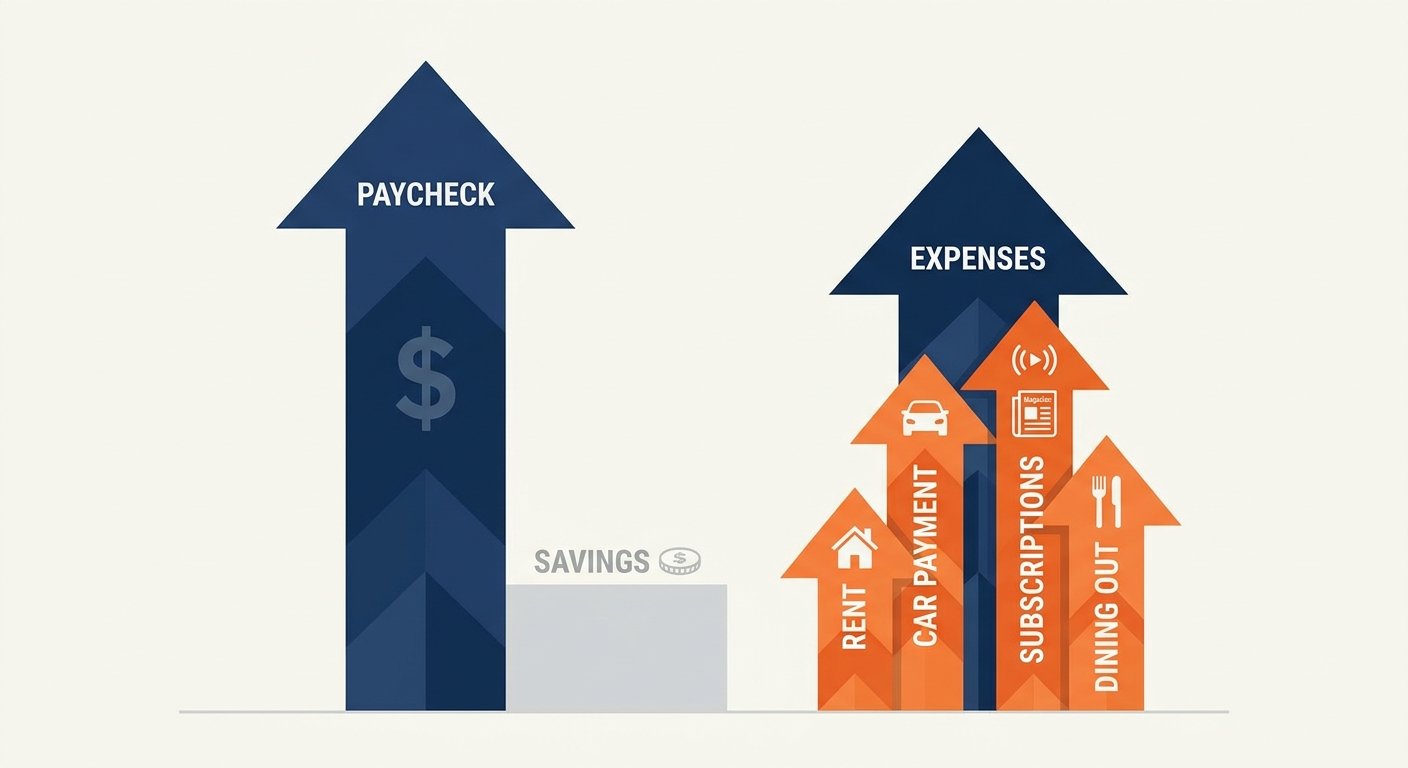
You got the raise. For a few weeks, it felt like breathing room – maybe you upgraded your apartment, financed a nicer car, or finally started ordering takeout without checking your balance first. A year later, your paycheck is bigger than it’s ever been, and somehow your savings account looks almost exactly the same as before. Nothing reckless happened. There’s no single purchase you regret. This is lifestyle creep, and the money just found somewhere else to go.
Lifestyle creep is the tendency for spending to rise quietly alongside income, until the extra money is gone before it ever becomes savings, investing, or debt payoff. It isn’t about irresponsible spending – it’s about how naturally a higher paycheck expands to fill the space around it. Every income increase deserves a decision, not an automatic upgrade. This article breaks down how lifestyle creep starts, where it hides in an ordinary American household, and how to enjoy a bigger income without letting every raise quietly disappear.
Why Earning More Can Still Leave You Feeling Financially Stuck
A raise changes how safe spending feels before it changes anything else. The new number on your paycheck creates a sense of margin, and that sense of margin makes upgrades feel justified – a better apartment, a nicer car, more convenience. None of this is irrational. It’s a normal psychological response to having more money available.
The trouble isn’t that people enjoy their higher income. Every increase in income can quietly become a permanent increase in expenses. This happens especially when nothing is intentionally set aside first. Enjoying a bigger paycheck isn’t the problem. The problem starts when 100 percent of it becomes new spending, every single time.
The Quiet Spending Changes That Follow a Bigger Paycheck
Lifestyle creep almost never arrives as one big decision. It builds through a series of small, individually reasonable upgrades: $200 more for a nicer apartment, a slightly bigger car payment, more frequent takeout, a couple of new subscriptions, a nicer hotel on vacation, delivery instead of driving to pick something up yourself.
Each choice looks harmless on its own. Stacked together over a year, they can absorb an entire raise without a single dramatic purchase to point to. That’s what makes lifestyle creep hard to notice – there’s no receipt you can look back on and say “that’s where it went.” It went everywhere, a little at a time.
How Lifestyle Creep Turns Small Upgrades Into Permanent Financial Commitments
Not all spending increases carry the same weight. A one-time purchase – a nice dinner out, a weekend trip – doesn’t change your monthly cash flow going forward. A permanent upgrade does: higher rent, a bigger car payment, a pricier insurance plan, a new recurring membership. These become fixed costs that show up every single month, whether or not the extra income keeps coming.
That distinction matters because permanent upgrades are the ones that actually erase a raise. A $300-a-month increase in rent doesn’t just cost $300 once – it costs $3,600 a year, every year, for as long as you live there. Recurring commitments deserve far more scrutiny than occasional spending, because they compound quietly in the background.
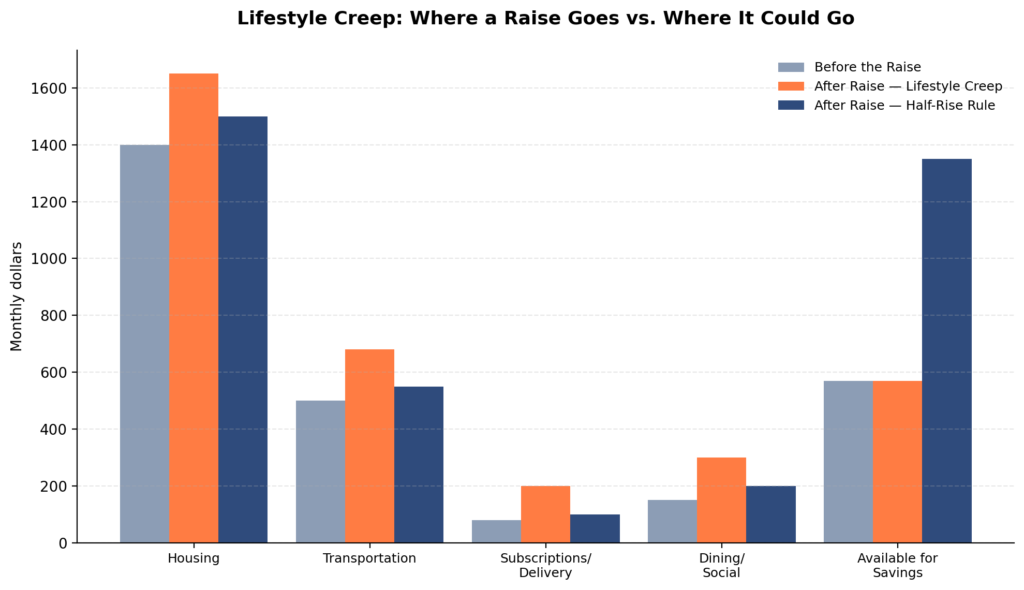
Consider an illustrative example of how quickly lifestyle creep can absorb a raise. A worker earning $65,000 gets promoted to $78,000 – a real, meaningful $13,000 raise. Before the promotion, their expenses and savings were relatively stable. Afterward, they move into an apartment that costs $250 more a month, upgrade to a car with a $180 higher payment, add $120 in new subscriptions and delivery habits, and spend more on dining out and weekend trips. Add it up, and roughly $700 to $800 of that raise is already spoken for every month – long before any of it reaches a savings account. The paycheck grew. The financial cushion didn’t.
The Real Difference Between Spending More and Becoming Wealthier
It helps to separate three things that often get blurred together in discussions of lifestyle creep: income growth is simply more money coming in. Lifestyle growth is more money going out to support a higher standard of living. Wealth building is what’s left over – the portion of income actually retained and directed toward savings, investing, or debt reduction.
Financial progress depends on the gap between what you earn and what you permanently commit to spending – not on the size of your paycheck alone. According to the Bureau of Economic Analysis, the national personal saving rate – the share of after-tax income households actually save – was 2.7 percent in June 2026, a reminder of how little room is typically left once spending has adjusted to income. For a broader look at how this rate is tracked over time, the Federal Reserve Bank of St. Louis maintains a running data series on personal saving as a share of disposable income. A bigger paycheck only becomes real financial progress if some of it consistently stays on the saving side of that gap.
Where Lifestyle Creep Usually Hides in an American Household
Lifestyle creep tends to concentrate in a few predictable categories rather than spreading evenly across a budget. Related patterns show up in how we spend once a paycheck feels bigger – see also our breakdown of cutting everyday expenses without major lifestyle changes.
A few categories tend to absorb raises faster than people expect:
Housing. A nicer place often brings higher rent or a bigger mortgage, plus higher utilities and maintenance.
Transportation. A newer or larger vehicle usually means a bigger payment, higher insurance, more fuel, and more maintenance.
Food and convenience. More income makes delivery apps, restaurants, and convenience purchases feel easier to justify – small charges that add up fast. (For a closer look at how these add up, see hidden monthly expenses.)
Subscriptions. Streaming services, apps, and memberships accumulate quietly, one small monthly charge at a time.
Social spending. Higher income often raises expectations around travel, gifts, and entertainment – spending that feels appropriate to the new income level.
Paid convenience. Services that save time are genuinely useful, but too many of them running at once can absorb a meaningful share of a raise.
None of these are inherently bad. The goal isn’t to eliminate them – it’s to notice when several are rising at the same time.
Enjoying Your Money Without Losing It to Lifestyle Creep
Avoiding lifestyle creep doesn’t mean staying frozen at the same standard of living forever. It means your lifestyle should improve more slowly than your financial capacity does. You can eat better, travel, upgrade your home, and spend on things you care about – while also increasing what goes toward savings, retirement contributions, debt payoff, and your emergency reserve.
The goal is balance, not deprivation. A household that captures even half of every raise for long-term goals, while still enjoying the other half, ends up in a fundamentally different financial position five years later than one that spends every dollar of every increase.
Is Lifestyle Creep Growing Faster Than Your Financial Security?
A quick self-check can reveal whether lifestyle creep has taken hold:
- Has your income increased in the past year while your savings balance barely moved?
- Did your recurring monthly expenses rise noticeably after your last raise or promotion?
- Are you now paying for conveniences you didn’t need or want before?
- Have you upgraded several areas of your lifestyle – housing, car, subscriptions – around the same time?
- Does your current income feel necessary just to maintain your current lifestyle, rather than optional comfort on top of it?
- Would a temporary pay cut create immediate financial pressure?
Answering “yes” to several of these doesn’t mean you’ve done anything wrong. It just points to where a closer look is worthwhile.
How to Enjoy Higher Income Without Spending Every Extra Dollar
Save part of every raise automatically. Before your spending has a chance to adjust, redirect a portion of the new income straight into savings or investing – ideally on the same day it lands.
Create a “raise rule” in advance. Decide ahead of time, before the next raise or bonus arrives, roughly how it will be split between lifestyle and financial goals. Deciding in the moment almost always favors spending.
Watch recurring expenses first. A single $50 monthly subscription matters more over a year than an occasional $50 dinner. Review permanent commitments before worrying about occasional purchases.
Upgrade intentionally, not everywhere at once. Pick one or two changes that genuinely improve your life rather than letting housing, transportation, food, and entertainment all creep upward simultaneously.
Keep fixed costs under control. Because permanent upgrades compound every month, they deserve more scrutiny than one-time spending – a smaller ongoing commitment often beats a bigger one-time splurge.
Give the extra money a specific job. Whether it’s an emergency fund, extra debt payments, retirement contributions, or a future goal, assign the money a purpose instead of letting it sit in checking waiting to be spent.
Review your lifestyle once or twice a year. Ask honestly whether your current spending still reflects what actually matters to you, or whether some of it is just momentum from a past raise.
One useful framework is the “half-rise” approach: instead of letting an entire raise flow into spending, split it between future goals and current lifestyle. There’s no universally correct percentage – it depends on your debt, savings, income stability, and family needs – but the underlying principle holds regardless: don’t let 100 percent of any income increase become permanent spending.
The Mistakes That Turn Raises Into Bigger Monthly Bills
Upgrading everything at once. Several small, reasonable-looking decisions made in the same few months can combine into a large, permanent recurring burden.
Treating a raise as permission to increase every expense. Income growth doesn’t have to translate into lifestyle inflation across every category simultaneously.
Focusing only on small daily purchases. Cutting coffee runs matters less than a single unnecessary $200 monthly car payment or subscription bundle.
Saving whatever is left over. If savings only happens when something remains at month’s end, it usually doesn’t happen – plan the amount instead of hoping for it. (Our guide on how much you should save each month offers a starting framework.)
Confusing looking wealthier with becoming wealthier. A nicer car and a bigger apartment are visible. An actual net worth increase usually isn’t – and the two don’t always move together.
A 30-Day Lifestyle Creep Reset
Week 1 – Audit. Review your recurring monthly expenses line by line, especially anything that started or grew in the past year or two.
Week 2 – Identify. Flag which upgrades appeared around the same time as a raise, promotion, or new job.
Week 3 – Decide. For each one, ask whether it genuinely improves your life or is simply a habit you’ve stopped noticing. Keep what matters; adjust what doesn’t.
Week 4 – Redirect. Set up an automatic transfer that sends a specific amount toward savings, debt, or retirement – ideally the same day your paycheck arrives.
The goal of this month isn’t to eliminate enjoyment from your budget. It’s to make sure some of your income is working for your future, not just your present.
How to Make Every Future Raise Work Harder for You
The most durable fix isn’t a single month of discipline – it’s a repeatable system. Every time you get a raise, bonus, promotion, new job, or increase in side income, the same sequence can run automatically: income increases, a set portion goes straight to a financial goal, and the remainder becomes available for intentional lifestyle spending.
Set it up once, and it protects you the next time a raise arrives, without requiring a fresh burst of willpower each time. That’s the real difference between a bigger paycheck that quietly disappears and one that actually changes your financial trajectory. If you’re also dealing with a paycheck that already feels tight before any raise arrives, our related piece on the paycheck trap covers that earlier stage of the same problem.
Final Thoughts
Lifestyle creep isn’t a sign that you’re bad with money – it’s what happens by default when spending is allowed to expand at the same pace as income, without anyone deciding otherwise. You don’t need to freeze your lifestyle in place to build real financial security. You need a system that captures part of every future increase before your spending has the chance to claim it. Start with your next raise, not your last one – decide now what portion of it belongs to your future.