

The paycheck trap catches even careful spenders. Your paycheck lands. Rent or the mortgage comes out first, then the car payment, then insurance, then the credit card minimum. Groceries and gas eat into what’s left. By the time you check your balance a week later, the number staring back at you is smaller than you expected, and the $500 you meant to save never made it into an account. You didn’t blow the money on anything unnecessary. It just went somewhere.
That gap between earning a steady income and actually building financial breathing room is exactly what the paycheck trap describes. It doesn’t only happen to people who spend carelessly. It happens to people who pay every bill on time, avoid luxuries, and still watch their bank balance reset to almost nothing every two weeks. The problem may not be that you earn too little. It may be that too much of your future paycheck is already spoken for before it even arrives. Income, housing costs, debt, family obligations, and location all shape how much room is actually left – and understanding that difference is the first step toward changing it.
Why A Regular Paycheck Still May Not Create Financial Security
From the outside, a household with a steady job, a car, and an apartment or house looks financially stable. But stability and flexibility are not the same thing. A family can pay every bill on time and still have almost no cushion if something goes wrong – which is exactly how the paycheck trap hides in plain sight.
Show Image. The typical cycle looks like this: the paycheck arrives, fixed bills get paid, everyday spending covers the essentials, and then something unplanned shows up – a car repair, a medical copay, a school expense. Savings, which was supposed to happen “this month,” gets pushed to next month. Then the next paycheck arrives and the cycle starts over.
According to the Federal Reserve’s most recent Survey of Household Economics and Decisionmaking, only 63 percent of adults said they could cover a hypothetical $400 emergency expense using cash or its equivalent – a share that has stayed roughly flat for several years. That means more than a third of adults would need to borrow, sell something, or go without to handle a relatively small surprise. This isn’t a story about irresponsible spending. It’s a story about systems that leave very little room for anything unplanned.
The Problem Starts Before You Even Spend the Money
Most people think about saving as whatever is left over after everything else is paid. That framing sounds reasonable. But it quietly guarantees failure for a lot of households, because “leftover money” only exists if every other expense behaves predictably – and expenses rarely do. This is one of the quieter engines of the paycheck trap: a system, not a spending habit.
There’s a meaningful difference between leftover money and planned money. Leftover money is saved only if something remains at the end of the month. Planned money is given a purpose before the month unfolds – a specific amount moved into savings the same way rent gets paid, not as an afterthought.
This isn’t about willpower. Two people with identical incomes and similar discipline can end up in very different financial positions depending on whether their system treats savings as a bill or as a hope. A household that automates a transfer on payday tends to build savings even when motivation is low. A household waiting to “see what’s left” tends to save only in unusually good months.
Where the Paycheck Trap Actually Comes From
A few overlapping patterns tend to drain a paycheck before savings gets a real chance.
Fixed-cost pressure. Housing, insurance, transportation, and debt payments are locked in before you make a single spending decision. When these commitments consume a large share of take-home pay, the flexible portion of the budget shrinks – and flexible money is usually where savings comes from.
Small recurring expenses. A streaming subscription, a food delivery app, a gym membership – each one looks harmless in isolation. Stacked together and repeated every month, they can add up to a meaningful chunk of the “leftover” that never quite materializes. (For a closer look at where these add up, see hidden monthly expenses.)
Income expansion. When a raise or a better job arrives, spending often rises alongside it – a nicer apartment, a newer car, more frequent takeout. This isn’t necessarily a moral failing; it’s a natural response to feeling more financially comfortable. But it means a bigger paycheck doesn’t automatically translate into a bigger savings balance, a pattern we cover in why your paycheck feels smaller.
Irregular expenses. Car repairs, annual insurance premiums, holiday spending, and medical bills don’t show up every month, so they rarely get budgeted for. When they land, they often get paid with a credit card, which quietly undoes months of progress.
Emergency dependence. Without a cash buffer, every one of those irregular expenses becomes a mini-crisis. Borrowing to cover a $600 repair means next month starts with a debt payment instead of a clean slate – which makes the next irregular expense even harder to absorb.
These patterns compound each other. Fixed costs shrink your flexible budget, small subscriptions quietly eat into what remains, and irregular expenses arrive with nothing set aside to absorb them – so the household reaches for credit, and the cycle tightens.
What This Looks Like Inside an Ordinary Household
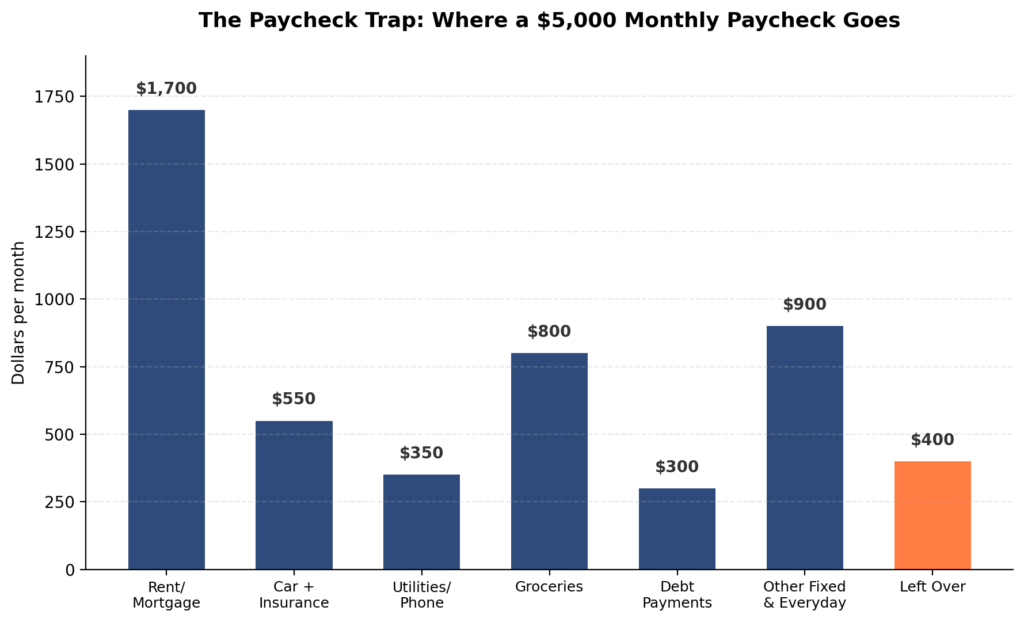
Numbers make the paycheck trap easier to see than a definition ever could. Consider a hypothetical household taking home $5,000 a month. Rent or mortgage might run $1,700. A car payment and insurance could take another $550. Utilities, phone, and internet add up to roughly $350. Groceries for a family run $700 to $900. Minimum debt payments – a credit card or a student loan – might be $300. Add health insurance premiums, gas, and a handful of subscriptions, and the household can easily be at $4,600 to $4,800 in committed and everyday spending before anything unusual happens.
That leaves $200 to $400 of genuine flexibility – and that’s before a car repair, a copay, or a birthday gift shows up. It’s not that this family is spending irresponsibly. It’s that nearly every dollar already has a job, and the job usually isn’t “become savings.” This is the mechanism behind the paycheck trap: not one large mistake, but dozens of small, reasonable commitments that leave almost nothing uncommitted.
Five Questions That Can Reveal Your Own Paycheck Trap
A quick self-check can show you where your money is actually going before it disappears.
- How much of your take-home income is already committed to fixed bills before the month even starts?
- How much do recurring subscriptions and automatic payments cost you each month, added together?
- Do irregular expenses – car repairs, medical bills, annual fees – have their own dedicated savings category?
- When your income rises, does your spending rise automatically with it?
- Could you handle an unexpected $500 expense right now without reaching for a credit card?
There’s no passing or failing score here. The point isn’t to feel bad about the answers — it’s to see the pattern clearly enough to change it.
A Better Way to Turn Income Into Savings
Getting out of the paycheck trap isn’t really about spending less in some vague, general sense. It’s about giving money a job before the month unfolds, so the job doesn’t depend on how disciplined you feel on any given day.
Know your baseline. Calculate your actual monthly take-home income — not your salary, but what actually lands in your account after taxes and deductions.
Separate fixed costs from flexible ones. Fixed costs (rent, insurance, minimum debt payments) are hard to change quickly. Flexible costs (dining out, subscriptions, discretionary shopping) are where near-term adjustments are realistic.
Build an irregular-expense fund. Set aside a modest amount every month specifically for the predictable-but-infrequent stuff: car maintenance, annual fees, holiday spending. This single step prevents more debt than almost anything else on this list.
Start with a realistic savings target. A sustainable $50 or $100 a month that actually happens beats an ambitious 20 percent target that collapses after six weeks.
Automate the transfer. Move money to savings the same day your paycheck arrives, before you see it in your checking account. Systems outperform motivation over the long run.
Create a paycheck buffer. Over time, work toward keeping one extra paycheck’s worth of expenses sitting in checking, so a late bill or a slow month doesn’t immediately become an emergency.
A useful way to think about savings itself is as three layers with different jobs: an immediate buffer for small surprises, a larger emergency reserve for bigger disruptions like job loss, and long-term savings for retirement or future goals. There’s no single dollar figure that’s right for every household — the amounts should reflect your own expenses, dependents, and job stability. If you’re starting from zero, our guide on how to build an emergency fund from scratch walks through the first steps in more detail.
Six Changes That Can Create More Financial Breathing Room
These are the adjustments that chip away at the paycheck trap fastest, according to guidance from the Consumer Financial Protection Bureau’s budgeting resources, which stresses matching a plan to your actual cash flow rather than a generic percentage.
- Audit recurring subscriptions once a quarter. Cancel or downgrade anything you haven’t used in the last 60 days.
- Move irregular expenses onto a monthly schedule. Divide last year’s car repairs, annual fees, and medical costs by 12, and set that amount aside monthly.
- Redirect part of every raise before you get used to it. Even splitting a raise 50/50 between spending and savings prevents lifestyle creep from consuming the whole increase.
- Use a separate account for savings. Money that’s harder to see is money that’s harder to spend impulsively.
- Negotiate or shop recurring fixed costs annually. Insurance premiums and phone or internet plans often have room to negotiate down.
- Track spending for one full month before changing anything. You can’t fix what you haven’t measured.
The Savings Mistakes That Keep People Starting Over
These five habits are what usually pull people back into the paycheck trap even after a good month, a pattern we’ve also seen play out in how a $90,000 income can still feel broke.
Waiting until the end of the month to save. By then, there’s usually nothing left. Save first, even a small amount, and let spending adjust around it.
Setting an unrealistic savings target. An ambitious goal that fails repeatedly is worse than a modest one that succeeds every month. Consistency builds the habit that larger goals depend on.
Ignoring irregular expenses. Treating a predictable annual cost as a surprise every single time it happens guarantees it will keep landing on a credit card.
Increasing spending every time income rises. A raise that gets fully absorbed into a bigger apartment or a nicer car doesn’t move the needle on financial security.
Draining savings for every non-emergency purchase. If the emergency fund becomes a general spending account, it never has the chance to actually protect you when a real emergency arrives.
Your 30-Day Paycheck Reset
Think of this as a 30-day audit of the paycheck trap in your own budget, not a crash diet for your finances.
Days 1–7: Observe. Track every dollar that comes in and goes out, without judging or changing anything yet. You need an accurate picture before you can fix it.
Days 8–14: Organize. Sort your spending into five buckets – essential expenses, flexible expenses, debt payments, existing savings, and irregular expenses. This alone usually reveals where the leaks are.
Days 15–21: Adjust. Pick one to three specific changes, not twenty. Cancel a subscription, renegotiate a bill, or set up an irregular-expense fund.
Days 22–30: Automate. Set up a recurring transfer to savings for the day after payday, even if the amount is modest. The goal of this month isn’t financial freedom – it’s a system that keeps working after you stop paying close attention to it.
How to Keep the Paycheck Trap From Coming Back
Systems break down when life gets busy or expensive, not when things are calm. That’s when old habits creep back in. The households that stick with a savings habit tend to revisit their budget every few months rather than setting it once and forgetting it. When income changes, when rent goes up, or when a new expense becomes permanent, the plan needs a quick adjustment rather than an abandonment.
It also helps to expect friction. Some months the irregular-expense fund will get used. Some months the savings transfer will be smaller than planned. That’s normal – the goal is a system resilient enough to survive an imperfect month, not a plan that only works if nothing ever goes wrong.
Final Thoughts
The paycheck trap isn’t a character flaw, and it isn’t solved by a single motivational push to “save more.” It’s the predictable result of treating savings as whatever happens to be left over, in a budget where almost everything is already spoken for. The way out isn’t earning dramatically more or cutting out every small pleasure – it’s giving your money a job before the month starts, building a cushion for the expenses you know are coming, and letting a system carry the weight that willpower alone can’t. Start with one change this week. The rest can follow.