
Introduction: The New Epoch of High-Performance Computing
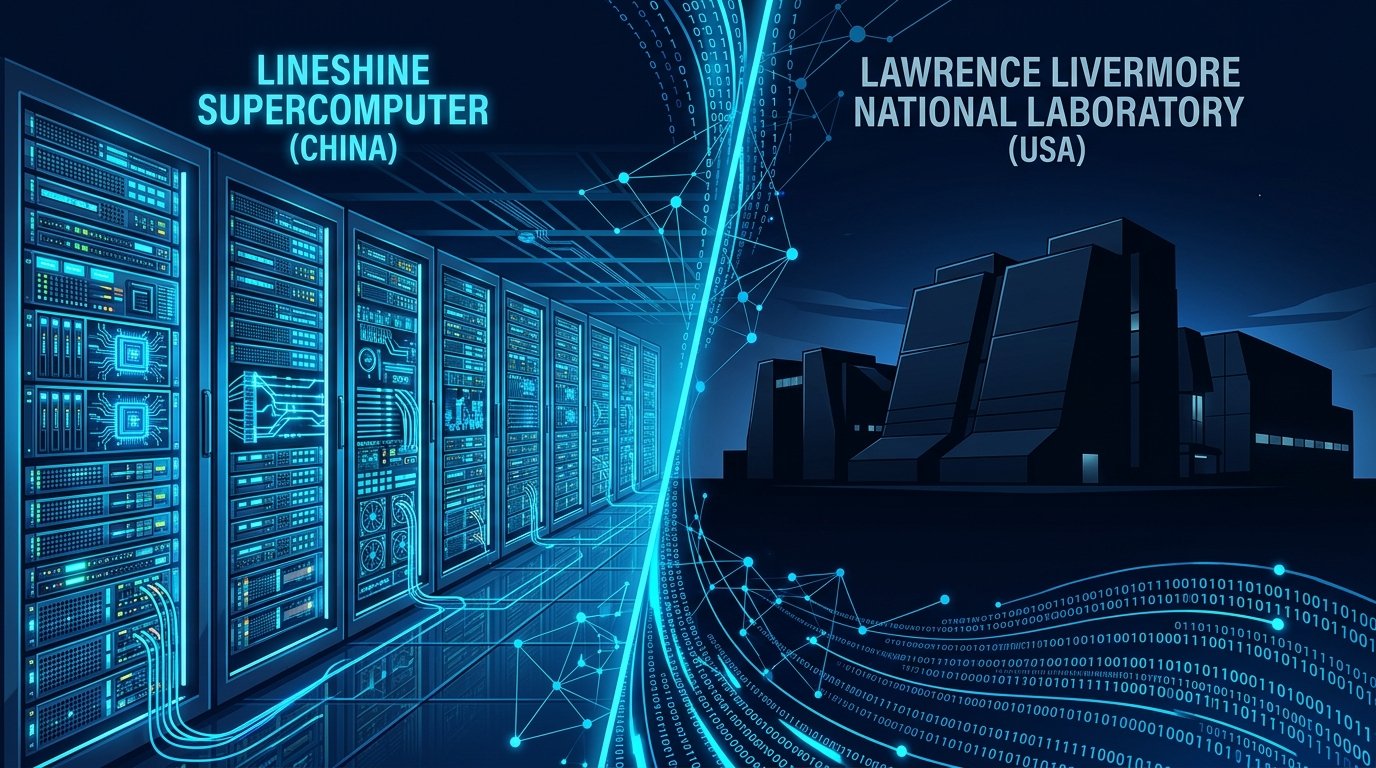
The geopolitical battlegrounds of the 21st century are no longer defined solely by territorial control or maritime presence; they are increasingly governed by computational supremacy. On June 24, 2026, the international tech ecosystem experienced a tectonic shift as the official TOP500 list announced that China’s newly unveiled supercomputer, LineShine, has officially dethroned the United States’ premier system, El Capitan, to become the most powerful supercomputer on Earth.
Housed at the National Supercomputing Centre in Shenzhen, LineShine did not merely edge past its Western competitor—it established an unprecedented 20% lead in absolute operational metrics. This development marks the first time a Chinese computing system has secured the absolute peak of global rankings since the Sunway TaihuLight architecture did so nearly a decade ago.
As artificial intelligence models evolve from localized software solutions into national-security infrastructures, the possession of exascale computing power dictates which superpower will lead the future of autonomous systems, cryptanalysis, and hyper-advanced scientific simulation. This investigative analysis details the architectural capabilities of the LineShine project, the geopolitical consequences of this technological transition, and how Washington is preparing to counter Beijing’s unexpected compute monopoly.
1. Decoding LineShine: The Raw Architecture of an Exascale Beast
To appreciate the scale of this milestone, one must look closely at the mathematical metrics defining LineShine’s processing throughput. The system has recorded a sustained performance benchmark of 2.198 exaflops.
+-------------------------------------------------------------+
|               GLOBAL EXASCALE COMPUTING MATRIX             |
+-------------------------------------------------------------+
|                                                             |
|   1. LineShine (Shenzhen, China)   ---> 2.198 Exaflops      |
|   2. El Capitan (California, US)   ---> ~1.850 Exaflops     |
|   3. Frontier   (Tennessee, US)    ---> ~1.200 Exaflops     |
|                                                             |
+-------------------------------------------------------------+
In plain terms, an exaflop represents a system’s capability to execute one quintillion ($10^{18}$) calculations per single second. LineShine performs more than two quintillion calculations systematically every moment, rendering traditional supercomputers obsolete by comparison.
Overcoming the Semiconductor Embargo
What makes LineShine’s sudden ascent an architectural marvel—and an intelligence surprise for Western analysts—is the nature of its internal hardware. For years, the United States Commerce Department has maintained stringent export controls designed to starve China’s supercomputing centers of advanced processing units, such as Nvidia’s H100, B200, and specialized enterprise graphic processing chip arrays.
LineShine’s success signals that China has successfully bypassed these logistical barriers through deep local innovations:
- Domestic Lithography Adaptations: Utilizing indigenous chip manufacturing processes and advanced multi-die packaging, Chinese engineers have synthesized massive, custom-designed neural processing fabrics that do not rely on American technology blocks.
- Optical Interconnect Frameworks: LineShine utilizes highly advanced silicon photonics—transferring data inside the supercomputer via light waves rather than conventional copper wiring. This drastically reduces thermal output while multiplying processing speeds between node clusters exponentially.
2. The Geopolitical Shockwave: Why Compute Dictates National Sovereignty
The transition of the TOP500 crown from Lawrence Livermore National Laboratory in California (where El Capitan resides) to Shenzhen is far more than a corporate competition. In modern international governance, high-performance computing (HPC) is directly proportional to national security capabilities.
| National Application | Strategic Impact of LineShine |
| Advanced Artificial Intelligence | Training next-generation, trillion-parameter generative models at three times the speed of conventional data silos. |
| Hypersonic Simulation | Testing atmospheric thermodynamics for strategic missile vectors without needing physical wind tunnels. |
| Cryptographic Decryption | Bypassing modern data encryption protocols via raw, brute-force computational processing grids. |
By controlling the world’s fastest computing grid, Beijing gains a distinct advantage in deploying large-scale autonomous defense systems, simulating strategic economic models during regional stress scenarios, and optimizing localized industrial supply lines via predictive machine learning frameworks. This structural capability allows China to establish a technical insulation barrier against future Western sanctions.
3. The American Counter-Strategy: The Battle for Post-Exascale Supremacy
In Washington, the realization that China has broken through the exascale barrier with proprietary silicon has triggered immediate legislative and institutional responses. Defense analysts and technology policy advisors are warning that the current US infrastructure strategy requires immediate revisions.
A. Accelerating the Horizon of Post-Exascale Systems
The US Department of Energy is already fast-tracking preliminary development frameworks for its next generational cluster projects, aiming for systems that will enter the Zettascale domain ($10^{21}$ calculations per second). However, engineers acknowledge that achieving this leap requires completely new power distribution methodologies and breakthrough quantum-hybrid processing integrations that are still years away from scalable commercial production.
B. Tightening the Technological Noose
We expect the US to respond by broadening the scope of its technological blockades. Future regulatory updates will likely restrict not just physical microchips, but the international distribution of cloud-based electronic design automation (EDA) software, cloud compute sharing agreements, and the migration of high-level AI talent across geopolitical borders.
4. Environmental and Infrastructure Realities: The Power Consumption Crisis
While the computational prowess of LineShine is historic, it highlights a dark reality shared by all modern high-performance computing systems: the massive environmental and energy costs required to sustain them.
+---------------------------------------------------------------+
|               THE MASSIVE ENERGY MATRIX OF COMPUTING          |
+---------------------------------------------------------------+
|                                                               |
|   [Municipal Grid Energy Input] ---> 40-60 Megawatts Required |
|                                             |                 |
|                                             v                 |
|   [LineShine System Execution]  ---> Intense Heat Generation  |
|                                             |                 |
|                                             v                 |
|   [Advanced Closed-Loop Liquid] ---> Dedicated Cooling Plants |
|                                                               |
+---------------------------------------------------------------+
Running a system capable of processing two quintillion calculations a second demands a massive continuous power supply, often ranging between 40 to 60 megawatts—enough energy to power a medium-sized metropolitan city.
To prevent the microcomponents from melting under intense thermal pressure, LineShine utilizes advanced closed-loop liquid submersion cooling architectures. Entire racks of processors are submerged in specialized dielectric fluids that transfer heat away from the chips far more efficiently than air conditioning systems. The sheer logistical demand for water, sustainable energy grids, and localized sub-stations means that future supercomputing supremacy will be determined not just by software brilliance, but by a country’s physical infrastructure capacity to generate massive amounts of electricity.
Conclusion: Entering the Era of Computational Multipolarity
The triumph of China’s LineShine system over America’s El Capitan marks the definitive end of unipolar Western dominance in the tech space. The global technology landscape has settled into a state of structural multipolarity, where two competing technological ecosystems—each with its own independent chip manufacturing lines, operating systems, and AI models—will exist in parallel.
As the race moves toward quantum computing integrations and zettascale frameworks, the metrics of victory will continuously redefine themselves. However, the announcement from Hamburg on the TOP500 index leaves no room for ambiguity: the silicon throne has migrated eastward. The decisions made in Washington and Beijing over the coming months will determine whether this computational arms race will pave the way for shared scientific breakthroughs or lead the world toward a highly dangerous, completely automated digital conflict.