
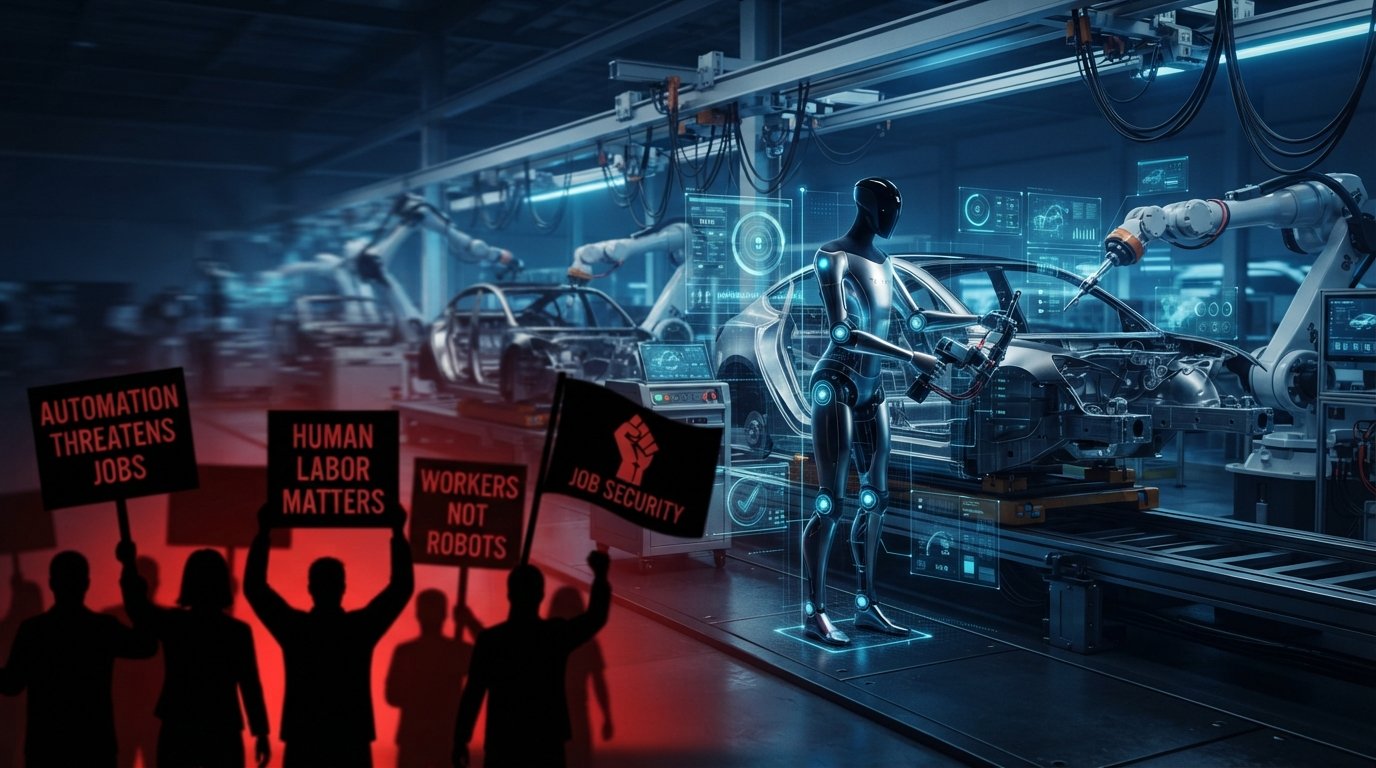
Introduction: The Substitution Threshold of AI-Powered Robotics
The philosophical debate surrounding whether artificial intelligence will replace human labor has transitioned from a future projection into an immediate, disruptive economic reality. On July 3, 2026, the global manufacturing sector reached a watershed moment as automotive and logistics giant Tesla officially completed the initial mass deployment phase of its Optimus Gen-3 Humanoid Robots across its major Gigafactories in Texas, Berlin, and Shanghai.
Unlike previous pilot programs where robotic units were limited to isolated testing zones, the Gen-3 infrastructure has been seamlessly integrated directly into the primary assembly lines, taking over continuous heavy logistics, precision components shifting, and hazardous material management.
While corporate stakeholders celebrate this deployment as a multi-billion-dollar leap in operational optimization, the global workforce infrastructure has responded with immediate, coordinated resistance. A coalition of North American and European automotive labor unions has announced a historic, multi-national legal filing and planned structural strikes, citing a direct violation of worker displacement protections and manufacturing safety protocols.
This comprehensive investigative report details the technical capabilities driving the Optimus Gen-3 infrastructure, the macroeconomic ripple effects altering global supply chains, and the escalating battle between institutional labor movements and autonomous corporate automation.
1. Architecture of the Gen-3: The Engineering Behind Full Autonomy
To understand why labor unions view the Optimus Gen-3 as an existential threat rather than a mere factory tool, one must analyze the technological upgrades that differentiate this system from its predecessors.
+-------------------------------------------------------------+
|              TESLA OPTIMUS GEN-3 OPERATIONAL VECTOR         |
+-------------------------------------------------------------+
|                                                             |
|   [Central Neural Network - FSD Chipset Integration]        |
|             |                                               |
|             ├──> 1. Tactile Biomimetic Hands                |
|             │    (Handles micro-wires, non-rigid objects)   |
|             │                                               |
|             └──> 2. End-to-End Spatial Vision Networks       |
|                  (Operates with zero pre-programmed maps)   |
|                                                             |
+-------------------------------------------------------------+
A. Biomimetic Tactile Precision
Previous industrial robots were stationary, massive structures requiring precise pre-programmed paths to perform simple repetitive actions. Optimus Gen-3 operates on a fully mobile, humanoid architecture equipped with high-density biomimetic tactile sensors inside its hands. This allows the system to sense pressure, texture, and component resistance in real-time, enabling it to execute complex blue-collar tasks—such as routing flexible wiring harnesses, threading structural bolts, and handling delicate composite materials—with human-level dexterity but with zero physical fatigue.
B. Full Self-Driving (FSD) Core Integration
The cognitive engine running the Gen-3 architecture is a direct adaptation of Tesla’s Full Self-Driving (FSD) neural network arrays. The robot does not rely on a localized facility map or continuous human remote instructions. Utilizing its embedded visual cameras and spatial vision networks, the humanoid robot continuously scans its surrounding manufacturing environment, predicts human movement dynamics within shared floor spaces, and self-corrects its task workflows when an assembly line bottleneck occurs.
2. The Labor Backlash: The Battle for the Factory Floor
The deployment of thousands of autonomous humanoid units operating 24/7 with zero healthcare overhead, zero wage adjustments, and near-zero downtime has broken the historic consensus governing corporate industrial relations.
On July 3, 2026, international representatives from the United Auto Workers (UAW) and European industrial federations issued a unified mandate demanding a global freeze on advanced autonomous humanoid integrations until comprehensive regulatory frameworks are established.
| Labor Conflict Vector | Union Grievance (July 2026) | Corporate Stance |
| Socio-Economic Displacement | Sudden structural elimination of entry-level manufacturing and logistics positions without transition funds. | Automation addresses chronic structural labor shortages in heavy industrial manufacturing sectors. |
| Spatial Operational Safety | High-density deployment of autonomous metallic humanoids alongside human workers poses physical collision risks. | Advanced neural vision networks ensure zero-incident collaborative workflows with millisecond reaction times. |
| Telemetry Surveillance | Continuous 360-degree camera arrays on robots record human workplace metrics and behavioral data. | Environmental scanning data is utilized strictly for localized obstacle avoidance and operational logs. |
The union’s strategic counter-offensive is no longer limited to standard picketing; it has expanded into regulatory and legislative warfare. Legal councils are leveraging localized consumer safety and digital data protection laws to argue that autonomous robots collecting visual telemetry within private workspaces infringe upon human privacy rights, seeking court-ordered injunctions to stall factory production lines.
3. Macroeconomic Ripple Effects: Rewriting Supply Chain Logistics
The economic rationale driving this aggressive push toward humanoid automation centers around a permanent alteration of global corporate operating cost structures.
+---------------------------------------------------------------+
|               THE AUTOMATION ECONOMICS BALANCE                |
+---------------------------------------------------------------+
|                                                               |
|   High Onboarding Costs ---> 24/7 Autonomous Shift Execution  |
|                                             |                 |
|                                             v                 |
|   Near-Zero Marginal Costs  <--- Elimination of Variable Wage |
|                                  and Operational Overhead     |
|                                                               |
+---------------------------------------------------------------+
Industrial analysts project that while the initial research, development, and manufacturing cost of an exascale-trained humanoid robot remains high, its long-term marginal operating cost falls significantly below traditional human hourly wages.
When applied across international factory infrastructures, this cost reduction alters the old rules of global manufacturing globalization:
- The Reversal of Offshoring: For decades, multinational corporations migrated their assembly operations to developing countries to capitalize on lower manual labor costs. With highly efficient humanoid automation, manufacturing can be localized directly inside high-consumption Western markets, saving billions in transcontinental maritime shipping fees.
- The Capital-Compute Consolidation: Economic power is rapidly concentrating away from states with large population demographics and toward regions that control advanced semiconductor foundries, robotic battery supplies, and massive machine learning data centers.
4. The Sovereign AI Regulation Crisis
As the legal tension escalates, international policymakers are realizing that existing labor laws are completely unequipped to handle autonomous humanoid workforces. Current regulatory frameworks across North America and Europe distinguish clearly between passive industrial machinery and human workers, leaving an immense legal gray area regarding mobile, self-learning AI systems executing manual tasks.
Several progressive legislative bodies are fast-tracking draft proposals advocating for a “Robot Tax Framework.” Under these conceptual models, corporations deploying autonomous humanoid systems to replace human personnel would be required to pay a specialized tax equivalent to the payroll taxes traditionally collected from human workers. These funds would be directly funneled into national retraining programs and localized socio-economic safety nets.
However, technology lobbying networks are aggressively pushing back, stating that early implementation of automation taxation would stifle technological innovation and cripple a country’s industrial competitiveness on the global stage.
Conclusion: The Final Demarcation of Human Competence
The global labor standoff unfolding on July 3, 2026, is not a temporary dispute over standard contract terms or hourly shift structures; it represents the opening chapter of a permanent reorganization of human civilization’s economic fabric. The integration of the Optimus Gen-3 infrastructure has proven that the divide between mental intelligence and physical labor is no longer a safe boundary for human employment protection.
The societies that successfully navigate this epic transition will be those that design adaptive, highly integrated economic structures where human creativity, artisanal craftsmanship, and strategic management collaborate systematically with autonomous kinetic systems.
As the legal battles move through international courts and factory workers prepare for historic strikes, the industrial landscape faces an undeniable transformation. The humanoid robot revolution has officially arrived on the factory floor, and the global marketplace must now decide how to balance corporate efficiency with human dignity.