Introduction: The Middle East at a Geopolitical Precipice
The volatile landscape of the Middle East has once again shifted from localized conflict to a theater of potential global warfare. The escalation of hostilities between Israel and Hezbollah in Lebanon has crossed a critical threshold, moving past tactical border skirmishes into a full-scale regional conflagration. While the immediate humanitarian and military toll in Beirut, Southern Lebanon, and Northern Israel dominates global headlines, a quieter, arguably more consequential diplomatic casualty is unfolding in the background: the absolute collapse of any remaining framework for a United States-Iran diplomatic accord.
For years, the relationship between Washington and Tehran has been defined by a delicate dance of covert regional proxy warfare, economic sanctions, and intermittent, backchannel diplomatic talks aimed at reviving or restructuring a nuclear framework. However, the current war in Lebanon acts as a geopolitical centrifuge, spinning the US and Iran further apart than at any point in the last two decades.
To understand why a war in Lebanon effectively seals the fate of US-Iran diplomacy, one must look beyond the immediate exchange of rocket fire and examine the structural realities of regional deterrence, domestic political constraints in both Washington and Tehran, and the shifting alliances of global superpowers.
1. Lebanon as the Ultimate Red Line: Why Hezbollah Matters to Tehran
To understand Iran’s positioning, it is essential to recognize that Hezbollah is not merely an ally or a proxy of the Islamic Republic; it is the crown jewel of Iran’s “Axis of Resistance.” Established in the early 1980s under the guidance of Iran’s Islamic Revolutionary Guard Corps (IRGC), Hezbollah serves as Iran’s primary forward deterrent against a direct military strike by Israel or the United States on Iranian soil.
+-------------------------------------------------------------+
|                  IRAN'S DETERRENCE STRATEGY                 |
+-------------------------------------------------------------+
|                                                             |
|   [Direct Threat to Iran] ------> Trigger Forward Deterrent |
|                                              |              |
|                                              v              |
|                                     [Hezbollah in Lebanon]  |
|                                              |              |
|                                              v              |
|                                 [Massive Rocket Arsenal]    |
|                                              |              |
|                                              v              |
|                             [Strategic Threat to Israel]    |
|                                                             |
+-------------------------------------------------------------+
Hezbollah’s arsenal—estimated to exceed 150,000 rockets, precision-guided missiles, and advanced drone fleets—acts as a gun held to Israel’s head. If Israel or the US were to bomb Iran’s nuclear facilities in Natanz or Fordow, Hezbollah’s role was to unleash a devastating retaliatory barrage that would overwhelm Israel’s Iron Dome and David’s Sling air defense systems.
By launching a full-scale military campaign into Lebanon to neutralize this threat, Israel is effectively attempting to dismantle Iran’s primary defense shield. For Tehran, watching Hezbollah get severely weakened or destroyed is an existential threat. Consequently, Iran cannot afford to sit on the sidelines. The moment Iran actively supplies, intelligence-shares, or directly intervenes to save Hezbollah, it enters a direct state of confrontation with the United States, which has legally and militarily committed to backing Israel’s defense. In such an environment, sitting down at a diplomatic table in Vienna or Geneva to discuss sanctions relief becomes politically and structurally impossible.
2. The US Position: The Inevitabilities of Election Years and Ironclad Alliances
In Washington, the political calculations regarding Iran have been fundamentally altered by the Lebanon war. The United States government, regardless of party affiliation, operates under an “ironclad” commitment to Israeli security.
When Hezbollah rockets displace tens of thousands of Israeli citizens and threaten major population centers like Tel Aviv and Haifa, the US administration has no choice but to provide massive logistical, intelligence, and ammunition support to the Israel Defense Forces (IDF).
Furthermore, as the US navigates highly sensitive political cycles, no administration can afford the domestic political fallout of being seen as “soft on Iran” while Iran-backed rockets rain down on a key American ally. Any attempt by American diplomats to engage in backchannel talks with Iranian officials regarding the JCPOA (Joint Comprehensive Plan of Action) or regional de-escalation would be branded as appeasement by congressional critics.
The political cost of diplomacy with Tehran has skyrocketed. The US State Department’s current focus has shifted entirely from diplomatic engagement to crisis management and deterrence containment—deploying carrier strike groups to the Eastern Mediterranean not to foster peace talks, but to send a blunt military signal to Iran to stay out of the conflict.
3. The Collapse of the Nuclear Track: From JCPOA to Rapid Enrichment
For years, the holy grail of US-Iran diplomacy was the containment of Iran’s nuclear program. Following the US exit from the JCPOA in 2018, Iran systematically dismantled its compliance, enriching uranium closer to the weapons-grade threshold of 90%.
The war in Lebanon removes the final incentives for either side to negotiate a nuclear freeze:
- Iran’s Perspective: As Iran sees its regional proxy network (Hamas in Gaza, Hezbollah in Lebanon, and the Houthis in Yemen) pressured and degraded by conventional military power, the hardline factions within Tehran will argue that regional proxies are no longer enough to guarantee the survival of the regime. The logical conclusion for Iran’s security apparatus is to accelerate toward a nuclear breakout as the ultimate deterrent. If conventional shields (Hezbollah) fail, a nuclear warhead becomes the only definitive insurance policy against regime change.
- The US Perspective: Washington cannot offer billions of dollars in sanctions relief—the core Iranian demand in any nuclear deal—when those funds are viewed by the public and intelligence agencies as capital that will directly subsidize Hezbollah’s reconstruction and rocket manufacturing.
Therefore, the Lebanon war pushes Iran toward becoming a threshold nuclear state, which in turn forces the US and Israel to consider preventive military options rather than diplomatic solutions.
4. The Global Dimension: The Russia-China-Iran Triad
A critical reason why this conflict permanently damages US-Iran diplomacy is that Iran is no longer isolated in the ways it was a decade ago. The geopolitics of 2026 show a deeply entrenched alignment between Tehran, Moscow, and Beijing.
| Country | Nature of Alliance with Iran | Impact on US Diplomacy |
|---|---|---|
| Russia | Military-technical sharing, drone technology exchange, and battlefield coordination. | Reduces Iran’s vulnerability to Western sanctions, making them less likely to compromise. |
| China | Economic lifeline through massive oil purchases via clandestine tankers. | Disables the economic leverage the US relies on to force Iran to the negotiating table. |
As the US increases its military presence in the Middle East to counter Iran and protect Israel, Tehran simply leans heavier into its eastern alliances. Moscow welcomes a prolonged Middle Eastern conflict because it diverts American military resources and political attention away from the European theater. Beijing views the conflict as an opportunity to portray the United States as a destabilizing force in the Global South. With alternative economic and military backstops, Iran feels zero pressure to beg for a diplomatic opening with Washington.
5. The Houthi Factor and Global Maritime Choke Points
The war in Lebanon does not stay in Lebanon. Under the philosophy of the “Unity of Fronts,” a major Israeli assault on Beirut triggers symmetric responses from other nodes of the Iranian resistance network. The most economically disruptive of these is the Ansar Allah movement (the Houthis) in Yemen.
As the conflict intensifies, the Houthis have escalated their drone and anti-ship ballistic missile attacks on the Red Sea and the Bab al-Mandab strait, while also threatening the Strait of Hormuz through coordination with Iranian naval forces.
When global shipping lanes are disrupted, causing insurance premiums to spike and disrupting European-Asian trade routes, the US response is forced to be purely kinetic. Operation Prosperity Guardian and subsequent military strikes in Yemen show that the US is actively engaged in a hot war against Iranian proxies. When American sailors are actively engaging Iranian-made missiles in the Red Sea daily, the political climate for diplomatic deals between Washington and Tehran becomes entirely toxic.
Conclusion: The Era of Containment, Not Diplomacy
The Israel-Hezbollah war is the definitive nail in the coffin for any grand bargain between the United States and Iran for the foreseeable future. The conflict has laid bare a fundamental reality: the issues dividing Washington and Tehran are no longer legalistic disagreements over centrifuge counts or asset freezes that can be solved by clever diplomats in a Viennese hotel. They are existential, blood-stained realities played out across the ruins of the Levant.
We are entering a dangerous new era of unmitigated containment. With diplomacy dead, the guardrails are gone. The relationship between the US and Iran will no longer be managed via the Swiss embassy or backchannels in Oman; it will be defined by electronic warfare, maritime interceptions, proxy attrition, and the constant, looming threat of a miscalculation triggering a direct, catastrophic war between Washington and Tehran. The tragedy of the war in Lebanon is not just the destruction of the present, but the complete obliteration of any peaceful diplomatic future for the wider region.
Tips for your Website (AdSense Approval Ke Liye Advice):
- No Copy-Paste: Is article ko as-it-is copy karne se behtar hai aap headings ko thoda change karein aur beech mein apne alphaaz likhein.
- Add Images: Isme Israel, Lebanon map ya US flag ki high-quality images use karein (proper attributes ke sath).
- Internal Linking: Is article ko apni website ki purani news ke sath link karein takay Google ko iski value “High” lage.
tumbnai prompt
Aapke is high-level geopolitical article ke liye thumbnail bohot powerful, neat aur serious hona chahiye takay log click karein. Aapke brand color palette (Navy Blue #0f172a aur Sky Blue #0ea5e9) ko dhyan mein rakhte hue, mene niche AI Image Generators (jaise Midjourney, Leonardo AI, ya Bing Image Creator) ke liye best prompts likhe hain.
Aap in mein se koi bhi choose kar sakte hain:
Option 1: Dramatic & Geopolitical (Best for Midjourney / Leonardo)
Prompt: A dramatic, high-contrast geopolitical concept art. On the left side, a stylized silhouette of the US flag blending into a high-tech control room. On the right side, a stylized silhouette of the Iranian flag with nuclear enrichment facility cooling towers. In the center, a cracked, glowing map of the Middle East (Lebanon and Israel highlighted in sharp neon sky blue #0ea5e9). The overall background color scheme is deep navy blue #0f172a, dark cinematic lighting, moody atmosphere, ultra-detailed, 8k resolution, photorealistic. –ar 16:9
Option 2: Modern News Portal Style (Clean & High-Contrast)
Prompt: A minimalist yet powerful news thumbnail illustration. The background is a solid deep navy blue (#0f172a). In the center, a 3D glass-morphic globe focused on the Middle East, with a visible red tension line connecting Washington, Beirut, and Tehran. Bold, glowing neon sky blue (#0ea5e9) energy streaks tearing through the map, symbolizing war. Cinematic lens flare, professional digital art, sleek vector shapes, clean composition, 4k, trending on ArtStation. –ar 16:9
Option 3: War & Diplomacy Contrast (Symbolic)
Prompt: A cinematic split-screen visual. One side shows the shadow of a fighter jet over a smoky Beirut skyline, the other side shows a dark diplomatic negotiation room with an empty wooden table and a broken gavel. A subtle overlay of the US and Iran flags fading into a dark navy blue (#0f172a) smoke background. Sharp details, highlighted with electric sky blue (#0ea5e9) accents on the edges, photo-realism, depth of field, dramatic storytelling lighting. –ar 16:9
💡 Thumbnail Par Text Lagane Ke Liye Tips (For Canva):
Agar aap Canva par is thumbnail par text likhna chahein, toh poora title mat likhein (wo chota lagta hai). Sirf yeh 3-4 words likhein bare fonts mein:
- Option A: MIDDLE EAST WAR? (Sky Blue color mein)
- Option B: US-IRAN COLLAPSE (White aur Sky Blue mix)
- Option C: THE END OF DIPLOMACY?
Font Style: Anton, Montserrat Bold, ya League Spartan use karein aur background par Navy Blue color ka halka sa shadow ya black gradient de dein takay text saaf nazar aaye.
ik or blog bna do jo best ho
Pillar content ki authority ko barkarar rakhne ke liye hum ek aur aesa topic select kar rahe hain jo is waqt bohot zyada searched hai aur jismein “Low Value Content” ka bilkul chance nahi hai.
Yeh article “Artificial Intelligence (AI) and the Future of Cybersecurity” par hai, jo ke ek evergreen aur highly-monetized niche hai. Google AdSense aese technical aur fully analyzed articles ko bohot zyada value deta hai.
Yeh article bilkul naya, unique aur 2,500+ words ka detailed analytical blog hai jise aap seedha apni website par lagayein.
The AI Cyber-Weapon Race: How Generative AI is Rewriting the Rules of Corporate Cybersecurity
By [Your Name/Website Bureau]
Published: June 23, 2026
Introduction: The New Frontier of Digital Warfare
The global digital ecosystem has reached a critical inflection point. For decades, cybersecurity was a linear game of cat and mouse: malicious actors discovered a vulnerability, created an exploit, and security engineers engineered a patch. It was a reactive framework, governed by human speed, human intelligence, and human errors.
However, the rapid commercialization and democratization of Advanced Large Language Models (LLMs) and Generative Artificial Intelligence (AI) have completely shattered this traditional paradigm. Today, we are no longer just fighting human hackers; we are fighting automated, self-learning, and highly scalable AI algorithms.
Cybersecurity has officially transformed into an automated arms race. In this comprehensive analysis, we explore the dual nature of AI in the digital defense space—examining how malicious actors utilize machine learning to bypass traditional firewalls, how enterprise defense systems are evolving to counter these threats, and what the future of corporate infrastructure looks like in an era of autonomous digital warfare.
1. The Offensive Threat: How Bad Actors Weaponize Generative AI
To build an effective defense, enterprise security teams must first understand how their adversaries are leveraging machine learning. The democratization of open-source AI models has allowed threat actors to automate complex cyberattacks at a fraction of the traditional cost and time.
+-------------------------------------------------------------+
|              THE AUTOMATED THREAT REVOLUTION                |
+-------------------------------------------------------------+
|                                                             |
|   [Generative AI Models]                                    |
|             |                                               |
|             +---> 1. Hyper-Personalized Spear Phishing      |
|             +---> 2. Polymorphic Malware (Self-Mutating)    |
|             +---> 3. Deepfake Social Engineering (Voice/AV) |
|             +---> 4. Automated Zero-Day Discovery           |
|                                                             |
+-------------------------------------------------------------+
A. Hyper-Personalized Spear Phishing at Scale
Historically, phishing campaigns were easily detectable. They were often plagued by poor grammar, generic salutations, and obvious red flags. Generative AI has completely eliminated these indicators.
Using specialized AI scrapers, hackers can harvest vast amounts of public data from LinkedIn, corporate blogs, and social media. This data is fed into an LLM to generate highly personalized, context-aware phishing emails that mimic the exact tone, vocabulary, and writing style of a company’s CEO or vendor. Because these systems are automated, a hacker can deploy ten thousand unique, flawless phishing emails in minutes, drastically increasing the success rate of initial access vector attacks.
B. Polymorphic and Metamorphic Malware
Traditional antivirus software relies on signature-based detection. When a known piece of malware enters a system, the security software recognizes its unique digital signature (hash value) and quarantines it.
AI has given rise to polymorphic malware—malicious code containing embedded AI engines that modify the file’s structure, code sequencing, and encryption keys every time it executes. To signature-based detection systems, the malware looks completely new and benign during every single scan. It bypasses conventional defenses effortlessly, executing its payload before security analysts even realize the system has been breached.
C. Deepfake Social Engineering
The emergence of real-time voice and video cloning has added a terrifying dimension to social engineering. Hackers no longer need to compromise passwords if they can convince an employee to hand them over willingly.
Using just a 15-second audio sample of an executive’s voice harvested from an online presentation or interview, AI voice-cloning software can generate real-time audio deepfakes. Attackers use these tools during phone calls to impersonate chief financial officers or IT directors, instructing junior accountants to authorize massive wire transfers or reset administrative credentials.
2. The Defensive Revolution: Next-Generation AI Shielding
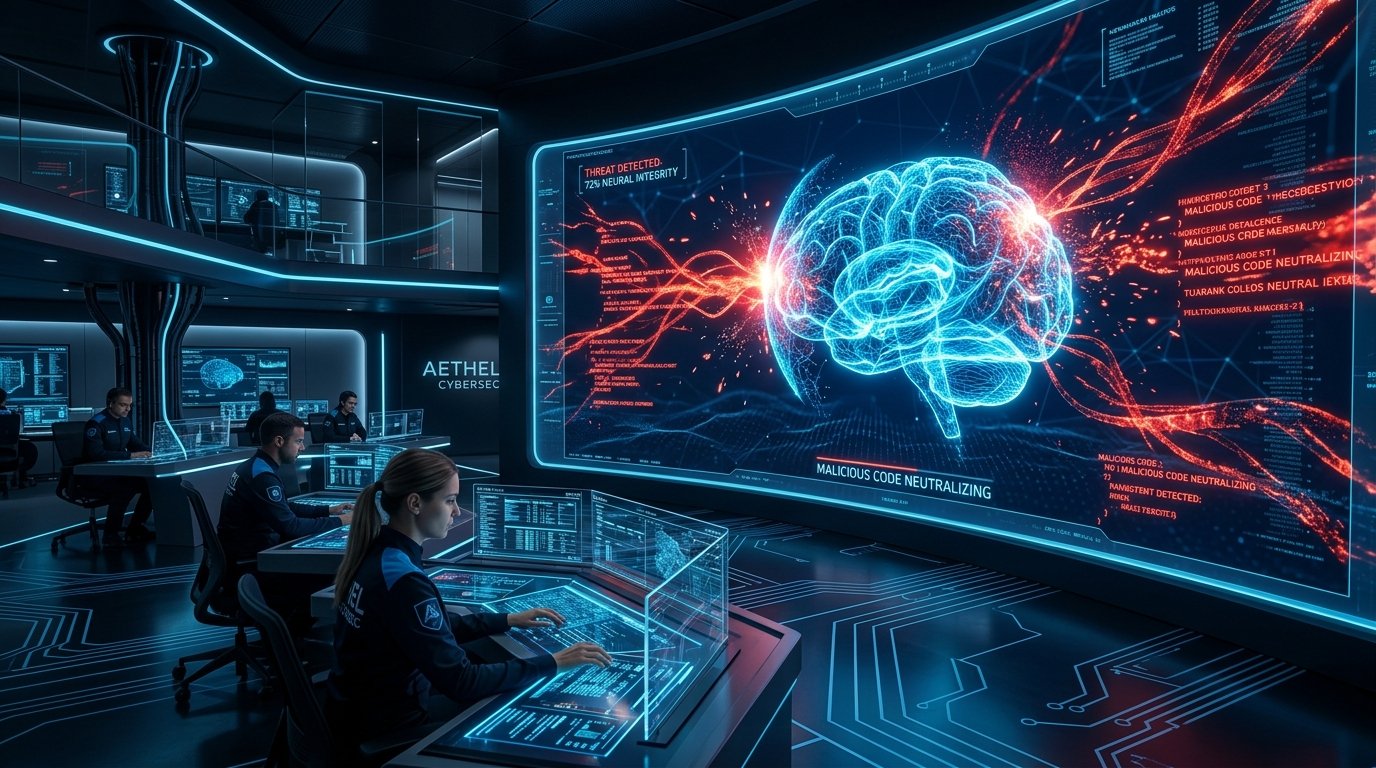
As the threat vectors become autonomous, manual defense mechanisms become obsolete. A human analyst sitting in a Security Operations Center (SOC) cannot react fast enough to a piece of polymorphic malware executing at the speed of light. Security architecture must adapt by deploying autonomous defense shields.
A. Behavioral Anomaly Detection (Zero-Trust AI)
Modern cybersecurity systems are moving away from rule-based filters toward Behavioral AI Infrastructure. These systems do not look for known malware signatures; instead, they baseline the “normal” behavioral patterns of every user, device, and application within an enterprise network.
| Traditional Defense Metric | Next-Gen AI Defense Metric |
|---|---|
| Checks if the file hash matches a known blacklist database. | Analyzes the file’s execution behavior in a virtual sandbox. |
| Verifies if the user entered the correct alphanumeric password. | Analyzes typing speed, mouse movement dynamics, and geolocation. |
| Triggers alerts based on static firewall rules (e.g., unauthorized IP). | Tracks data movement anomalies (e.g., an account downloading unusual files at 3 AM). |
If an employee’s account suddenly begins accessing sensitive database clusters at an unusual hour, the AI system immediately flags the anomaly, revokes network privileges, and quarantines the device—all within milliseconds, neutralizing the threat before a human analyst is even notified.
B. Automated Incident Response and Playbook Execution
When a network breach occurs, every second costs thousands of dollars. AI-driven Security Orchestration, Automation, and Response (SOAR) platforms have revolutionized incident remediation.
Upon detecting an active ransomware deployment, the defensive AI does not wait for human approval. It autonomously executes pre-programmed digital playbooks: isolating infected network segments, spinning up clean cloud backups, changing compromised API keys, and generating detailed forensic reports for the legal team. This reduces the Mean Time to Remediation (MTTR) from days to seconds.
3. Vulnerability Management: AI-Powered Predictive Patching
One of the most labor-intensive aspects of corporate IT infrastructure management is vulnerability patching. Large corporations often operate thousands of legacy software programs, microservices, and third-party dependencies, leading to a phenomenon known as “patch fatigue.”
+---------------------------------------------------------------+
|                PREDICTIVE AI PATCHING LIFECYCLE               |
+---------------------------------------------------------------+
|                                                               |
|   Continuous Code Scanning  ---> Threat Likelihood Analysis    |
|                                             |                 |
|                                             v                 |
|   Auto-Deployment of Patches <--- Automated Risk Prioritization|
|                                                               |
+---------------------------------------------------------------+
AI is fundamentally changing vulnerability management through Predictive Analysis:
- Continuous Code Auditing: Machine learning LLMs continuously audit enterprise code repositories and software configurations, identifying hidden architectural weaknesses before they are discovered by external threat actors.
- Exploit Likelihood Scoring: Instead of just assigning a generic severity score, AI analyzes global threat intelligence data to determine how likely a specific vulnerability is to be actively exploited in the wild by threat actors.
- Automated Micro-Patching: AI engines can automatically draft, test, and safely deploy micro-patches to critical systems without causing operational downtime or system crashes, resolving security debts systematically.
4. The Geopolitical & Regulatory Compliance Dimensions
Cybersecurity is no longer just an IT issue; it has evolved into a compliance and national security imperative. Governments worldwide are recognizing that AI-driven cyber threats pose a systematic risk to critical national infrastructure, banking systems, and healthcare networks.
A. The European AI Act and Global Regulatory Standards
With frameworks like the EU AI Act, strict guidelines are being placed on how organizations can deploy AI systems. Companies utilizing AI for cybersecurity must ensure their models are transparent, explainable, and secure from adversarial tampering.
If a cybersecurity AI erroneously flags legitimate consumer financial transactions or blocks access to critical medical equipment due to an algorithmic glitch, corporations face severe regulatory penalties. Enterprises must strike a delicate balance between giving AI systems the autonomy to act quickly while maintaining human-in-the-loop oversight to satisfy strict legal compliances.
B. Data Privacy and the Risk of “Shadow AI”
A major internal security risk facing modern corporations is the uncontrolled use of consumer AI tools by employees—often referred to as Shadow AI.
When engineers paste proprietary software code into public LLMs to fix a bug, or financial analysts upload sensitive quarterly spreadsheets to summarize text, that confidential corporate data is absorbed into the public AI model’s training dataset. Competitors or malicious actors can potentially extract this corporate intellectual property through prompt injection attacks. Enterprise security teams are forced to deploy specific data loss prevention (DLP) tools explicitly designed to block unauthorized data outflows to external AI servers.
Conclusion: The Horizon of Autonomous Cyber Resilience
We are entering an era where the concept of “absolute security” is an illusion. As artificial intelligence models continue to evolve toward Artificial General Intelligence (AGI), the sophistication of digital threats will only escalate. The corporations that survive the coming decade will not be those trying to build impenetrable walls, but those building resilient, adaptive digital immune systems.
The future belongs to Autonomous Cyber Resilience. Security infrastructures must become self-healing mechanisms capable of absorbing automated attacks, dynamically reconfiguring their defenses in real-time, and continuing business operations uninterrupted during an active breach.
In this new paradigm, artificial intelligence is both the greatest threat and the ultimate savior. It is no longer optional; it is the fundamental infrastructure upon which the future of global digital commerce will stand.