China arms to Iran in the Gulf war sits in the middle ground between full‑fledged military alliance and outright betrayal. Beijing is not openly sending tanks, fighter jets, or long‑range missiles, but it is quietly supplying the microelectronics, guidance components, and engine parts that keep Iran’s Shahed drones and ballistic missiles flying.
At the same time, Chinese firms continue buying Iranian oil at discounted prices, and Chinese officials publicly criticize US and Israeli strikes – creating a picture of strategic empathy without full‑scale military commitment. The global question is no longer whether China will become Iran’s military ally, but how far Beijing will go before American sanctions, Gulf‑state outrage, and its own economic interests force it to pull back.
Why China Cannot Become Iran’s Military Ally
China’s relationship with Iran is often described as a strategic partnership against US influence, but the Gulf conflict exposes the limits of that partnership. Iran supplies about 13% of China’s crude imports, which is valuable for Beijing’s energy‑hungry manufacturers. But Saudi Arabia alone supplies about 17% of China’s oil – a bigger, more direct energy relationship. The UAE, Kuwait, and other Gulf states also matter more to China’s trade, investment, and infrastructure projects than Iran does.
Beijing cannot openly arm Iran while claiming to be a reliable partner to Gulf states whose oil, finance, and infrastructure are targeted by Iranian missiles and drones. Every missile fired by Iran that hits a Saudi oil terminal, Qatari LNG plant, or Kuwaiti‑hosted US base is also an indirect hit on China’s economic interests. The SWIFT, dollar‑based financial system, and semiconductor imports China relies on mean that overt arms‑to‑Iran deals would trigger US secondary sanctions, something Chinese banks, firms, and the state itself are unwilling to risk.
There is also Israel – a quiet but important technology partner of China. Israeli agri‑tech, water‑management, and industrial systems flow into Chinese projects. If Beijing openly supplied weapons to Iran against Israel, those relationships would collapse. China’s real position is: Iran is useful, but not worth losing Gulf oil, US‑linked finance, or Israeli tech.
The Dual‑Use Game: Civilian Parts, Military Weapons
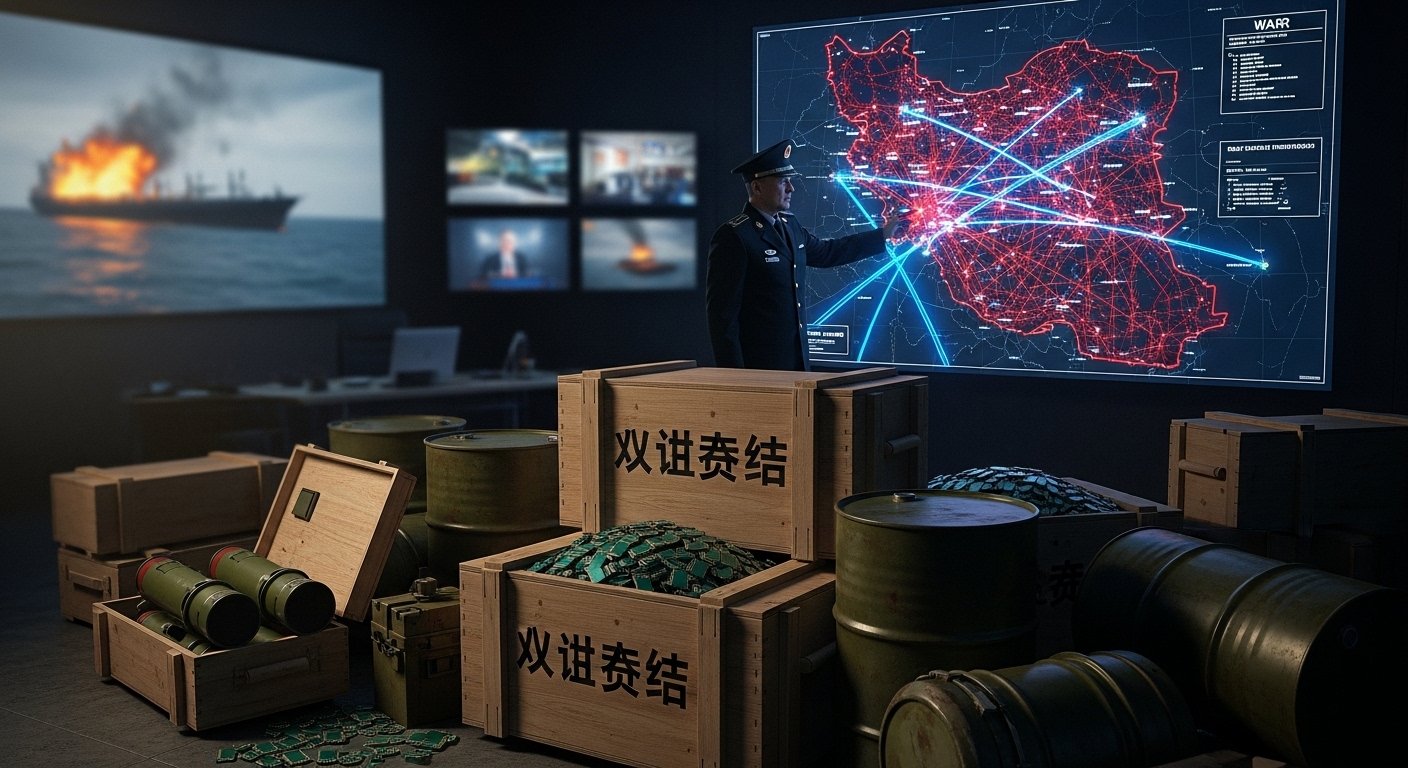
China says it does not send military hardware to Iran. Technically, that is true – at least on paper. In practice, Chinese firms export microchips, guidance systems, engine components, and precision tools that are civilians on paper but military in function. Shahed‑136 drones and Fateh‑type ballistic missiles use the same kinds of chips found in phones, industrial machines, and telecom equipment. The paperwork calls it “commercial trade.” The result: Iranian weapons factories get critical components that make their missiles and drones work.
US defense analysts have repeatedly identified Chinese companies running smuggling‑style networks for Iran. These networks route shipments through third countries, use front companies, and fake end‑user documents so the final buyer looks like a civilian customer. The same pattern is visible in China‑Russia arms trade: Beijing supplies dual‑use tech to Moscow while maintaining public neutrality in Ukraine. In both cases, the pattern is clear – China wants to help its partners win without formally crossing legal red lines.
The Munitions War: Iran’s Cheap Drones vs. America’s Expensive Missiles
The Gulf conflict has turned into an attrition war of missiles and drones, not just a clash of soldiers and bases. Iran’s Shahed‑136 suicide drone costs about $20,000 to produce. The US Patriot PAC‑3 missile that shoots it down costs over $2 million – a 100‑to‑1 cost ratio in Iran’s favour. If Iran keeps producing and launching drones, the economic pressure on the US and its allies grows faster than the stress on Tehran’s budget.
Ballistic missiles follow a similar pattern. A Fateh or similar Iranian missile might cost around $1 million. The SM‑6 or THAAD interceptors that destroy them cost 4–5 million dollars each. Over time, Iran hopes to exhaust Western air‑defence inventories, forcing the US and Gulf states to either accept more damage or cut back on operations.
Trump’s strategy banks on the opposite idea – that Iran’s missile stockpile (estimated at 3,000–5,000) is depleting faster than it can be rebuilt, and that oil sanctions, drone‑part shortages, and economic collapse will force Iran to stop before the US runs out of interceptors. The outcome of the war now depends on who is right – Iran’s attrition theory, or America’s depletion‑of‑Iran theory.
Russia’s Role: The Real Military Partner
If China is Iran’s “quiet supply shop”, Russia is its real military partner. Iran has already sent more than 50,000 Shahed drones to Russia for use in Ukraine. In return, Moscow offers cash, strategic ties, and political cover. Russia’s own military and diplomatic needs create a mutual dependency China cannot match.
Rumours suggest Russian Verba MANPADS (short‑range air‑defence missiles) may be flowing back to Iran. These systems can threaten F‑35s and Apache helicopters that have operated in the Gulf with little danger from portable air‑defence weapons so far. Russia also has fewer incentives than China to avoid conflict with Gulf states; Moscow is itself a major oil producer and benefits from higher global prices caused by Gulf instability.
Still, Russian logistics are slow. Heavy systems like S‑400 air defences take months to move, install, and train crews. Russia can send ammo, MANPADS, and technical advisors quickly, but these are tactical help, not a game‑changing force alone.
Iran’s Last‑Resort Options: Chemical and Nuclear Thresholds
If Iran’s missile and drone stockpiles run low, the war takes on a darker dimension. One possibility is chemical weapons, using agents developed or kept from the Iran‑Iraq War. Iran knows the Chemical Weapons Convention looms over such moves. Any chemical attack would trigger massive international condemnation, potential military escalation, and isolation far beyond conventional fighting.
The nuclear option is even more extreme. Reports of Iran enriching uranium to 90% U‑235 suggest it is weeks, not months, away from weapons‑grade material. A conventional military collapse that threatens regime survival could change Tehran’s calculus: rather than keep nuclear weapons at the edge of development, it might choose to build a working bomb and use it as a deterrent, even with the cost of US or Israeli retaliation. That scenario would transform the entire Middle East security landscape — and China, too, fears this outcome.
China’s Private Fear: A Nuclear Iran
Publicly, China talks about Iran’s “right to resist” and criticizes US military actions. Privately, Chinese strategists worry about a nuclear‑armed Iran in an active war against the US and Israel. A nuclear Iran would trigger regional chaos: Gulf oil flows could collapse, Saudi Arabia might rush to build its own bomb, and the US‑Israel‑Iran triangle could spiral into broader nuclear tension. All of that threatens the cheap oil and stable trade routes that keep China’s economy running.
Beijing also fears regional nuclear contagion. If Iran crosses the nuclear threshold, Saudi Arabia, Turkey, and others may follow, turning the Middle East into a multi‑nuclear environment. China wants to limit the number of nuclear powers it must negotiate with and plan threats for. A non‑nuclear Iran that is a nuisance to the US, but not a nuclear crisis, is far more comfortable for Beijing than a nuclear‑armed one.
The Patriot Paradox: US Air‑Defence Costs
The Gulf war has exposed a weakness in US military economics. Patriot PAC‑3 interceptors are produced at about 550 per year. THAAD and SM‑6 missiles are produced even more slowly. Iran, even with disrupted supply chains, can roll out hundreds of Shahed drones and dozens of missiles per month. At the current 100‑to‑1 cost ratio, Iran can exhaust US munitions faster than factories can replace them.
The deeper problem is political. The US Congress watches the price tag closely. When each Iranian drone costs $20,000 but each intercept costs $2 million, the public and lawmakers ask: “How long can we keep this up?” Trump’s bet is that Iran will crack before Congress says “enough.” But if the conflict drags on and munitions run low, the real limit may be American budget and political will, not military capability.
Pakistan Stuck in the Middle: CPEC, Iran, and the Gulf
Pakistan’s position is uniquely difficult. The China‑Pakistan Economic Corridor (CPEC) – a $62 billion network of roads, ports, and power plants – runs through Balochistan, which borders Iran. The war in the Gulf, combined with Iran‑Pakistan border tensions and Baloch militants targeting CPEC, puts Chinese workers and investments at risk. Beijing therefore wants Pakistani neutrality, not open alignment with either side.
At the same time, Pakistan must manage US pressure to cooperate, Gulf expectations of solidarity, and China’s desire to keep CPEC safe and profitable. The 10 million Pakistani workers in Gulf states now face uncertainty: their jobs, safety, and remittances all depend on the region becoming stable again. A mass return to Pakistan could strain the economy.
China’s Four‑Dimensional Chess: Long‑Term Strategy
China’s approach is not simple hypocrisy. It is a multi‑goal strategy:
- Buy cheap Iranian oil while oil prices spike everywhere else.
- Keep selling dual‑use tech to Iran, helping its drones and missiles stay operational.
- Maintain solid ties with Gulf states by criticizing US war methods without backing Iran militarily.
- Watch the US burn munitions and political capital while Beijing positions itself as the post‑war reconstruction and investment leader.
In the end, Beijing hopes a war‑tired America, weakened Iran, and exhausted Gulf states will turn to China for energy deals, infrastructure, and diplomatic mediation. The Gulf will be damaged, but China will be the biggest non‑war player at the negotiating table.
Three Endgame Scenarios
The war can end in one of three main ways:
- Iran collapses internally:
- Missile stockpiles run low.
- Supreme‑leadership losses and economic collapse create regime instability.
- A new government agrees to limit its nuclear and missile programmes, and the US‑led coalition accepts that as victory.
- US overextends politically and economically:
- Congress imposes budget caps on munitions and operations.
- High oil prices and election‑year pressure force Washington into a partial withdrawal.
- Iran survives with some limits on its missiles, but no full‑scale regime change.
- Controlled escalation to a clear endpoint:
- US and allies launch targeted ground operations to destroy nuclear and missile sites.
- Iran loses major capabilities but keeps its core regime.
- A ceasefire and limited sanctions relief are the final arrangement.
Conclusion
China’s limited support to Iran shows the gap between rhetoric and reality in authoritarian alliances. Beijing talks about resistance to US power, but its real strategy is calculated neutrality – helping Iran just enough to stay useful, without risking sanctions, losing Gulf oil, or opening the door to a nuclear Middle East. The Gulf war has become a war of missiles, drones, and money, not just soldiers. The outcome will be decided by who runs out first – Iran’s missiles, America’s interceptors, Gulf‑state patience, or Iran’s internal stability. China will likely stay on the sidelines, watching, waiting, and quietly preparing to collect the economic dividends of whatever comes next.