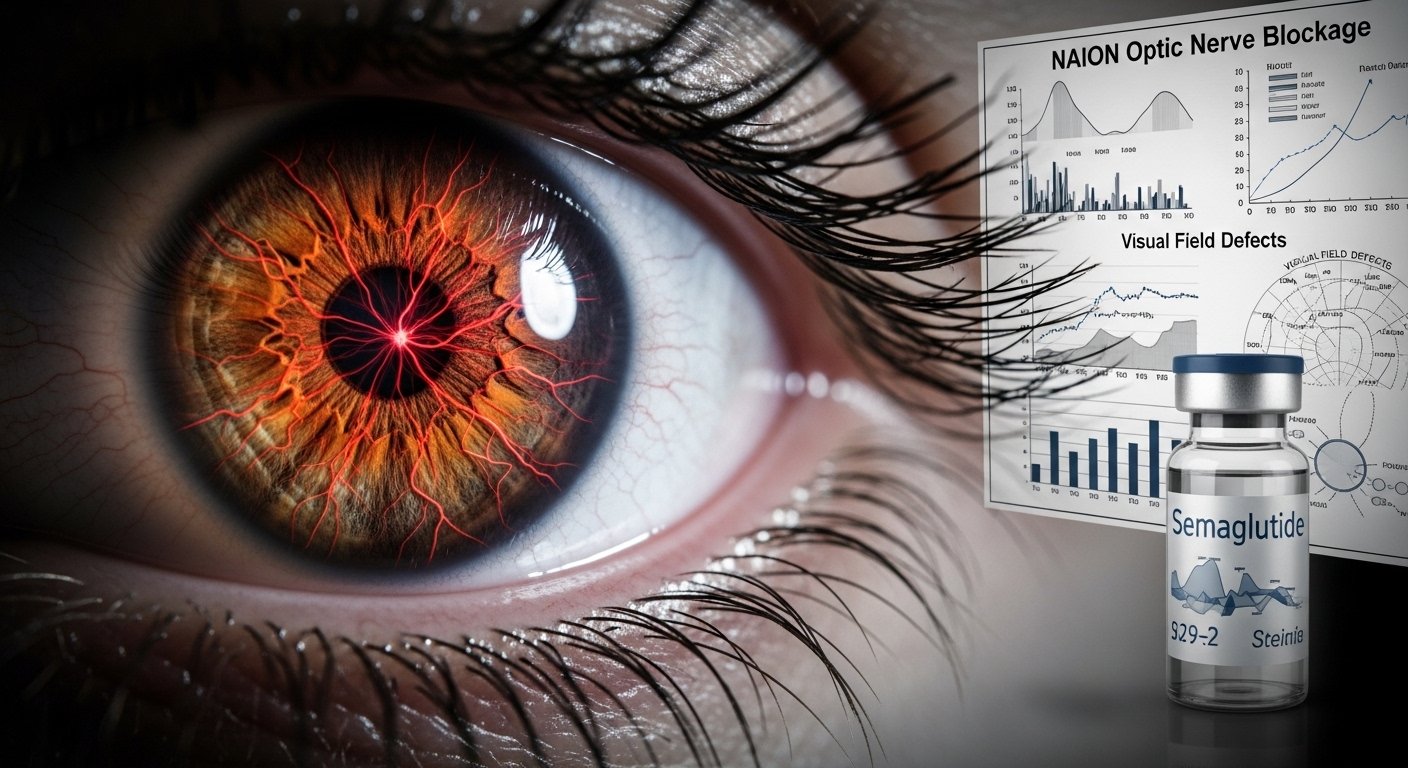
Wegovy users face 5x higher risk of sudden blindness – this is the warning emerging from a major new study published in the British Journal of Ophthalmology, which links the higher‑dose semaglutide injection Wegovy to a five‑fold increase in non‑arteritic anterior ischemic optic neuropathy (NAION) compared to Ozempic users. About 20 million people worldwide take semaglutide for obesity or diabetes, and sales of these drugs reached $27 billion in 2025, but the new research shows that Wegovy’s benefits come with a rare, potentially devastating risk of sudden, often permanent vision loss in one eye.
NAION, often called an “eye stroke”, occurs when the blood supply to the optic nerve is suddenly cut off, usually without pain or warning. A patient can go to sleep with normal vision and wake up blind in one eye, or notice a sudden dark spot or scotoma in their visual field that does not improve with glasses or eye drops. The optic nerve has very limited ability to recover once blood flow is lost, so the damage is often permanent or only partially reversible. The new study estimates that NAION affects about 1 in 10,000 semaglutide users, which sounds small on paper but translates to roughly 2,000 affected patients among the current global user population.
The science behind the 5x higher risk
The research was led by Dr. Edward Margolin at the University of Toronto, who analyzed FDA adverse‑event reports from 2017 to 2024 for four GLP‑1 drugs: Wegovy, Ozempic, Rybelsus, and Mounjaro. These reports are voluntary, so the study does not prove that Wegovy causes NAION, but it clearly shows a strong statistical signal of risk. The data reveal that Wegovy users report NAION at about five times the rate seen in Ozempic users, and men on Wegovy show three times the risk of women.
In contrast, Rybelsus (the oral semaglutide tablet) and Mounjaro (which uses tirzepatide) show no elevated NAION signal. This pattern suggests that the risk is not tied to semaglutide alone, but to the higher‑dose, injectable form of the drug. Wegovy’s 2.4 mg weekly dose produces more aggressive weight loss (often 15–20% of body weight) than Ozempic’s lower dose, which can reduce blood volume and stress the delicate blood vessels that feed the optic nerve.
How NAION works in the eye
The optic nerve is like a cable connecting the eye to the brain, and it is supplied by tiny blood vessels called short posterior ciliary arteries. These are extremely sensitive to changes in blood pressure, blood volume, and blood viscosity. When anything reduces blood flow to these vessels – such as dehydration, low blood pressure, or blood‑clotting changes – the nerve can become ischemic.
In NAION, the blood flow drops suddenly, and the nerve begins to die. Because the nerve has very little capacity to regenerate, the visual loss is often permanent. Some patients see small improvements in the first few months, but full recovery is rare. The result is a blind spot or scotoma in the affected eye that can cover a large portion of the visual field. For many people, this is life‑changing, affecting driving, reading, and even recognizing faces.
The new study shows that Wegovy users, especially older men with hypertension, diabetes, cardiovascular disease, or sleep apnea, are at the highest risk. Rapid weight loss, nausea, vomiting, and fluid loss all add strain to the system, making it harder for the optic nerve’s blood supply to keep up.
The real‑life impact on patients
Behind the statistics are real people. A 45‑year‑old man in Chicago lost 20 pounds on Wegovy and was feeling healthier than ever until he woke up one morning completely blind in his right eye. The diagnosis was NAION, and the damage was irreversible. A 38‑year‑old woman in London switched from Ozempic to Wegovy for faster weight loss and, three months later, began noticing a dark patch in her vision. Within weeks, the vision in one eye was severely impaired.
Ophthalmologists are reporting a noticeable rise in NAION cases since 2022, when GLP‑1 drugs like Wegovy and Ozempic became widely used. Before 2022, NAION was relatively rare in many clinics; now, some doctors see multiple cases per month in patients taking these medications. Online patient communities are full of stories of blurred vision, dark spots, and sudden one‑sided visual loss that some doctors initially dismissed as unrelated to the drug.
Who is most at risk?
The risk is not the same for everyone. The new research and clinical experience point to a clear high‑risk group:
- Men over 40–50 years old
- Pre‑existing vascular risk factors: hypertension, diabetes, cardiovascular disease, or prior stroke
- Sleep apnea
- Rapid weight loss (more than two pounds per week over time)
- Older age, which naturally increases NAION risk in the general population
For a healthy 32‑year‑old woman using Wegovy, the 1 in 10,000 risk may be acceptable compared to the benefits. For an older man with hypertension and untreated sleep apnea, the same risk looks far less favorable, especially when safer alternatives like Mounjaro or lower‑dose Ozempic are available.
Regulatory and medical response
Regulators have reacted quickly. The UK’s Medicines and Healthcare products Regulatory Agency (MHRA) issued a formal safety alert in February 2026, telling doctors to watch for sudden changes in vision in one eye and to stop Wegovy immediately if NAION is suspected. The European Medicines Agency (EMA) has updated Wegovy’s patient information to warn about NAION risk. The US Food and Drug Administration (FDA) is reviewing the data and may add a label change or even a black‑box warning.
Novo Nordisk, Wegovy’s manufacturer, acknowledges the signal but stresses that no causal link has been proven in controlled trials. The company says it is planning further studies to better understand the risk. At the same time, more than 50 lawsuits have already been filed in the US by patients who say they lost vision while on Wegovy and were not adequately warned.
How doctors should change their practice
For patients already on Wegovy, the key message is do not stop the medication without medical advice, but do have an honest conversation about NAION risk. Doctors should now:
- Perform a baseline eye exam before starting Wegovy, especially in high‑risk patients
- Explain the warning signs: sudden blurry vision, a dark spot, or abrupt loss of clarity in one eye
- Tell patients to stop Wegovy immediately and see an ophthalmologist urgently if any of these symptoms appear
- Consider Mounjaro, lower‑dose Ozempic, or slower‑paced weight‑loss programs for patients with hypertension, sleep apnea, or vascular disease
For many people, Wegovy’s benefits – dramatic weight loss, better blood sugar control, and reduced risk of heart disease – clearly outweigh the risk of NAION. But for others, the risk–benefit balance is less clear, and treatment should be individualized, not one‑size‑fits‑all.
The bigger picture: benefits versus risk
Wegovy is a powerful tool that has transformed the treatment of obesity for millions of patients. Obesity itself increases the risk of heart disease, stroke, diabetes, joint problems, and some cancers. The SELECT trial showed that semaglutide reduces major cardiovascular events by about 20% in overweight patients with existing heart disease. For these patients, a 1 in 10,000 risk of sudden blindness may still be outweighed by the benefits.
But the new research forces medicine to think more carefully. Vision loss is not a side effect that can be fixed with a dose adjustment – once NAION has caused damage, it is often permanent. The path forward is not to abandon effective drugs, but to use them more wisely: identify high‑risk patients, monitor them more closely, and give them clear information about what to watch for and what to do if something goes wrong.
Conclusion
Wegovy users face 5x higher risk of sudden blindness – that is the hard message of the latest research, and it deserves to be taken seriously. For many patients, the weight‑loss and metabolic benefits of Wegovy are real and life‑saving. For others, especially older men with vascular risk factors, sleep apnea, or rapid weight loss, the risk of NAION is significant enough to reconsider their treatment choice.
The right response is better risk stratification, better patient education, and closer monitoring, not fear‑driven panic. Doctors and patients alike need to recognize that eyesight is precious, and when a drug can threaten it, the evidence must be treated with the gravity it deserves.