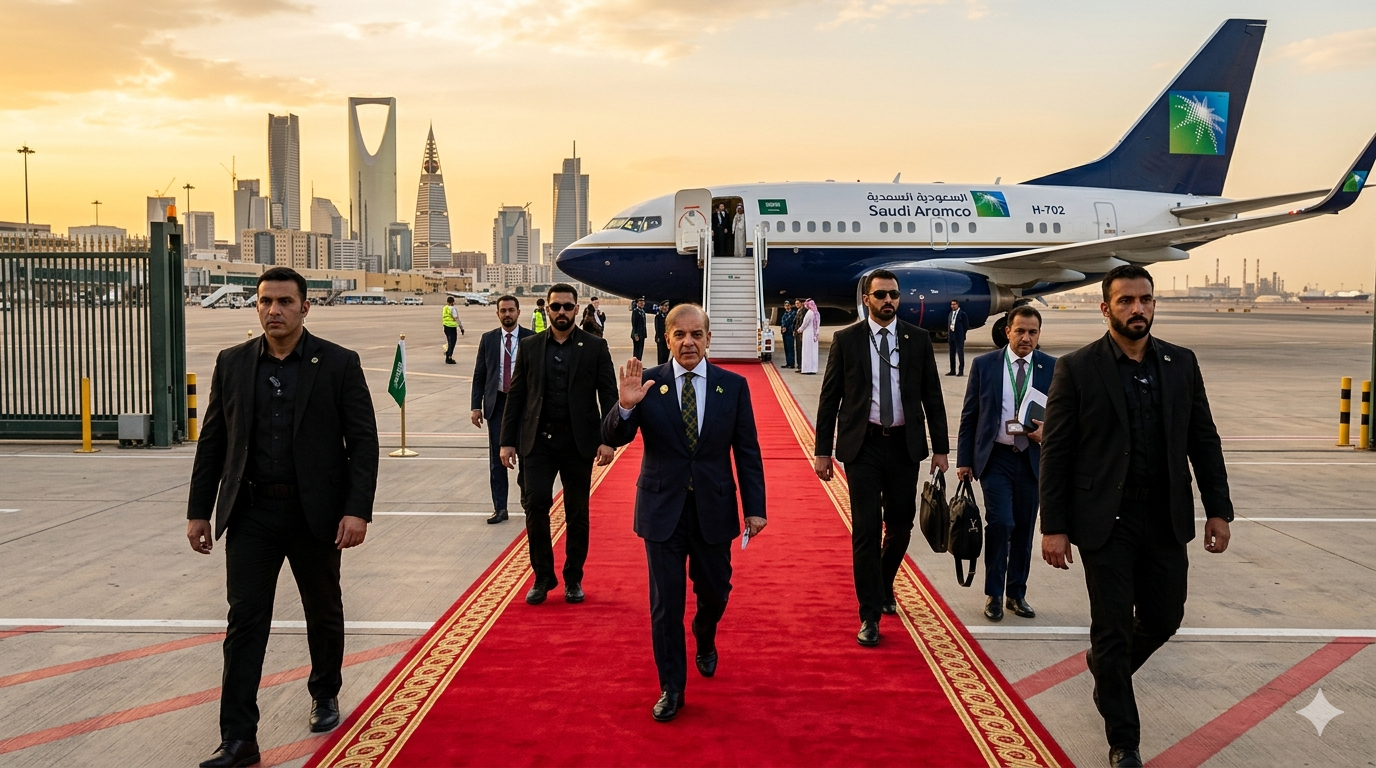
Riyadh or Ruin is the phrase echoing through Pakistan’s corridors of power this week, because the Riyadh or Ruin crisis has forced Prime Minister Shehbaz Sharif onto an unannounced special flight to Riyadh, where the next 72 hours could determine whether Pakistan survives the Persian Gulf energy shock or buckles under its weight. The flight is not a routine courtesy visit; it is an economic triage mission disguised as diplomacy, driven by collapsing foreign‑exchange reserves and soaring oil prices.
Pakistan’s economy was already on thin ice before the Gulf crisis. The Central Bank’s reserves were low, the rupee had weakened significantly against the dollar, and the government was struggling to meet IMF‑programme conditions. With crude oil crossing $103 per barrel and Saudi Arabia supplying 40 percent of Pakistan’s oil imports, the survival of Pakistan’s import‑dependent economy now hinges on one private dinner at Al Yamamah Palace with Crown Prince Mohammed bin Salman. The Riyadh‑or‑Ruin choice is real, and the window to decide is narrow.
The Perfect Storm That Forced Sharif’s Hand
The decision to board the emergency flight came after a 72‑hour cascade of crises. On March 10, 2026, Iranian drone boats sank the Theseanu tanker in Iraqi waters, marking the opening of a full‑scale maritime campaign. By March 11, four more ships were hit near the Strait of Hormuz, with crew members killed and the global shipping industry thrown into crisis. By March 12, Brent crude had crossed $102.47 per barrel, and Pakistan’s finance ministry warned that petrol could reach Rs320 per litre by the weekend.
CNG queues began re‑forming in Karachi and Lahore, Daraz announced shipping‑cost hikes of 35 percent, and the KSE‑100 index fell 4.2 percent. Pakistan’s strategic oil reserves – enough for about 60 days at current consumption – suddenly looked inadequate against a prolonged Gulf blockade. For Sharif, the Riyadh‑or‑Ruin reality was clear: either fly to Riyadh within 48 hours, or risk sovereign default. The flight to Riyadh became not just strategic, but essential.
What Pakistan Is Actually Asking For in Riyadh
The Riyadh‑or‑Ruin strategy has three core elements: emergency oil, financial stabilization, and security cooperation. First, Pakistan seeks 5 million barrels per month on 90‑day credit terms, increasing its usual 40 percent share of Saudi oil by 20 percent. Saudi Arabia has 2 million barrels per day in spare capacity, so the volume is technically feasible – the real negotiation is over credit terms and political risk.
Second, Pakistan wants financial support. It is asking Saudi Arabia to double its deposits from $5.1 billion to $10 billion, provide $2 billion in immediate oil credit, and roll over $15 billion in existing debt obligations. If all three are approved, the IMF‑related default risk reduces sharply, though Pakistan remains in Fitch’s CCC rating band. Third, there is security cooperation, where Saudi Arabia wants expanded Pakistani military presence – including F‑16 patrols over the Gulf of Oman – in exchange for the oil and credit Sharif seeks.
Pakistan’s Economic Dependence on Saudi Arabia
The Riyadh‑or‑Ruin narrative is rooted in structural dependence. Saudi Arabia supplies 40 percent of Pakistan’s oil imports, and Pakistani workers in the Kingdom send home $8.2 billion per year – 29 percent of Pakistan’s total remittances. Saudi Arabia has also pledged $25 billion in FDI across projects like NEOM and Reko Diq. No other country can match this mix of energy, finance, and security in the short term.
Alternatives face political and sanctions barriers. Russian oil is cheaper but blocked by U.S. sanctions. Azerbaijan can supply 1 million barrels per day, but European buyers have priority. Iran, despite its proximity, has damaged infrastructure due to the ongoing conflict, and the Gwadar‑Iran pipeline was never completed due to American pressure. In this Riyadh‑or‑Ruin environment, Saudi Arabia is Pakistan’s only viable lifeline.
The Geopolitical Tightrope: Trump, China, and Iran
The Riyadh‑or‑Ruin mission unfolds under pressure from three major powers. President Donald Trump has publicly told Pakistan to “pick a side,” warning that Iran loses – a demand at odds with Pakistan’s neutral‑non‑alignment foreign‑policy tradition. Pakistan cannot afford to alienate the U.S., whose support is key to the IMF programme, but it also cannot provoke Iran into targeting Gwadar or escalating along the 900‑kilometre border.
China’s $62 billion CPEC corridor runs through Gwadar, giving Beijing a direct stake in Gulf shipping and Pakistan’s stability. Iran’s IRGC has warned that Pakistani ports could become the “next Hormuz,” signaling that Tehran is watching this Riyadh‑or‑Ruin negotiation closely. Sharif’s “brotherly Muslim nations dialogue” framing is an attempt to balance U.S., Saudi, Chinese, and Iranian interests simultaneously – a high‑stakes diplomatic tightrope walk.
Riyadh Has Always Bailed Pakistan Out
The Riyadh or Ruin phrase encapsulates a long‑standing pattern. In 1999, Saudi Arabia sheltered Nawaz Sharif after his ouster, cementing the Sharif‑Riyadh relationship. In 2014, $1.5 billion in Saudi deposits steadied Pakistan’s reserves. In 2022, another $2 billion helped Pakistan avoid default. In 2023, $2 billion more plus $2 billion in debt rollover kept the economy afloat.
Saudi Arabia benefits from a stable, solvent Pakistan. Pakistan is a nuclear‑armed Muslim nation with a capable military that protects holy sites, constrains Iranian influence, and provides strategic depth. When Pakistan is economically unstable, its security role weakens, and Saudi Arabia loses a key partner. MBS understands that a failed Pakistan is a failed Saudi‑strategic bet. The Riyadh‑or‑Ruin pattern continues, though the underlying structural problems remain unaddressed.
What Pakistan Gets If the Deal Works – And If It Doesn’t
If Sharif succeeds, Pakistan gains 90 days of breathing room. With 5 million barrels per month on 90‑day credit, expanded Saudi deposits, and debt rollover, Pakistan avoids the Rs350‑per‑litre petrol shock, the KSE‑100 index stabilizes, and IMF negotiations continue without a fresh crisis. The rupee may hover near Rs285 per dollar, and energy shocks are absorbed without mass industrial shutdowns. Riyadh‑or‑Ruin worst‑case scenarios are delayed.
If the deal fails, or its security costs become politically unsustainable, the arithmetic is brutal. Petrol crosses Rs350 per litre by April, CNG hits Rs250 per cubic metre, Pakistan’s textile‑export sector shuts down, and the IMF programme risks collapse. The 2027 elections become unrealistic under conditions of economic emergency. Analysts agree: Saudi money buys time, not reform. Riyadh‑or‑Ruin is a lifeline, not a cure.
Impact on Pakistan’s Stock Market: Winners and Losers
The Riyadh‑or‑Ruin narrative has already hit the KSE‑100. OGDC surged 15 percent, targeting Rs150, as investors expect energy‑sector relief. PPL rose 12 percent, aiming for Rs30, on offshore‑block news. Air Link gained 8 percent, benefiting from air‑freight rate hikes due to shipping‑chaos.
On the losing side, Engro dropped 9 percent as fertilizer‑input costs soar. Systems Limited fell 7 percent on dollar‑shortage fears, and Bank Alfalah slid 6 percent, as investors worry about rising non‑performing loans from energy‑cost shocks. Riyadh‑or‑Ruin investors clearly see: energy‑linked and logistics‑linked stocks benefit, while import‑ and dollar‑dependent firms suffer.
Riyadh‑or‑Ruin: Lifeline or Life Support?
Even if MBS approves the oil‑credit package, expanded deposits, and debt‑rollover, Pakistan’s circular‑debt, weak tax‑revenue, and currency‑vulnerabilities remain. The deal buys three to six months of breathing room, but the crisis‑and‑bailout cycle has repeated in 2014, 2022, 2023, and now potentially 2026.
For Pakistan, Riyadh‑or‑Ruin is both a lifeline and a warning. It proves Saudi Arabia will not let Pakistan fail, but it also proves that Pakistan has not fixed its fundamentals. Without serious energy‑pricing reforms, tax‑system overhaul, and public‑sector‑efficiency gains, the next Riyadh‑or‑Ruin crisis is already on the way. The Riyadh‑or‑Ruin choice is not just about Sharif’s visit – it is about Pakistan’s long‑term survival.