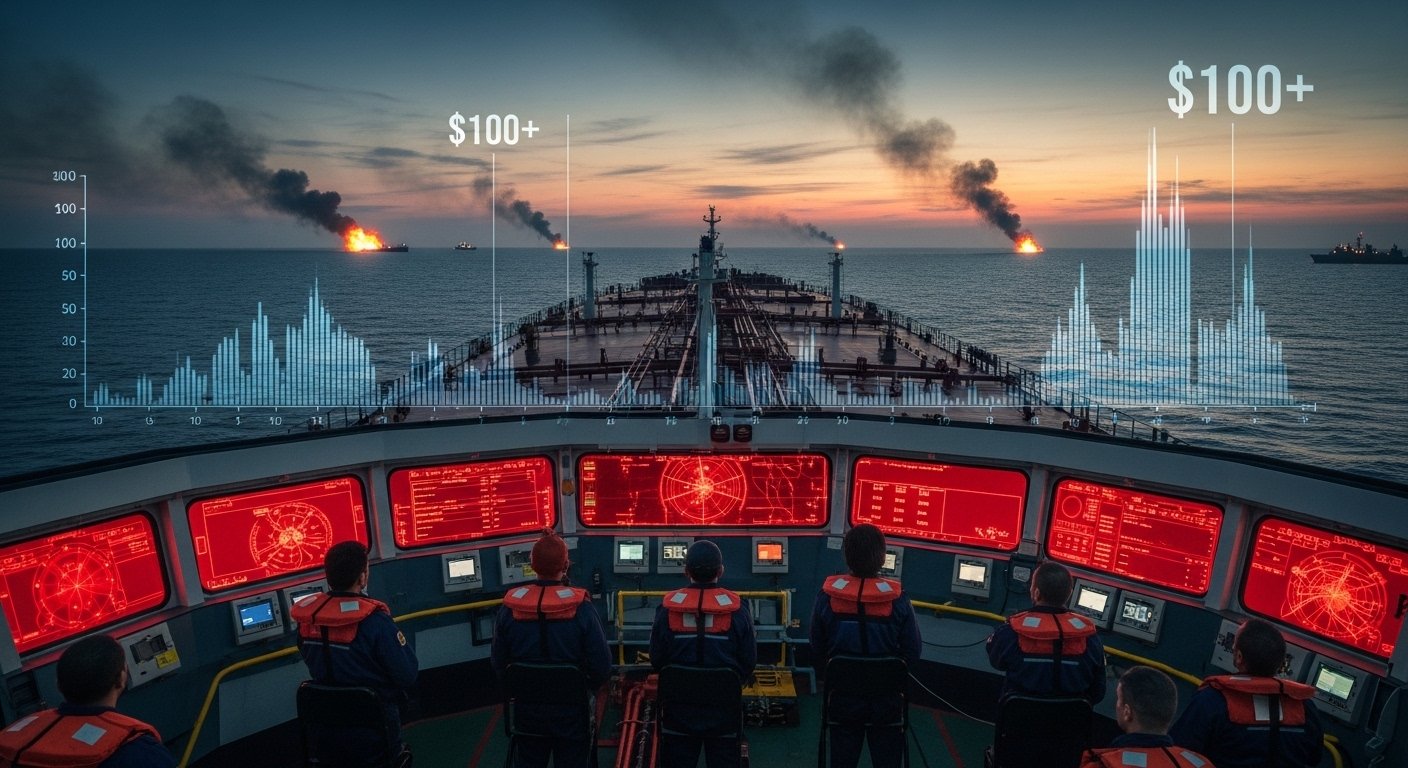
Oil breaks $100 as the Iran–US war freezes the Strait of Hormuz, the critical waterway that carries about 20% of the world’s oil. For the first time in nearly four years, crude has crossed the psychologically important $100‑per‑barrel threshold, and this spike is not just another market scare.
Behind the headline price lies a real‑world energy crisis: the Strait of Hormuz, once a busy commercial lane, has become a near‑empty ghost route for tankers. The conflict between Iran and the US, including coordinated strikes and retaliatory threats, has halted normal shipping through this narrow passage. Gulf producers like Saudi Arabia, the UAE, Iraq, and Kuwait now struggle to export oil, while global buyers face rising prices, fuel‑cost spikes, and fresh inflation risks.
What Changed on Monday: The $100 Threshold
The move on Monday marked a sharp shift in the oil market. US crude, known as WTI, settled at $94.77 per barrel, up about 4.3% on the day. Brent crude, the global benchmark used in most international contracts, jumped 6.8% to close at $98.96 per barrel. At one point in the overnight session, before a partial pullback, WTI briefly touched $118, the highest level since the immediate aftermath of Russia’s 2022 invasion of Ukraine.
What makes this episode different from past spikes is that the price surge is not driven mainly by speculation or short‑term supply worries; it reflects a physical choke in supply created by the war‑related closure of the Strait of Hormuz. The last time oil spent an extended period above $100 was from March to July 2022, when the Ukraine war disrupted Russian exports. Then, alternative supply and spare capacity softened the blow. Today, the shock hits the Gulf’s main export route itself, leaving the market with far fewer safety valves.
The Strait of Hormuz: Why It Matters So Much
The Strait of Hormuz is a narrow waterway, roughly 33 kilometers wide at its narrowest point, separating Iran to the north from Oman and the UAE to the south. Under normal conditions, about 20 million barrels per day of crude oil and refined products pass through it, making it one of the most important chokepoints in the global energy system. That volume accounts for roughly 20% of global oil consumption and a far larger share of seaborne crude trade.
Analysts often compare the current disruption to twice the scale of the 1956–57 Suez Canal closure. Unlike Suez, the Gulf has no real alternative for large‑scale oil exports. Saudi Arabia’s East‑West pipeline can route some crude to Red Sea ports, but it operates at only a fraction of Hormuz’s normal flow, and it cannot fully replace the lost transit capacity.
Tanker‑tracking data now show near‑zero commercial traffic through the strait. Ships that would normally load at Ras Tanura or Jebel Ali and head east to Asia are sitting at anchor, waiting for a safer security environment. Others are rerouting far south, around the Cape of Good Hope, which adds two to three weeks to journey times and significantly raises fuel, wage, and insurance costs.
The “Spare Capacity Problem”: No Swing Producer to Rescue Markets
In past oil shocks, such as the 1973 Arab oil embargo, the 1979 Iranian revolution, and the 1990 Gulf War, OPEC spare capacity, especially in Saudi Arabia, helped cushion the impact. When one region lost supply, Saudi Arabia and other Gulf producers could ramp up output to partly fill the gap. That role turned Saudi Arabia into the world’s main “swing producer” and made the market’s response to disruptions more predictable.
In today’s crisis, that safety net is largely gone. Saudi Arabia and the UAE together hold most of OPEC’s spare capacity, estimated at roughly 3 million barrels per day under normal conditions. However, their export infrastructure is tied directly to the Strait of Hormuz. Even if Aramco or other national producers could increase output, there is nowhere to send that crude.
Storage tanks in Gulf ports are filling up while cargoes sit stranded. In some cases, Aramco and other Gulf exporters have declared force majeure on contracts, not because of production problems, but because they cannot move the oil through the closed strait. Without a credible swing producer able to step in, the market’s usual shock‑absorbing mechanism is broken, and prices can rise for longer before demand‑destruction forces them back down.
What the Futures Curve Tells Us
The structure of oil futures contracts offers a window into how traders see the crisis unfolding over time. Near‑term contracts, covering delivery over the next three to six months, trade at steep premiums over the cash price, reflecting the immediate tightness created by the sealed‑off Strait of Hormuz. Contracts for delivery in 2027 and 2028, by contrast, hover around the high $60s, implying that the market still expects the conflict to end and supply to normalize eventually, but not quickly.
Analysts such as Homayoun Falakshahi of Kpler warn that if the strait remains closed through the end of March, $150 per barrel is a plausible upper bound for prices. Falakshahi emphasizes tanker‑flow data as the most reliable indicator, since physical vessel movements often tell a clearer story than diplomatic headlines.
Dan Pickering of Pickering Energy Partners describes a “vicious loop”: higher oil prices increase pressure on Western governments to secure a diplomatic solution, but at the same time they give Iran more leverage to maintain the disruption and use it as a bargaining chip. As this loop continues, the price shock becomes more entrenched, and the eventual adjustment becomes harder for all economies.
How This Compares to Past Oil Shocks
Energy‑market historians often reach back to the 1973 Yom Kippur War and Arab oil embargo, the 1979 Iranian revolution, and the 1990 Gulf War when they try to explain the current spike. Each of those episodes produced sharp price increases and inflationary pressure, but in each case, the crisis eventually eased either through diplomatic or military resolution, the mobilization of alternative supply, or demand destruction in response to high prices.
The current situation is structurally harder to resolve. Military options in 2026 face a more complex strategic and nuclear‑shadowed landscape than in earlier conflicts. The spare capacity that once cushioned markets is now blocked rather than merely reduced. Alternative supply routes cannot move the volumes at stake, and demand‑killing price levels would likely trigger a global recession if sustained. Goldman Sachs’ models now point to a base case of around $120 per barrel if the Strait of Hormuz remains closed, with a bull case above $150 and a bear case closer to $80 if a swift diplomatic fix restores transit.
Winners in a $100‑plus Oil World
Not every economy or company suffers from a world in which oil breaks $100. The distribution of winners and losers reveals how energy wealth flows across the global system. US shale producers such as Exxon, Chevron, and smaller independents typically operate with break‑even prices in the $45–55 per barrel range. At $100 Brent, their margins expand dramatically, and they are announcing new capital spending plans that will eventually add supply to the market. However, the production cycle from commitment to first barrels often takes 12 to 18 months, so this new supply provides little short‑term relief.
Offshore producers in Guyana and Brazil benefit because their oil routes bypass the Strait of Hormuz and reach markets directly via Atlantic routes. Their production growth will add to global supply over the coming year, but it is not enough to offset the loss of Gulf flows.
Russia finds itself in a particular irony: despite Western sanctions that require Urals crude to trade at a discount, the absolute rise in global prices has pushed that discount‑crude close to $90 per barrel, erasing much of the intended financial pressure. Meanwhile, Tesla and other electric‑vehicle makers gain a tailwind as higher gasoline prices accelerate consumer interest in EVs, even though the full transition remains a multi‑year story.
Pakistan’s Vulnerability: More Than Just Higher Bills
For Pakistan, oil at $100 is not an abstract economic variable; it is a direct threat to foreign‑exchange reserves, fiscal stability, and the purchasing power of ordinary citizens. Pakistan imports roughly $14–15 billion worth of petroleum products each year under normal conditions. A sustained 40–50% increase in crude prices translates into an additional $5–7 billion in annual import costs, a significant fraction of the country’s foreign‑exchange reserves.
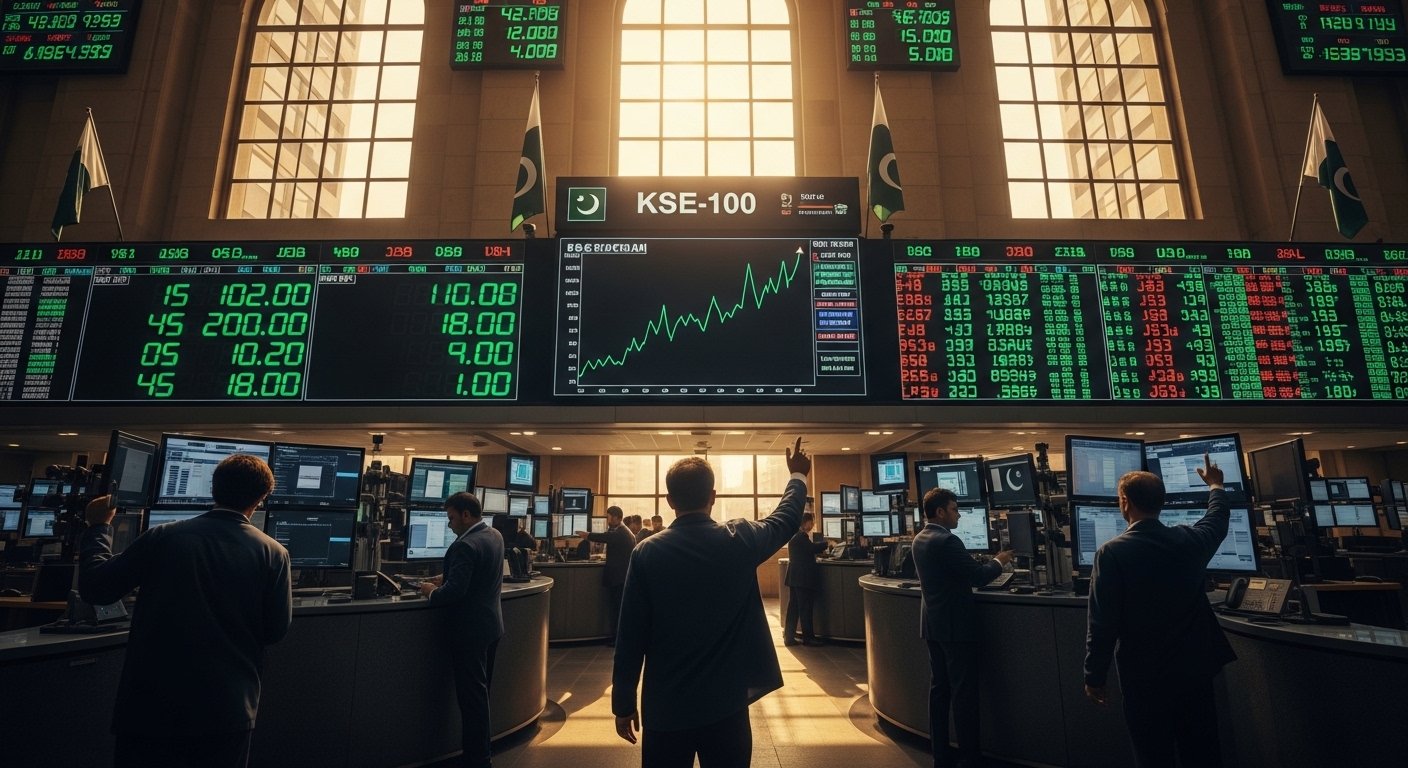
The rupee is directly exposed to oil‑price shocks through the current‑account dynamics that drive currency valuations in import‑dependent economies. As oil bills rise, the demand for dollars to pay for imports also rises, pushing the rupee lower and feeding import‑driven inflation across a wide range of goods. The KSE‑100 has shown sharp swings tied to oil prices, illustrating how closely the equity market tracks the energy shock.
Pakistani workers in the Gulf, whose remittances supply about $8 billion annually, face uncertainty as Gulf economies themselves confront higher energy‑driven costs. Reduced remittance inflows combined with higher import costs create a balance‑of‑payments squeeze that even a Saudi‑backed oil‑credit arrangement can only partly offset.
The Global Inflationary Consequence
The transmission of an oil‑price spike into broader inflation is a familiar pattern from the 1970s, but it is now happening again in modern economies. Direct effects hit within days: gasoline prices in the United States have risen about 50 cents per gallon in a week, reaching around $3.48 per gallon, with further increases likely if oil stays above $100.
European pump prices are approaching €2.50 per liter. Airline fuel costs, which can account for 20–30% of operating expenses, are spiking, forcing carriers to add surcharges, cut capacity, and warn of sharply lower profits. UPS and similar logistics firms have announced rate hikes that will flow through to e‑commerce and retail pricing.
Indirect effects take longer to work through, but they are broader. Energy costs are embedded in the production and transport of almost every good and service. When oil prices rise, manufacturing margins compress, logistics costs climb, and the prices of everything from food to electronics tend to follow.
Central‑bank models estimate that a sustained period of $100 oil could add 1–2 percentage points to annual inflation in major economies. For Pakistan, India, and similar emerging‑market importers, the blow is more severe because energy accounts for a larger share of household budgets and policy credibility is lower, making it harder to anchor inflation expectations.
Government Responses: Strategic Reserves and Diplomatic Pressure
Governments in major energy‑consuming economies have moved rapidly from analysis to action. The G7 is discussing a coordinated release from strategic petroleum reserves, including the United States’ 700‑million‑barrel stockpile, along with contributions from European and Japanese reserves. During the 2022 Ukraine crisis, a similar coordinated drawdown temporarily knocked $5–10 off the price of crude before the market absorbed the extra supply and prices rebounded. A similar move now could provide temporary relief but would not resolve the underlying physical constraint.
The Trump administration has also floated a US‑backed insurance program for Gulf‑bound tankers, seeking to replace the private‑insurance market that has suspended coverage for vessels transiting the Strait of Hormuz. The larger obstacle, however, is not insurance but the physical security risk in a conflict zone. Naval escorts or protected convoys could help, but they raise their own escalation risks.
On the diplomatic front, Saudi Crown Prince Mohammed bin Salman has reportedly spoken directly with President Trump, hinting at back‑channel negotiations aimed at reopening the strait. Any deal must balance the need to restore energy flows with the political requirement that neither Washington nor Tehran be seen as capitulating.
The Road Ahead: Three Scenarios and What Each Means for Prices
The oil market is now pricing a range of potential outcomes, and understanding these scenarios helps clarify what might come next. The bull case for producers – though worst for consumers – is that the Strait of Hormuz remains effectively closed through the summer. In that scenario, strategic‑reserve releases provide only temporary price relief before being absorbed by ongoing supply tightness, spare capacity stays blocked, and prices grind higher toward the $120–150 range that analysts see as an equilibrium in a world without Hormuz transit. That path would likely push the global economy toward a recession.
The base case involves a diplomatic resolution by mid‑year, perhaps through a negotiated ceasefire, face‑saving formulas, and security guarantees that allow commercial tanker traffic to resume, possibly with international naval escorts. In this outcome, prices ease from their peaks but settle in the $80–90 range as the market factors in a persistent geopolitical risk premium alongside gradually recovering supply.
The bear case for oil – best for consumers, hardest for producers – is a rapid diplomatic or military resolution that reopens the strait within weeks. That would let prices fall sharply, potentially back toward $70–80, as the risk premium deflates and the physical blockage disappears. Tanker‑tracking data currently show near‑zero transit through Hormuz, which is why the market treats $100 as a floor rather than a ceiling.
Conclusion: The Ghost Strait of Hormuz
Oil at $100 is a number that cascades through the global economy, reshaping pump prices, airline fares, manufacturing costs, food prices, currency values, stock markets, central‑bank policy, and the political fortunes of governments from Washington to Islamabad.
The specific mechanism behind this spike – the closure of the Strait of Hormuz and the inability of alternative supply sources to compensate at the required speed – makes the current crisis structurally more severe than many past oil shocks. There is no ready swing producer waiting in the wings; there is no alternative shipping route capable of moving the volumes at stake; and there is no simple technical fix that resolves the problem without addressing the underlying conflict.
The resolution of that conflict is the only durable answer to the oil crisis, and it depends on diplomatic and military developments whose timeline cannot be predicted from energy‑market data alone. What the data do show clearly is that the economic pressure building from $100 oil will force that resolution sooner rather than later, as the domestic political costs of sustained high energy prices become unbearable for any government.
Until then, the empty seas visible on Strait‑of‑Hormuz tracking maps tell the story more vividly than any price chart: 20% of the world’s oil supply is stuck, and the world is waiting for the war to end – one way or another.