
The measles outbreak America is facing in 2026 is not a distant public health statistic – it is an active, spreading crisis that has forced emergency rooms, school boards, and exhausted health departments across the country into a response mode most of them hoped they would never need again.
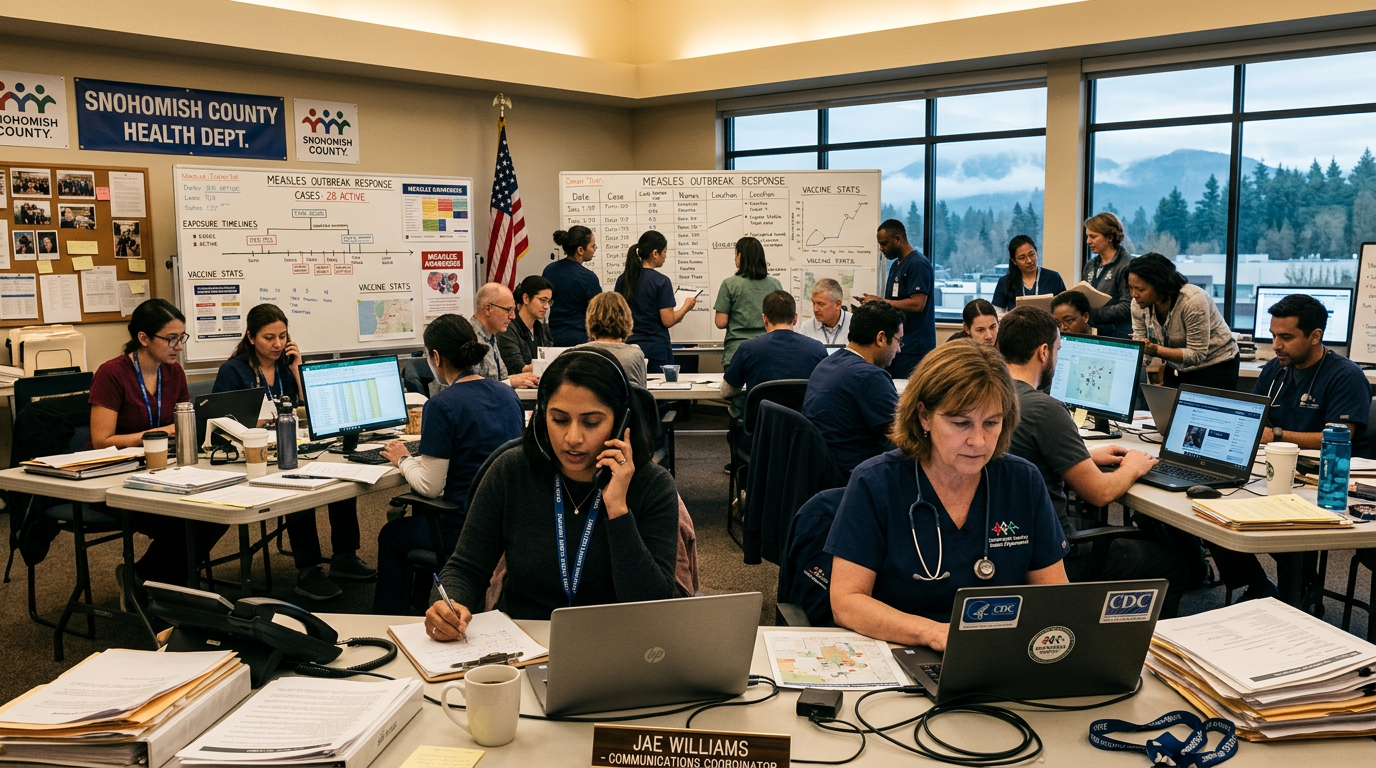
Three cases became six. Six became ten. Ten became twelve. A health department in Snohomish County, Washington that had not run a full measles response operation in years was suddenly back in emergency mode — contact tracing, testing, vaccinating, and making hundreds of phone calls to tell complete strangers they may have been exposed to one of the most contagious viruses in human history.
The disease was measles. The year was 2026. And the United States was facing the very real possibility of losing something it had worked 25 years to achieve and maintain.
An Outbreak That Restarted the Clock
Snohomish County’s crisis did not emerge from nowhere.
It arrived as part of a nationwide surge building for over a year – driven by a dangerous combination of falling vaccination rates, growing public hesitancy, and a policy environment that had failed to respond to years of clear warning signs.
The national measles outbreak America is experiencing right now is most severe in South Carolina, where more than 600 cases have been confirmed, schools have been temporarily closed, and hospital systems have experienced strain not seen from a vaccine-preventable disease in years.
Washington State has recorded 25 confirmed cases and counting, with Snohomish County and neighboring Clark County as the primary affected areas. Every single case shares a common thread running through virtually every measles resurgence in recent American history – the majority involve unvaccinated individuals, and most transmission chains trace back to settings where vaccination rates fell below the level required to stop the virus from spreading.
The stakes extend far beyond case counts. The United States achieved measles elimination status in the year 2000 — a CDC designation confirming the absence of continuous, endemic measles transmission in the country. That status has been maintained for 25 years. In 2025, three Americans died from measles complications. In 2026, epidemiologists are openly asking whether elimination status can even survive what is currently unfolding.
Losing that status would not be symbolic. It would mean measles has permanently re-established itself as an endemic American disease – one requiring indefinite, active suppression rather than simple management of the occasional imported case.
Why Measles Is Both Beatable and Terrifying
What makes the current measles outbreak America is experiencing so deeply frustrating for public health professionals is a painful irony – measles is, in every technical sense, a completely manageable disease.
Unlike the early months of COVID-19, when the pathogen was unknown, tests were scarce, and effective treatments did not exist, measles in 2026 is an enemy that medicine has understood completely for decades.
The MMR vaccine – protecting against measles, mumps, and rubella – has been in use for over five decades. Two doses provide approximately 97% protection against infection. Diagnostic tests return results within hours. Clinical management of complications follows well-established protocols. Contact tracing methodology has been refined through generations of real-world application.
None of this is new. None of it is experimental. None of it is uncertain.
What makes measles terrifying despite all of this is its extraordinary infectiousness.
Measles is the most contagious virus ever documented in human history – approximately 12 times more contagious than SARS-CoV-2. A single infected person in an unvaccinated group will transmit the disease to 90% of those exposed. The virus remains infectious in a room for up to two hours after the infected person has left – meaning an unvaccinated person who walks through a grocery store or airport an hour after an infected person departed can contract measles with zero direct contact.
This combination produces an unusually demanding herd immunity requirement. To reliably prevent measles from spreading through a community, approximately 95% of the population must be immune – either through vaccination or prior infection.
The current national MMR vaccination rate sits at approximately 92%.
Three percentage points sounds modest. In practice, it means that wherever unvaccinated individuals cluster together in sufficient numbers, measles can establish and sustain transmission chains – even when the broader surrounding population is substantially protected.
Inside the Response: The Work Nobody Sees
The work of containing a measles outbreak is largely invisible to the American public.
It happens in health department offices at midnight. In phone calls made at 11 PM by nurses who started their shift at 7 AM. In pop-up vaccination clinics staffed by volunteers giving up their weekends. In careful, patient conversations with hesitant parents that require empathy, discipline, and the ability to absorb genuine frustration without returning it.
Susan Babcock, a public health nurse with the Snohomish County Health Department, has been at the center of this response. Her account of what outbreak containment actually requires makes clear why a single confirmed measles case can consume dozens of staff members across multiple departments for weeks at a time.
Identification and Isolation
The moment a suspected case is identified, the patient must be immediately separated from others while confirmatory testing is conducted. In Snohomish County, that testing now returns results within hours. Once confirmed, the clock starts – and it does not stop.
Contact Tracing Against the Clock
Contact tracing for measles is uniquely demanding because the infectious window begins four days before any symptoms appear.
A patient who felt perfectly healthy during those four pre-symptomatic days – healthy enough to fly, attend school, shop for groceries, or visit a medical facility – may have created dozens or hundreds of exposure events across multiple locations without knowing it.
Response teams must reconstruct every single movement during that window. They review airline flight manifests. They examine security camera footage where available. They rely on patient memory to fill gaps. Then they contact every identified individual – informing them of their potential exposure, advising them on symptom monitoring, and directing them toward testing.
In Snohomish County, this process has required hundreds of phone calls per single confirmed case.
To sustain this effort, the health department has pulled staff from every functional area communications, environmental health, substance abuse programs, refugee services, emergency preparedness, and finance personnel have all been redeployed into direct outbreak support roles. It is a whole-department mobilization that simultaneously reveals the seriousness of the situation and the chronic understaffing of local public health infrastructure that makes such drastic redeployment necessary when emergencies arrive suddenly.
Why Vaccination Rates Fell – And Why It Matters
The driving force behind the measles outbreak America is confronting in 2026 is not mysterious. It is the same force identified in every measles resurgence documented in the United States over the past decade – localized concentrations of unvaccinated individuals that provide the virus with enough unprotected contacts to sustain ongoing transmission. The sources of under-vaccination are multiple and intersecting.
Medical exemptions – granted for patients with genuine, documented contraindications to the MMR vaccine – represent a small and entirely legitimate category. Religious exemptions, which many states permit for school attendance requirements, represent a larger population whose objections are sincerely held but whose unvaccinated status creates collective risk that extends far beyond their own households. Philosophical exemptions, available in certain states, create yet another legal pathway around vaccination requirements – one with no medical basis but significant epidemiological consequence.
Layered on top of these existing exemption categories is a newer source of hesitancy directly traceable to the COVID-19 pandemic. The rapid development and emergency authorization of COVID vaccines generated genuine skepticism in some communities – skepticism that has since extended to existing, long-established vaccines with safety profiles documented across literally billions of administered doses. Social media amplified these concerns without distinguishing between novel pandemic-era platforms and decades-tested childhood immunizations, and the measurable result has been increased MMR hesitancy in communities where COVID vaccine skepticism was already present.
Babcock describes conversations with hesitant parents as among the most delicate and consequential work of the entire outbreak response. The approach her team uses is deliberately non-confrontational sharing personal experience honestly, providing factual information without condescension, and creating genuine space for questions rather than delivering one-sided lectures. Decades of public health experience have consistently shown that patient, respectful engagement produces far better vaccination uptake than pressure or confrontation ever does.
The People Carrying This Response
The professional commitment required to sustain a measles outbreak response across weeks and months cannot be adequately captured by organizational charts or response protocols. It is sustained by individual human beings who choose – repeatedly, daily – to miss family events, work through exhaustion, and make their two-hundredth difficult phone call of the week with the same patience and genuine care they brought to the first.
Jae Williams joined the Snohomish County Health Department as communications coordinator on January 8, 2026 – the same day as the first confirmed exposure events in the current outbreak. Her onboarding did not include a gradual orientation period. It began immediately with drafting urgent public notifications, developing community messaging strategy, and coordinating media communications for an active, evolving public health emergency.
Her prior experience managing COVID-19 communications in California provided a foundation. But beginning a new role in the middle of a live outbreak – with no runway, no settling-in period, and no margin for error – represents the kind of professional trial by fire that reveals character quickly.
The volunteer dimension of Snohomish County’s response has been equally significant. Retired community members have staffed telephone banks for hours each day. Teachers identified potential cases in their classrooms before health officials were notified. Community organizations hosted vaccination clinics on short notice and provided translation services for non-English-speaking residents – including Somali refugee families in neighboring Clark County who required culturally appropriate outreach and multilingual support to access care.
This has not been a health department acting on behalf of a passive public. It has been a community actively participating in its own protection.
South Carolina: What Full-Scale Outbreak Looks Like
While Snohomish County’s situation is serious, it exists within a national context whose most alarming current expression is in South Carolina – where the scale of measles transmission has reached levels that would have been considered extraordinary in the United States just three years ago.
South Carolina has confirmed over 600 measles cases in the current outbreak cycle – the largest state-level measles outbreak in the United States in decades. Schools in affected districts have been closed. Hospital systems have activated outbreak protocols that a generation of clinical staff has never previously needed to use. The response has strained state and local public health resources to the point of requiring sustained federal support to maintain.
South Carolina illustrates with painful clarity what happens when vaccination rates in a geographically concentrated population fall sufficiently below the herd immunity threshold to allow sustained community transmission. Once measles establishes an active chain in an under-vaccinated community, the mathematical dynamics of its reproduction drive rapid case accumulation – and the race to vaccinate faster than the virus spreads becomes harder to win with every passing day.
What Every American Needs to Do
The public health response to a measles outbreak ultimately depends on individual action at a scale that no health department can mandate or substitute for.
Check your vaccination status today. Children should have received two MMR doses – the first between 12 and 15 months, the second between 4 and 6 years. Adults born before 1957 are considered immune by presumption, as most were infected during childhood when measles was endemic. Adults born after 1957 who cannot document two MMR doses or laboratory-confirmed immunity should contact a physician about catch-up vaccination – which is safe, widely available, and effective.
Know what measles looks like. It presents initially with fever, cough, runny nose, and red eyes symptoms easily mistaken for a common cold – followed three to five days later by a characteristic rash beginning on the face and spreading downward across the body.
If you develop these symptoms, do not walk into an emergency room or urgent care clinic without calling ahead first. Arriving unannounced risks exposing other vulnerable patients – including infants too young to be vaccinated and immunocompromised individuals – in waiting rooms. Call ahead, describe your symptoms and any potential exposure history, and follow the specific instructions you receive.
If you have been formally notified of a potential exposure, monitor yourself carefully for 21 days from that exposure date. Any fever or respiratory symptoms arising within that window should be treated as potentially measles-related until clinically confirmed otherwise. Isolate immediately and contact your healthcare provider by phone before going anywhere.
The Policy Decisions That Will Determine What Comes Next
Containing the current outbreak is an operational challenge. Preventing the next one is a policy challenge – one that requires political decisions that have been deferred for years while the warning signs accumulated.
The most directly impactful change available to state legislatures would be eliminating non-medical exemptions from school vaccination requirements. The evidence that broad philosophical and religious exemption policies increase measles outbreak risk is now sufficiently robust and consistent that several states have already acted. The political resistance to such measures is real. So is the mounting human cost of not acting.
Adequate public health funding is equally essential and equally unresolved. The Snohomish County response has required cannibalizing staff from every departmental function to sustain outbreak operations – an impressive mobilization that simultaneously exposes the absence of dedicated surge capacity that would allow emergency response without hollowing out other essential services. That capacity requires sustained investment that most local health departments have not received.
Rebuilding community trust before the next crisis arrives is the longest and hardest work of all. The information environment shaping vaccine hesitancy does not change quickly in response to regulatory pressure alone. What public health experience consistently demonstrates is that the most durable improvements in vaccine acceptance come from sustained, relationship-based community engagement – built before emergencies, not only during them.
Conclusion: Only the Community Can Keep the Curve Bent
The measles outbreak America is confronting in 2026 is not a mystery. It is not random. It is not the result of forces beyond anyone’s control.
It is the predictable, documented consequence of vaccination coverage falling below the threshold required to prevent transmission – driven by hesitancy that has been growing for years while the policy response it warranted failed to materialize.
The tools for controlling measles are five decades old, proven, and available. The vaccine is safe and effective. The contact tracing methodology works. The clinical protocols are established. Everything required to end this outbreak and prevent the next one already exists.
The nurses working 14-hour shifts in Snohomish County, the new communications coordinator who started her job in the middle of a public health emergency, the volunteers staffing phone banks, the community members hosting clinics and providing translations – they are doing everything that can be done at the operational level.
Whether their work succeeds in preserving 25 years of measles elimination – or whether the United States enters a new era of endemic measles transmission – will be decided in legislatures, school board meetings, and individual households across the country.
The health department can bend the curve. Only the community can keep it bent.