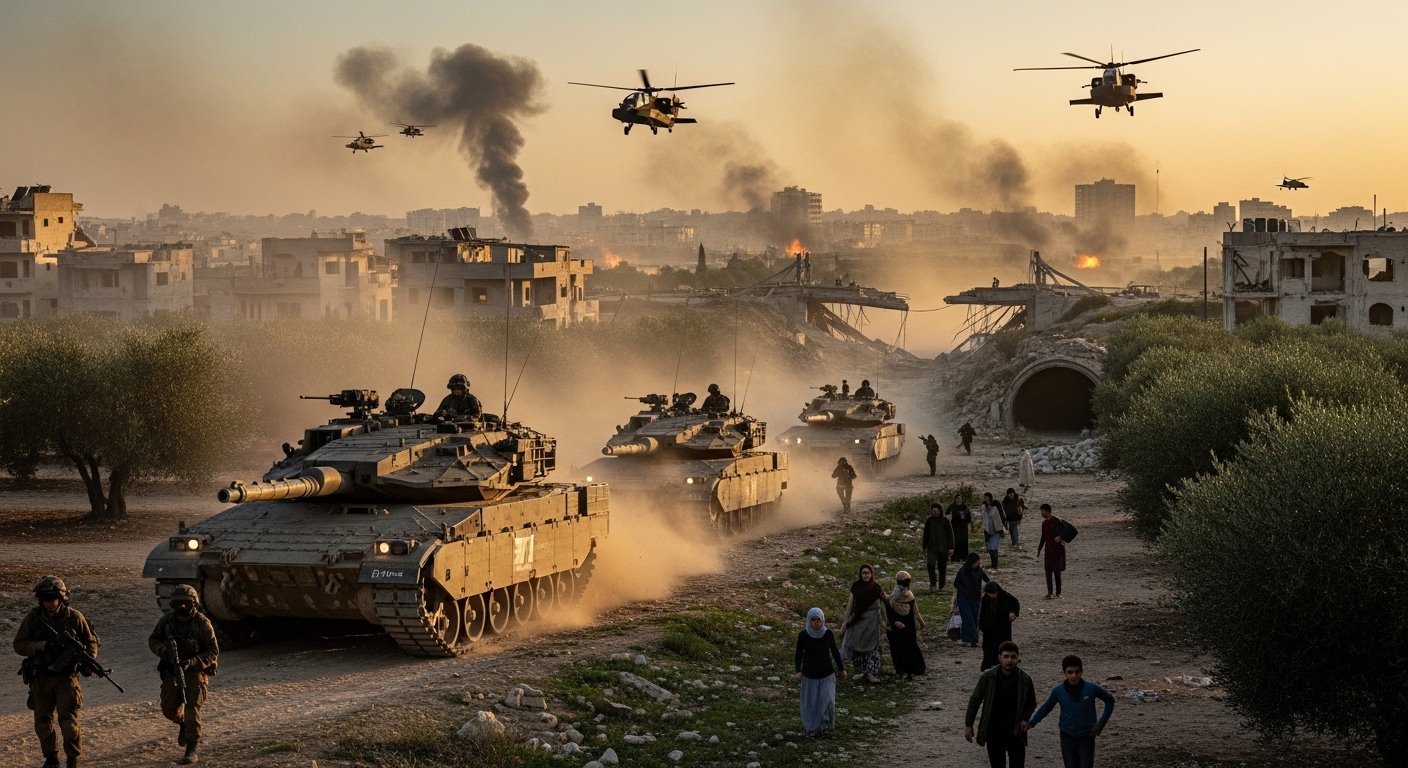
Israeli Defense Minister Israel Katz’s authorisation of ground troop deployment into southern Lebanon on Tuesday morning transformed a conflict that had already been described as the most dangerous regional escalation in decades into something categorically more severe. The Israeli Defense Forces are now crossing the border with orders that their commanders have described as hold and advance — not a reconnaissance probe, not a limited incursion, but the beginning of a ground campaign against Hezbollah positions that have been building in the hills south of the Litani River for years.
This is the development that every analysis of the broader conflict had identified as the step that could not be walked back. Airstrikes can be suspended. Artillery exchanges can be paused through mediation. Ground troops crossing an international border to advance and hold territory create facts on the ground that diplomacy must work around rather than through.
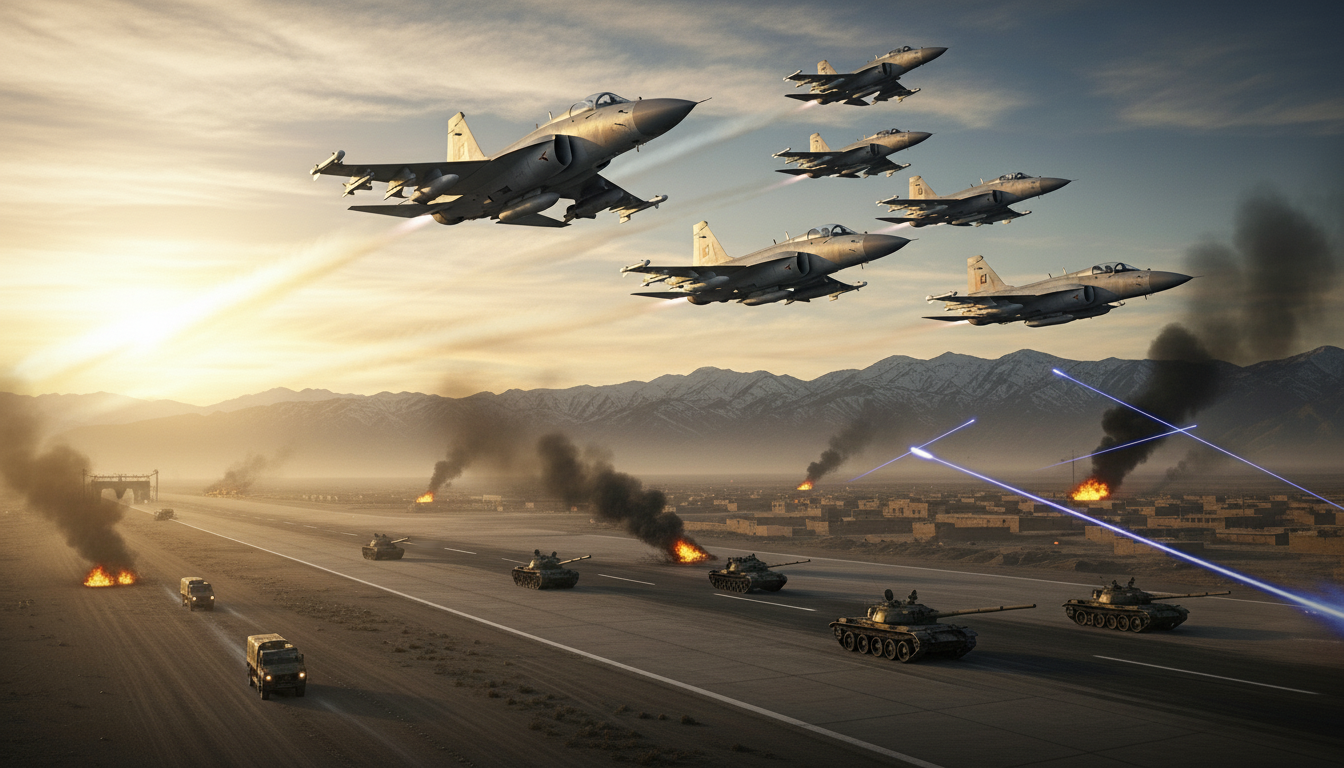
The battle map on Tuesday morning covers more geography than any Middle Eastern conflict since 1973. Iran is absorbing precision strikes on IRGC command bunkers, with leadership casualties mounting and missile stocks depleting. The Gulf states are in active combat participation for the first time in the conflict’s history, with Qatar having shot down Iranian Su-24s, Saudi Arabia scrambling F-15s, and UAE activating THAAD batteries. The Strait of Hormuz is producing zero barrels per day of transiting oil. And now Lebanon’s south is a ground war.
The question is no longer whether this is a regional war. The question is how it ends.
1. The Lebanon Ground Invasion: Objectives, Risks, and What the IDF Is Walking Into
Israel’s decision to commit ground forces to southern Lebanon carries military logic that is straightforward to articulate and genuinely difficult to execute. Air power has demonstrated its ability to kill Hezbollah commanders, disrupt supply routes, and degrade infrastructure. It has not demonstrated the ability to destroy the tunnel networks, hardened launch sites, and dug-in defensive positions that constitute Hezbollah’s core military capability in its southern Lebanon stronghold. Only ground forces can clear those positions with the thoroughness that eliminating the rocket threat requires.
The Litani River was established as Israel’s informal red line following the 2006 Lebanon War — the boundary north of which Hezbollah’s heavy rocket assets were not supposed to be positioned under the terms of UN Security Council Resolution 1701. That resolution’s implementation has been broadly characterised as a failure, with Hezbollah having spent the years since 2006 building precisely the kind of fortified infrastructure south of the Litani that the resolution was intended to prevent. IDF intelligence assessments of what ground forces will encounter describe tunnel networks comparable in design to those found in Gaza, rocket stockpiles estimated at 100,000 or more munitions, and villages that have been deliberately integrated into Hezbollah’s defensive architecture in ways that create the urban combat complexity that has proven most costly in previous Israeli ground operations.
The towns of Tyre and Nabatieh, which lie in the path of the IDF’s advance toward the Litani, have both historical significance and military importance as logistical and command nodes for Hezbollah’s southern operations. Fighting in and around populated urban centres — where Hezbollah’s doctrine explicitly uses civilian infrastructure for military purposes — will produce the kind of imagery and casualty reports that shape international opinion and create political pressure on Israel’s coalition supporters regardless of the military justifications for the operations.
Hezbollah’s situation entering the ground phase of the conflict is significantly more constrained than in 2006. The Iran lifeline — the resupply routes through Syria that have sustained Hezbollah’s weapons stockpiling for two decades — has been systematically bombed. Iranian financial and material support for the organisation is operating at degraded levels as Iran’s own military expenditure absorbs resources that previously flowed to its proxies. The sequential elimination of Hezbollah commanders through Israeli intelligence operations throughout the conflict period has disrupted the command structure that would coordinate a sophisticated defensive response. The organisation still has significant capability. It does not have the capability it had at the conflict’s opening.
2. Lebanon’s Government Bans Hezbollah: The Unprecedented Internal Crisis
The decision by Lebanon’s government to formally ban Hezbollah military operations and dispatch police to hunt Hezbollah cells launching rockets from Beirut suburbs represents a rupture in Lebanese political life so profound that its full implications are still being absorbed. Hezbollah has functioned as Lebanon’s de facto military force in its area of operations for decades, operating with a degree of institutional legitimacy within Lebanon’s power-sharing political system that made formal government opposition to its military activities essentially impossible.
The government’s calculation behind the ban is not difficult to identify. The Lebanese state, which has spent years navigating the tension between Hezbollah’s political participation in Lebanese institutions and its military operations that routinely draw Israeli strikes onto Lebanese territory, has concluded that the current conflict represents an existential threat to Lebanese infrastructure, civilian safety, and state survival that supersedes the political accommodation that had previously made coexistence possible.
The practical enforceability of the ban is a different question entirely. The Lebanese Armed Forces do not have the military capability to confront Hezbollah directly — a confrontation that would produce civil war rather than disarmament. The police operations targeting launch sites in Beirut suburbs represent a genuine attempt to establish state authority in areas that have been effectively Hezbollah-controlled, but their success depends on Hezbollah’s willingness to accept constraints that the organisation has historically resisted when they conflicted with its military objectives.
What the ban does accomplish, even in the absence of full enforcement capability, is a political and legal repositioning of the Lebanese state relative to the IDF’s ground campaign. Israel has consistently argued that Lebanon’s government bears responsibility for Hezbollah’s operations from Lebanese territory. The government’s ban does not eliminate Hezbollah’s presence or capability, but it changes the political framework within which Israel’s military operations are conducted — potentially affecting the international community’s assessment of proportionality and the post-conflict diplomatic landscape regarding Lebanese reconstruction support.
The 29,000 civilians who have fled southern Lebanon are the immediate human evidence of what the ground invasion means for the population caught between advancing IDF forces and Hezbollah’s defensive positioning. Their displacement is partial — the full population of southern Lebanon is considerably larger — and the trajectory of the ground campaign will determine whether the current displacement becomes a temporary emergency or a sustained humanitarian crisis comparable to the 2006 conflict’s civilian impact.
3. The Broader Battle Map: Iran, Gulf, and Lebanon Simultaneously
The simultaneous prosecution of military operations across three distinct theatres — Iranian territory, the Gulf, and Lebanon — creates a command and intelligence complexity that has no precedent in recent American or Israeli military history. Each theatre has its own operational logic, its own escalation dynamics, and its own civilian impact profile, but they are interconnected in ways that mean decisions in one theatre immediately affect the others.
Iran’s military situation on Tuesday reflects the sustained pressure of American and Israeli precision strike operations against IRGC command infrastructure. The bunkers that housed significant portions of Iran’s command and control architecture for its missile forces have been struck, with casualties described as including leadership figures whose loss disrupts the coordination of future operations. Supreme Leader Khamenei’s death — confirmed in earlier reporting — has left a command structure that is operating under IRGC hardliner direction without the clerical authority that previously provided at least a nominal moderating check on escalation decisions.
Iran’s missile stocks, estimated at 3,000 remaining from an initial arsenal of 8,000 after the conflict’s preceding weeks of operations, are being expended at a rate of approximately 100 per day across all operational theatres. At that rate, the remaining inventory represents approximately 30 days of sustained operations before stocks are critically depleted. The military significance of depletion is not merely the absence of missiles — it is the shift from a symmetric conflict in which both sides threaten each other’s infrastructure to an asymmetric one in which Iran’s ability to project force beyond its borders is severely constrained while American and Israeli air power continues operating from positions Iran cannot reach.
The Gulf theatre’s evolution from a conflict in which Iran was attacking Gulf infrastructure without direct military response to one in which Qatar, Saudi Arabia, and UAE are active combat participants has fundamentally changed the operational environment Iran faces. The GCC’s military capabilities — modern air forces, sophisticated missile defence systems, and US-backed command and intelligence infrastructure — add a layer of regional resistance to Iran’s operations that was not present at the conflict’s opening.
4. Hezbollah’s Military Situation: Capability, Constraints, and What Comes Next
Hezbollah entering the IDF ground invasion phase is a significantly diminished version of the organisation that fought Israel to a tactical standstill in 2006, though it retains formidable defensive capability in its home territory that the ground campaign will need to overcome at significant cost.
The 100,000 rocket stockpile that Hezbollah has claimed represents a wide range of capabilities, from short-range unguided Katyusha rockets to longer-range precision missiles. A significant portion of this arsenal has been described by Israeli intelligence as either degraded through targeted strikes on storage sites or rendered less reliable through supply chain disruption of replacement components. The effective deployable arsenal is substantially smaller than the headline figure suggests, though even a fraction of 100,000 rockets represents a sustained capability to threaten Israeli population centres.
The tunnel infrastructure that defines Hezbollah’s defensive doctrine in southern Lebanon creates challenges for IDF ground operations that air power cannot resolve. The 2006 experience of encountering Hezbollah fighters emerging from tunnel positions after extensive air preparation, fighting effectively, and then withdrawing into the tunnel network to avoid follow-on strikes, established a pattern that IDF ground forces are now tasked with permanently disrupting. Clearing tunnel networks requires a combination of engineering units, infantry in confined spaces, and the kind of patience-intensive operation that produces casualties and timeline pressure regardless of the force’s overall capability advantage.
The Syrian resupply route interdiction that Israeli air operations have sustained throughout the conflict represents Hezbollah’s most significant strategic constraint entering the ground phase. Previous Israeli campaigns against Hezbollah have been limited by the organisation’s ability to rearm through Iran-Iraq-Syria logistics routes relatively quickly after operational pauses. The sustained interdiction of those routes means that Hezbollah is fighting the IDF ground campaign on a one-way expenditure basis — using weapons it cannot replace at the pace previous operations assumed.
5. Trump’s Munitions War: The Strategic Calculus Behind the Attrition Approach
President Trump’s public acknowledgement that the Iran campaign will extend beyond its initial timelines represents a significant recalibration of the strategic communications that had surrounded the conflict’s earlier phases. The admission carries both an honest assessment of the conflict’s complexity and a deliberate signal to multiple audiences about the American commitment’s durability.
The attrition strategy that Trump is describing rests on a specific set of assumptions about the relative endurance of American and Iranian resources. Iran’s missile stocks are depleting faster than they can be replenished, given the degradation of its supply chains and the damage to its manufacturing infrastructure. Its oil export revenue — the primary funding source for both its military operations and its civilian economy — is operating at approximately 10 percent of normal capacity as Hormuz blockade and Gulf conflict conditions make export impossible. Its political leadership is operating under the stress of the supreme leader’s death, IRGC hardliner dominance of decision-making, and the absence of the clerical legitimacy that sustained popular acquiescence in previous periods of hardship.
Against this Iranian depletion trajectory, Trump is measuring American capacity: a $34 trillion economy, the world’s largest defence industrial base, and a political system whose support for the conflict is real but not unlimited. The specific constraint is Congressional budget authority — the legislative branch’s power over appropriations creates a timeline pressure on the executive’s military campaign that adversaries have historically attempted to exploit by sustaining operations long enough for domestic political opposition to erode war support.
Trump’s bet is explicitly that Iran’s resources run out before Congress’s willingness to fund the campaign does. The munitions economics — $20,000 Shahed drones requiring $2 million Patriot interceptors — work in Iran’s favour as a cost-bleeding strategy, but only if Iran can sustain drone production at a rate sufficient to maintain the pressure while its broader military and economic infrastructure continues to degrade. The Chinese dual-use component supply that keeps Iran’s drone factories running is the key variable in this calculation — one that China is managing with characteristic precision to maximise its strategic benefit while minimising its sanctions exposure.
6. Oil at Zero: What Hormuz Producing No Barrels Means for the World
The Strait of Hormuz, which under normal conditions transits approximately 21 million barrels of oil per day, is currently producing zero transiting barrels. Not reduced traffic. Not disrupted flow. Zero. The Iranian declaration of closure combined with the physical security environment that makes commercial tanker transit impossible without naval escort have produced a complete cessation of the strait’s function as the world’s most important energy transit route.
The price implications of a sustained Hormuz zero-barrels situation are not captured by the pre-conflict analytical frameworks that modelled disruption scenarios. Those frameworks assumed that Hormuz disruption would be partial, temporary, or both — that the strait would be contested rather than closed, or that the closure would last days or weeks rather than the open-ended duration that the current conflict’s trajectory implies. The transition from partial disruption to complete closure represents not a quantitative change in the market’s supply constraint but a qualitative one — moving from a tight market with price pressure to a genuine physical shortage in which available alternatives cannot compensate for the missing volumes at any realistic deployment speed.
Goldman Sachs’s AI market models had priced $120 per barrel as the base case without a strait fix. Those models did not contemplate the simultaneous destruction of Ras Tanura, the shutdown of Ras Laffan, and zero Hormuz transit. The $200 per barrel figure that analysts are now discussing as the trajectory in the absence of diplomatic resolution is not a speculative extreme but a supply-demand arithmetic outcome of the combined infrastructure destruction and transit closure.
For Pakistan, the translation of $200 oil into Rs400 per litre petrol is arithmetic rather than projection, and its consequences cascade through every sector of the economy simultaneously. Agriculture’s fuel costs for irrigation, transport, and processing increase. Manufacturing input costs rise. Power generation for a grid already operating under load-shedding conditions faces fuel cost increases that expand outage hours. The inflationary impact of energy price increases at this magnitude reaches every household regardless of income level.
7. Pakistan’s Multi-Dimensional Crisis: The Worst Combination of Pressures
Pakistan’s exposure to the current conflict represents one of the most concentrated combinations of external shocks that any economy its size and with its structural vulnerabilities has faced in the modern era. Each individual shock would be challenging. Their simultaneous arrival is genuinely overwhelming.
The Gulf evacuation dimension is the most immediately human. Ten million Pakistani workers employed across Kuwait, Qatar, Saudi Arabia, UAE, and other Gulf states face a situation in which their safety is uncertain, their employment is disrupted, and their ability to continue remitting is compromised. The $30 billion in annual remittances that these workers send home represents Pakistan’s most important source of foreign exchange, sustaining the import financing, debt servicing, and household income support that the domestic economy depends on. Large-scale returnee flows — potentially involving millions of workers if the Gulf security situation deteriorates further — would produce an unemployment shock and foreign exchange depletion that arrive simultaneously.
The Qatar LNG supply disruption has a specific and severe Pakistan dimension. Qatar supplies approximately 15 percent of Pakistan’s gas requirements, and the Ras Laffan shutdown has removed that supply from the market at a moment when alternative sources are either unavailable at short notice or priced at levels that Pakistan’s foreign exchange position cannot sustain. Power cuts that were already an economic and social challenge will worsen as gas-fired generation capacity faces fuel supply constraints. Industrial production dependent on gas — fertiliser, textiles, chemicals — faces input cost increases and potential supply interruptions that affect export competitiveness and domestic employment.
The Iran border dimension adds a security complexity to an already overwhelming economic situation. Baloch insurgent groups that have historically exploited regional instability to expand their operational space are active in the border zone at precisely the moment when Pakistan’s security forces are also managing the potential for conflict spillover, refugee flows from Iranian border communities, and the possible use of Pakistani territory as a transit route by various actors connected to the broader regional conflict.
8. The Human Cost: Numbers That Cannot Be Abstracted
Behind the strategic analysis and the market data are the human experiences of people whose daily lives have been transformed beyond recognition by a conflict whose origins lie in decisions made by governments and militaries whose populations are now bearing the consequences.
In Lebanon, 29,000 civilians have fled their homes in the south, joining the displacement flows that have characterised every previous conflict in the region. The pattern of displacement in southern Lebanon — families loading cars with whatever can be carried, driving north on roads that are themselves potentially subject to interdiction, arriving in Beirut or other northern cities without resources, accommodation, or certainty about when or whether return will be possible — is one that Lebanese families have navigated before, in 1982 and 2006. The psychological weight of repeated displacement accumulates in ways that single-event analysis cannot capture.
In Iran, the school strike that killed children in the course of IRGC facility targeting represents the kind of civilian casualty that, regardless of the military’s targeting intentions, defines how the conflict is experienced by the population bearing its consequences. The 168 girls killed at Shajareh Tayyebeh school in Minab remain the conflict’s most devastating single incident of child casualties, but they exist within a broader pattern of civilian harm that is accumulating across multiple theatres and multiple populations simultaneously.
In Kuwait, six American service members killed in the base attack represent families whose loss is the personal dimension of a conflict that political analysis tends to process as strategic calculation. Their deaths have direct consequences for the Trump administration’s domestic political management of the war, for the families and communities they came from, and for the American military’s institutional relationship with the mission it is prosecuting.
9. The Three Scenarios: How This Ends
The conflict’s trajectory toward one of three possible resolution scenarios is becoming clearer as the military, economic, and political variables that will determine the outcome continue to develop.
The Iranian regime collapse scenario — which Trump’s munitions war strategy is specifically designed to produce — requires that the combination of missile stock depletion, economic strangulation at 10 percent oil export capacity, leadership loss following the supreme leader’s death, and the visible military defeat of Iran’s proxy forces produces internal political fracturing sufficient to generate a transition. The historical precedents for this kind of externally induced regime change through sustained military and economic pressure are mixed — the Soviet Union’s collapse had internal drivers that external pressure accelerated, while the Cuba model demonstrates that isolated regimes can survive decades of economic pressure without collapsing. Iran’s specific situation — deep state institutions, IRGC structural power, and a nationalist narrative that external pressure can reinforce rather than undermine — makes the timeline and probability of this scenario genuinely uncertain.
The nuclear breakout scenario — Iran concluding that conventional military defeat is unavoidable and that the deterrent value of a demonstrated nuclear weapon outweighs the consequences of crossing that threshold — becomes more probable as conventional military options narrow. The IAEA’s 90 percent uranium-235 enrichment report places Iran within weeks of weapons-grade material. Whether the regime concludes that the American and Israeli response to nuclear weaponisation would be less damaging than the current trajectory of conventional defeat is the calculation that intelligence services across the world are currently attempting to model.
The American political fatigue scenario — Congressional resistance to munitions expenditure at current rates combined with domestic political pressure from $200 oil producing economic pain that the American public attributes to the administration’s military policy — creates the conditions for a negotiated outcome that falls short of stated American objectives. The timeline pressure is real: American political cycles, budget authority processes, and public opinion dynamics all create windows within which sustained military commitments must show results or face withdrawal of political support.
10. What the Next Week Determines
The conflict’s trajectory over the coming week will establish which of the three scenarios is most likely to materialise, and the specific developments that analysts are watching most closely are identifiable and trackable.
The IDF ground advance’s pace and the resistance it encounters will determine whether the Lebanon ground campaign achieves its objectives within a politically manageable timeframe or settles into the kind of attritional urban fighting that 2006 demonstrated can drag on far longer than initial timelines suggest. A rapid advance to the Litani with limited Israeli casualties would establish military momentum and political justification for the operation’s continuation. Heavy casualties in Tyre and Nabatieh urban fighting would immediately generate the domestic and international pressure that the 2006 campaign eventually produced.
Iran’s missile expenditure rate and drone production capability will determine whether the munitions attrition calculation is running as Trump’s strategy assumes. If Chinese dual-use component supply is successfully sustaining drone production at rates that offset the missile stock depletion, the attrition timeline extends in Iran’s favour. If the supply chain interdiction of Iran’s drone component imports is more effective than current analysis suggests, the depletion curve steepens toward the collapse scenario’s timeline.
The Gulf oil price’s trajectory will determine whether American domestic political support for the conflict can be sustained at its current level or whether the economic pain of $200 oil begins producing the Congressional pressure that the attrition strategy requires avoiding. Trump’s management of the domestic political economy of the conflict — the balance between demonstrating military progress and managing the consumer price consequences of Hormuz closure — is the political challenge that will ultimately determine whether the American commitment is sustained long enough for the strategy to succeed.
Conclusion
Tuesday’s IDF ground crossing into southern Lebanon is the development that transforms the current conflict from a regionally significant escalation into something that requires a different vocabulary to describe. Three active military theatres, nine countries directly affected, Hormuz at zero, Lebanon’s government banning its own unofficial army, Gulf states in active combat — the multi-front war has become exactly what analysts had warned was the risk of escalation without off-ramps.
Netanyahu has promised it won’t drag endlessly. Trump has acknowledged it will take longer than first suggested. The gap between those two statements contains the conflict’s fundamental tension — a democratic political system whose commitment to military operations is bounded by electoral cycles and budget processes, pursuing war aims against an adversarial system whose leaders face no equivalent accountability constraint.
The munitions war arithmetic is real. Iran cannot indefinitely sustain operations against the world’s largest economy’s defence industrial base. But the trajectory of conflicts driven by attrition logic — from the Western Front to Vietnam to Afghanistan — is that they take longer, cost more, and produce less clean outcomes than the arithmetic of relative resources suggests. The assumption that the stronger economy’s resources run out last does not guarantee that the stronger economy’s political will holds long enough to use those resources.
For Pakistan, for the workers stranded in Gulf cities, for the families in southern Lebanon who have fled for the second or third time in their lives, for the children whose schools have become targets — the conflict’s theoretical resolution scenarios are considerably less immediate than the decisions about fuel stockpiles, evacuation routes, and family safety that Tuesday morning has forced upon them.
The ground war in Lebanon has begun. The munitions war in Iran continues. The Gulf burns. The world watches, calculates, and waits.