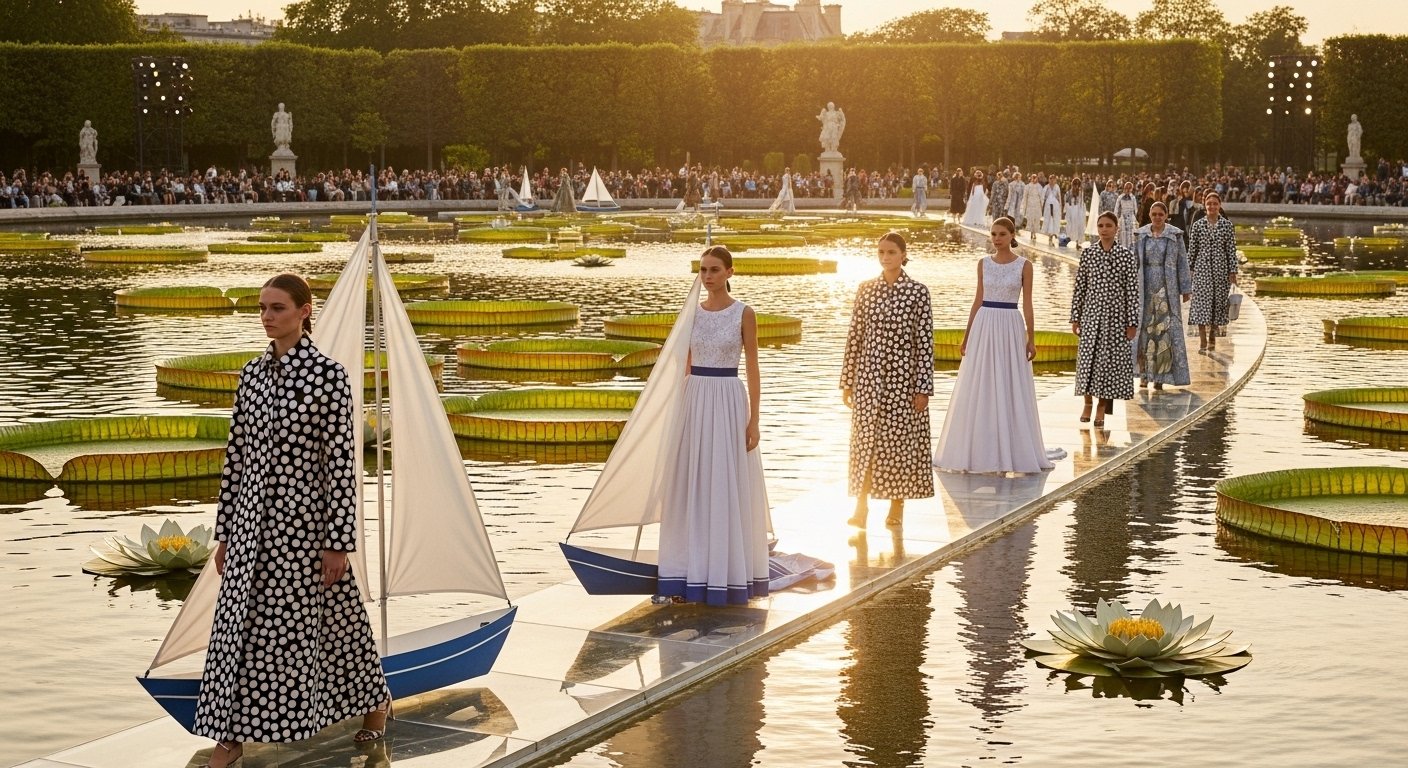
Dior’s Spring Paris Bash did not just present a new collection. It reminded the fashion industry why it fell in love with clothes in the first place. Jonathan Anderson’s second womenswear show for Dior took place on a floating catwalk above the octagonal pond in the Tuileries Garden. The water, the light, the reflections, and the city around created a feeling that went beyond the usual runway show. This was fashion living directly inside Paris, not just pretending to celebrate it.
The collection was not nostalgic. It responded to a world defined by the Gulf conflict, rising oil prices, and economic anxiety. Instead of escaping from those realities, Anderson used beauty to affirm them. The show became a statement that careful design, emotional depth, and cultural references matter even or especially – in turbulent times.
The Tuileries as a Living Stage
The Tuileries Garden has been part of Paris’s public life for over four centuries. Anderson transformed it into an active stage, not just a beautiful backdrop. The floating catwalk sat directly above the pond, with illuminated lily‑pad‑like structures pulsing beneath. The light shifted as the sun moved, so every model walked through a slightly different atmosphere.
From the front row, the spectacle looked like a painting in motion. The water reflected the city, the sky, and the clothes, creating a layered image that no single photo could capture. Fashion usually treats the city as decoration. Anderson treated it as a partner in the creative process.
From Seurat to Sewing Machines
The intellectual heart of the collection was Georges Seurat’s pointillism – the idea that thousands of separate dots form a complete image when seen from a distance. Anderson translated this into fabric with a coat that looked sage green from afar, but revealed a dense pattern of emerald, lemon, and azure beads when seen up close.
Other pieces used shadow‑print fabric that changed colour as models moved, echoing Monet’s experiments with shifting light. The palette itself carried specific names: Giverny Pinks, Electric Lavenders, Morning Mist Greys. These labels rooted the colours in Monet’s garden and the light of the Seine, turning the collection into a cultural argument, not just a seasonal colour story.
Silhouettes of Freedom
Anderson’s first Dior collection leaned into the house’s New Look heritage with structured corsets and stiff petticoats. The spring show moved away from that. The new shapes felt lighter, freer, and more fluid. The star was the Sailboat Hem – a triangular volume at the bottom of the garment that recalled the toy sailboats Parisian children race on the pond.
The volume was created without traditional petticoats, so the dresses moved more naturally with the body. This subtle shift showed Anderson’s direction for Dior: luxury that feels modern, not like a museum piece. The Garden Gloves – long silk gloves printed with floral patterns inspired by the gloves worn by park workers – also bridged the city’s everyday life and the runway.
Accessories That Tell a Story
Fashion collections are art, but they survive on commerce. Anderson’s accessories carried the commercial message of the show. The Eiffel Tower Heel – a stiletto based on the tower’s iron‑work lattice – felt both distinctly Parisian and wearable. It joined the ranks of accessories like the Balenciaga Triple S or the Bottega Veneta Pouch, capable of becoming cultural icons beyond the show.
The Lily Pad Clutch, made from recycled glass beads in the same green as the illuminated lily pads, turned sustainability into an aesthetic choice. The beads were what made the bag beautiful, not an afterthought. The “fancy picnic hampers” further connected the show to the image of Parisian leisure – something aspirational yet familiar to anyone who has picnicked in the Tuileries.
Beauty in a Time of Conflict
The collection arrived in a difficult global moment. The Gulf conflict, high oil prices, and political instability made declarations of beauty feel either frivolous or critically necessary. Anderson chose the second option. The final sequence, with 50 models in white and cream against the shimmering water, was read as cultural affirmation, not escapism.
He has spoken about the idea of “emotional heirlooms” – objects that gain meaning across time because of the moment in which they are created. The Eiffel Tower Heel and the Lily Pad Clutch were designed to feel like these kinds of objects. In a luxury market that faced pressure in 2025 and 2026, such pieces offered a long‑term value proposition beyond seasonal trends.
Anderson as Paris’s Storyteller
Anderson’s second Dior collection also clarified his role as Paris’s storyteller. He focused on the city’s everyday details – toy sailboats, green metal chairs, park workers’ gloves – not just its grand monuments. These references became structural elements of the collection, not just decorative touches.
This approach turned the working‑class reality of the city into a creative resource, without treating it as a joke or an aesthetic prop. The 3D‑printed floral buttons, inspired by the park’s flowers, functioned as real garment closures while still feeling symbolic. This attention to detail distinguished Anderson’s Dior from designers who borrow “street style” for superficial cool.
What This Means for Dior’s Future
Two collections into his tenure, Anderson’s direction for Dior is clear. The house will be deeply rooted in Paris, Impressionist light, and emotional resonance, not just logo‑driven trends. The “emotional heirloom” strategy bets that objects with depth and specificity will outlast fast‑fashion cycles and retain value over time.
Market response to the Tuileries show suggested buyers liked this approach. The Eiffel Tower Heel, the Lily Pad Clutch, and the Giverny Pinks may become some of the most memorable products of his early years. They represent a vision of luxury that feels both timely and timeless.
A Show That Changes the Conversation
Jonathan Anderson’s second Dior collection will be remembered not just as a beautiful show, but as a moment that changed the conversation about what a luxury house can be. It was a spectacle, a cultural statement, and a commercial proposition all at once. The floating catwalk, the pointillist‑style coats, the Sailboat Hems, and the Eiffel Tower heels all worked together to tell a story about why beauty still matters.
The front‑row critics said Anderson had captured Paris as a dreamy memory, not as its stressed‑out self. In 2026, that kind of insistence on beauty felt like a small act of resilience. It said that the things worth preserving – including the way fashion can reflect a city and its people – are still worth the effort, still worth the design, and still worth the price tag.