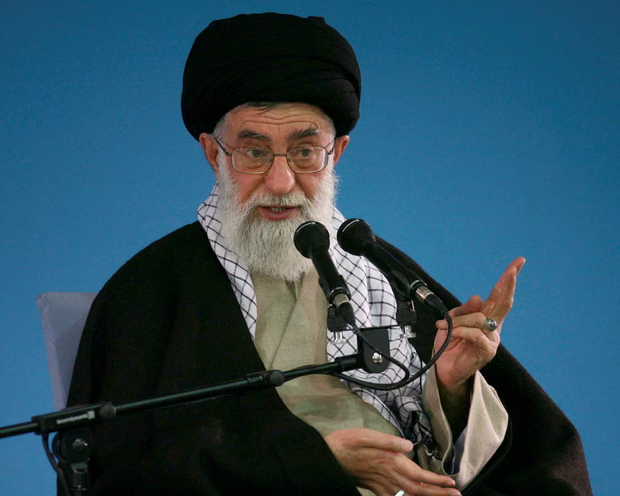
Ali Khamenei Iran is not just a political figure; he is the central character in the story of modern Iran – the man who turned the 1979 revolution into a durable system, built a regional empire of proxy forces, and kept the Islamic Republic standing through decades of sanctions, wars, protests, and global pressure.
The man who ruled the country for 35 years finally died in 2026, when US and Israeli jets bombed his Tehran compound, turning the moment of his death into a symbol of the war he had spent decades trying to avoid.
Behind the headlines of missiles, drones, and oil price spikes lies the story of one cleric who knew how to hold power – and how to lose it in the end. This article explores who Ali Khamenei was, what he built, and how his death changes the world he shaped.
Ali Khamenei: From Cleric to Supreme Leader
Ali Hosseini Khamenei was born in Mashhad, Iran, in 1939, into a deeply religious Shia family. At a young age, he was sent to the holy city of Qom, the center of Shia religious learning, where he studied under Ayatollah Ruhollah Khomeini, the future leader of the 1979 revolution.
Khamenei’s early life was marked by politics and repression; he joined the anti‑Shah movement, was arrested by the SAVAK secret police multiple times, and even survived a 1981 assassination attempt that left his right arm permanently paralyzed. This injury became a powerful symbol of his “revolutionary sacrifice.”
When Khomeini died in 1989, Khamenei was chosen as the new Supreme Leader, despite not being a top‑ranked Ayatollah. The Assembly of Experts adjusted the religious rules to make him eligible. At first, many saw him as a stopgap figure, but Khamenei surprised everyone by turning his leadership into a 35‑year reign, outlasting four US presidents, multiple crises, and waves of protests. He was not just a religious leader – he became the real power center of Iran, even more than the president.
The Architecture of Khamenei’s Power
Khamenei’s rule relied on two main pillars: the Islamic Revolutionary Guard Corps (IRGC) and the clerical‑state system. The IRGC, originally created as a special military force to protect the revolution from the regular army, became Khamenei’s personal security‑and‑economic power. Under him, the IRGC expanded into construction, telecom, oil, banking, and manufacturing, controlling around 60% of Iran’s economy. This gave the IRGC a reason to stay loyal: if the system collapsed, their business empires would collapse too.
Khamenei also controlled politics from behind the scenes. The Guardian Council, a powerful body he influenced, had the power to ban opposition candidates from elections. Presidents like Khatami, Ahmadinejad, and Rouhani could govern, but they always had to stay within the lines Khamenei drew. If someone stepped too far, they were pushed aside. This system turned Iran into a theocracy‑plus‑military‑state, where the Supreme Leader was the real decision‑maker, even if the president gave the speeches.
The Axis of Resistance: Khamenei’s Regional Empire
Khamenei’s biggest achievement was the Axis of Resistance – a network of allied forces across the Middle East that let Iran project power without using its own soldiers. The most powerful part of this network was Hezbollah in Lebanon. Iran helped create Hezbollah after Israel’s 1982 invasion of Lebanon, and Khamenei turned it into one of the world’s strongest non‑state armies, with thousands of rockets, underground tunnels, a political party, and social services that often worked better than the Lebanese government.
Other key players in the Axis of Resistance included:
- Hamas and Palestinian Islamic Jihad in Gaza, responsible for the October 7, 2023 attack on Israel that killed 1,200 people.
- The Houthis in Yemen, who could strike Saudi oil fields, Emirati targets, and international ships in the Red Sea with drones and missiles.
- Shia militias in Iraq, like the Popular Mobilisation Forces, which gave Iran heavy influence in Iraqi politics.
Through this axis, Khamenei made Iran a regional superpower. Israel, Saudi Arabia, and the US were constantly dealing with his proxies, not just Iran itself. This structure was the real reason the US and Israel eventually decided to target Khamenei directly – because beating Iran meant breaking this network at its core.
The Nuclear Game: 35 Years of “Almost” Weapons
Khamenei was also the master of Iran’s nuclear program, a long chess game with the West. He never openly built a nuclear bomb, but he kept Iran on the edge of that capability, always advancing enough to squeeze sanctions relief and diplomatic concessions. Under his rule, Iran enriched uranium, built centrifuges, and expanded its nuclear infrastructure, even signing deals like the 2015 Iran nuclear deal (JCPOA) that temporarily slowed progress.
When Donald Trump withdrew from the JCPOA in 2018, Iran resumed enrichment, reaching 90% enriched uranium – the level close to weapons‑grade material. By 2026, Iran was weeks away from having enough nuclear material for a bomb, and Khamenei was preparing to push Iran across that line if the war pressured him enough. His public fatwa against nuclear weapons was a political tool, not a binding religious law – it allowed him to claim Iran had no nuclear ambitions while still advancing toward the bomb.
The Presidents Who Served Khamenei
Five presidents ruled under Khamenei, each one dancing a different step with the Supreme Leader:
- Mohammad Khatami (1997–2005) tried to open Iran to democracy and the West, but Khamenei blocked his reforms, arrested his allies, and kept the IRGC in control.
- Mahmoud Ahmadinejad (2005–2013) was Khamenei’s hardline voice – provocative, anti‑West, and anti‑Israel. He helped Iran look like a resistant state, even as Khamenei tightened the real power.
- Hassan Rouhani (2013–2021) negotiated the JCPOA, giving Iran economic relief, but only within the limits Khamenei set.
- Ebrahim Raisi (2021–2026) and Masoud Pezeshkian (2025–2026) continued the line of strong, IRGC‑linked leaders who backed Khamenei against protests and war.
Every president, in the end, was a tool – Khamenei’s instrument to manage Iran’s economy, image, and international relations. His real power was in the background, always deciding the direction of the country.
The Domestic Repression: Khamenei’s Dark Side
Khamenei’s rule was not just about power and strategy – it was also about brutal control of his own people. He crushed opposition through security forces, internet blackouts, mass arrests, and executions. The 1999 student protests, 2009 Green Movement, and especially the 2022 “Woman Life Freedom” protests after Mahsa Amini’s death in a police station** all showed how far he would go to stay in power.
In 2022–2023, when women in Iran tore off their headscarves in the streets, and teenagers joined them in open defiance of the regime, Khamenei authorized a massive crackdown – live ammunition, torture, disappearances, and public trials. The death toll was estimated in the thousands or even tens of thousands, depending on sources. Many of these victims were young, educated Iranians who wanted a different future, but Khamenei saw them as a threat to the Islamic Republic itself.
This repression made him a symbol of tyranny for Iran’s youth, even as he was still respected by some conservative Shia who saw him as the defender of the revolution. The contradiction between those views is part of why his death created such a political earthquake.
The Long‑Term Impact on Iran and the Middle East
Khamenei’s death changed the balance of power in the Middle East overnight. The Axis of Resistance is under pressure – Hezbollah is fighting Israeli ground troops in Lebanon, Hamas is weakened in Gaza, and Iranian proxies in Iraq and Yemen are losing support.
The nuclear program is damaged by US‑Israeli strikes on sites, but the knowledge and infrastructure may still survive. The IRGC is now the main force making decisions, as the clerical establishment struggles to replace Khamenei.
Inside Iran, people are watching. If Khamenei’s death leads to a real political change, his legacy might be of a man who held the system together for 35 years – and then let it fall apart. If the IRGC finds a new leader and keeps control, people may see him as the founder of a durable dictatorship instead of a temporary strongman.
Conclusion: The Man Who Changed Iran
Ali Khamenei Iran was a cleric who turned ideas into power, protests into crackdowns, and a revolution into a 35‑year reign. He built the Axis of Resistance, kept the nuclear program alive, and crushed millions of Iranians’ hopes when they tried to push for change. His death under American bombs turned his life into a story of irony, tragedy, and power – a man who survived decades of crisis only to fall to the enemy he spent a lifetime resisting.
The world now watches what happens next. Will Iran rise against the IRGC and the system Khamenei built? Or will the revolution that started in 1979 survive in a new, even more dangerous form? The answer will decide how history remembers Ali Khamenei, and how the Middle East looks for the next 35 years.