LIVE
Wednesday, Mar 18, 2026
24/7 News

CM Green Tractor Scheme Phase 3: Punjab’s Agricultural Revolution Shifts Into High Gear

There is a specific kind of political statement that is made not through speeches or press conferences but through the accumulated weight of delivered outcomes — a statement whose credibility comes precisely from the fact that it can be counted, audited, and verified by the people it most directly affects. Punjab Chief Minister Maryam Nawaz Sharif’s launch of Phase 3 of the CM Green Tractor Scheme in Lahore this week is that kind of statement.

The numbers are not subtle. In the 25 years before the current Punjab government took office, Pakistan’s most agriculturally significant province distributed approximately 20,000 tractors to its farming communities. In the two years since Maryam Nawaz assumed the Chief Ministership, 31,000 tractors have been delivered. Phase 3 adds 10,000 more. The cumulative total will stand at 41,000 by the time Phase 3 deliveries are complete — more than double what two and a half decades of previous administration produced.

For the 427,500 applicants who registered for Phase 3’s 10,000 available tractors — all of them owners of five acres or less, all of them precisely the small-scale farmers whose agricultural productivity determines the welfare of rural Punjab’s majority population — the programme represents something considerably more significant than a government subsidy. It represents the possibility of farming with modern machinery rather than equipment that breaks every season, of saving Rs50,000 annually in fuel costs, and of generating the yield improvements that mean school fees paid and family futures secured.


1. The Numbers That Make This Remarkable

Before examining the scheme’s mechanics and implications, the headline statistics deserve to be stated clearly and placed in context — because their magnitude is not immediately intuitive without the comparison that gives them meaning.

Punjab’s agricultural sector employs approximately 60 percent of the province’s workforce and contributes roughly 40 percent of provincial GDP. It is, by any measure, the economic foundation on which the province’s prosperity rests. Yet the mechanisation of that sector — the replacement of manual and animal-powered cultivation with the modern machinery that transforms agricultural productivity — has proceeded at a pace that Agriculture Minister Kirmani characterised with a statistic worth dwelling on: Punjab currently has 140 tractors per 10,000 acres of cultivable land.

The global benchmark is approximately 300 tractors per 10,000 acres. India’s Punjab province — which shares its agricultural heritage and many of its crop patterns with Pakistani Punjab — operates at above 300. America’s Midwest, representing the frontier of mechanised farming, operates above 500. Pakistan’s Punjab, at 140, is operating at less than half the mechanisation density that comparable agricultural economies consider standard, in a province whose farming sector is theoretically among the most productive in South Asia.

The tractor gap is not a minor efficiency deficit. It is a structural constraint on agricultural productivity whose consequences ripple through the provincial economy in ways that are felt in household incomes, food prices, rural employment, and the general welfare of the majority of Punjab’s population who live in or depend economically on rural communities.

The previous 25 years’ delivery of 20,000 tractors — approximately 800 per year on average — was insufficient to close or even significantly narrow that gap. The current government’s 31,000 deliveries in two years — approximately 15,500 per year — represents a rate roughly 19 times faster than the historical average. Phase 3’s additional 10,000 units will extend that record further before Phase 4 planning is complete.


2. Why Tractor Prices Have Made This Intervention Necessary

Understanding why government intervention in tractor distribution is necessary requires understanding what has happened to tractor prices in Pakistan’s market over the past five years — a price trajectory that has effectively priced the small farmer out of mechanisation entirely.

Tractor prices in Pakistan have approximately doubled in the five years preceding the current scheme. The combination of rupee depreciation against the dollar, rising steel and component prices driven by global supply chain disruption, and the general inflationary environment that Pakistan’s economy has experienced has transformed the cost of a 50 to 65 horsepower tractor from a stretch purchase for a small farmer into an effectively impossible one. A machine that cost Rs600,000 five years ago costs Rs1.2 million or more today.

For a farmer with five acres of land — the profile specifically targeted by the Green Tractor Scheme — generating the capital required to purchase a modern tractor from income alone is essentially impossible. The annual income from five acres of crops, even under reasonably productive conditions, cannot sustain both household expenses and the capital accumulation required to purchase Rs1.2 million in machinery. Bank loans are theoretically available but practically inaccessible for small farmers without the land collateral that formal lending requires, and without the financial literacy and documentation that most rural Punjab households have never needed to develop.

The result, in the absence of the government scheme, is a bifurcated agricultural economy: large landowners who can afford mechanisation operating with tractors and achieving the yield improvements that come with it, and small farmers continuing to cultivate with animal power or rented machinery on terms that eat into the already thin margins of five-acre farming. The tractor gap of 140 per 10,000 acres is not evenly distributed — it is concentrated at the small-farm end of the landholding distribution in a way that specifically disadvantages the farmers the scheme was designed to help.


3. The Scheme’s Mechanics: Transparency as a Feature, Not an Afterthought

The CM Green Tractor Scheme’s design choices reveal an awareness of the specific ways that previous agricultural subsidy programmes in Pakistan have failed to reach their intended beneficiaries — primarily through the intermediary corruption that transforms government-to-farmer transfers into government-to-middleman transactions.

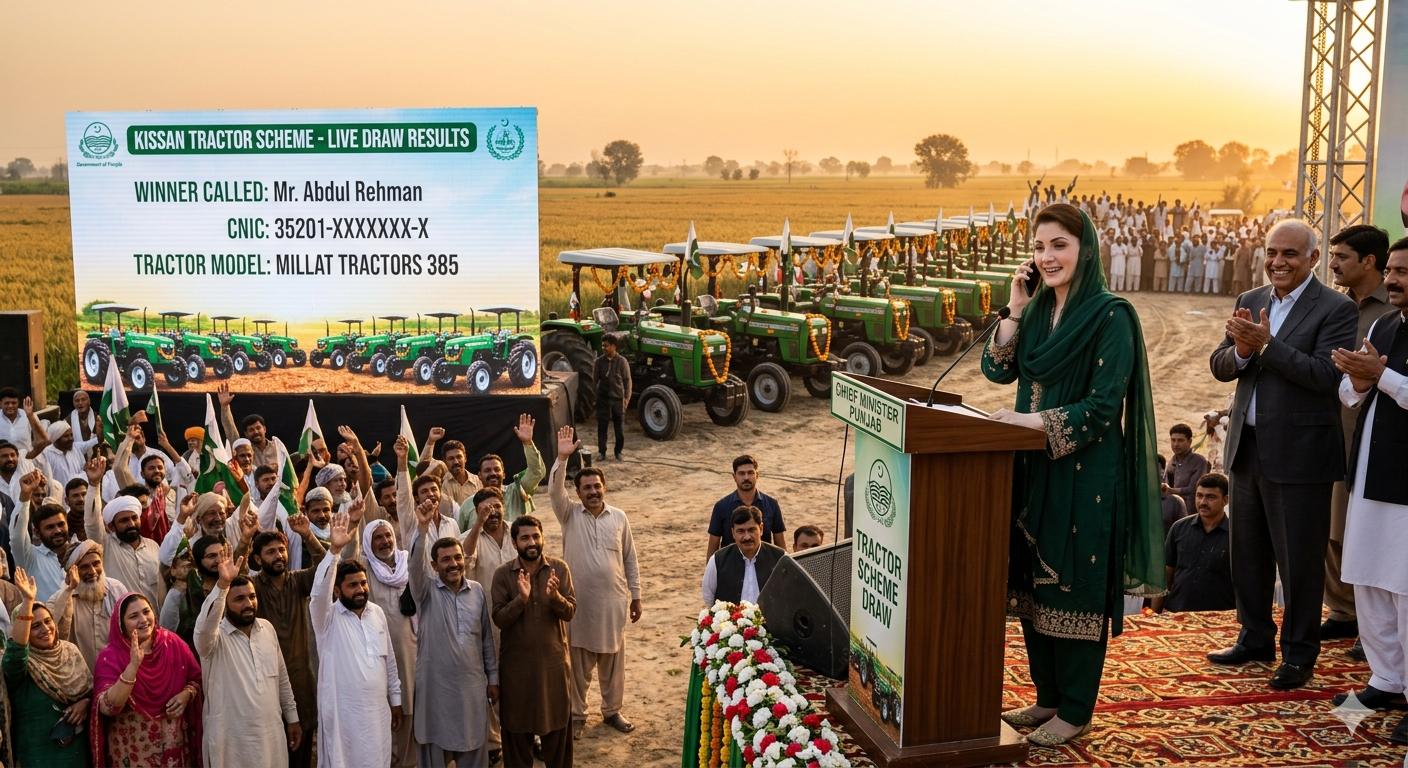
The ballot system is the scheme’s most important structural innovation. Rather than allowing discretionary allocation of tractors through bureaucratic channels where political influence, bribery, and personal connections historically determine who receives subsidised machinery, Phase 3 used a transparent computerised draw whose results have been published on the scheme’s dedicated portal at gts.punjab.gov.pk. Winners can verify their own results through a publicly accessible system, and the draw itself was conducted in a way that allowed the process to be observed and verified.

Maryam Nawaz’s personal phone calls to winners during the live draw — a detail that generated significant social media attention — served a function beyond the obvious political visibility it created. In a political culture where government benefits are typically delivered through layers of intermediaries who extract value at each stage, a Chief Minister personally calling a farmer in rural Punjab to inform them that they have won a tractor communicates something specific and important: the government is serious about these benefits reaching the people they were designed for, and the highest level of the provincial government is personally invested in that delivery.

The five-acre restriction on applicant eligibility is equally deliberate. Previous tractor distribution programmes in Pakistan have occasionally been captured by larger landowners who had the political connections to access subsidised machinery despite not being the intended beneficiaries. Limiting eligibility to owners of five acres or less creates a verifiable threshold that specifically targets the small-farmer constituency where mechanisation need is greatest and where the economic impact of a single tractor is most significant relative to the household’s overall income and productivity.


4. The Economic Chain Reaction: What a Tractor Actually Changes

The Rs50,000 annual fuel saving that Agriculture Minister Kirmani cited as a benefit of modern 50 to 65 horsepower tractors over the older equipment they replace is the most immediately quantifiable individual economic impact of the scheme, but it understates the full cascade of economic consequences that a modern tractor delivers to a small farming household.

The yield improvement is arguably more significant than the direct cost saving. A modern 50 horsepower tractor can cultivate three acres per hour under reasonable conditions. The animal power or old machinery that many of the scheme’s beneficiaries previously relied on works at a fraction of that rate, and with substantially less precision in soil preparation, depth consistency, and row spacing. Better land preparation produces better germination. Better germination produces more consistent crop emergence. More consistent crop emergence produces higher yields. The 20 percent yield improvement that the scheme’s economic analysis cites as the benefit of modern mechanisation is a conservative estimate based on documented improvements across comparable agricultural modernisation programmes in South Asia.

For a five-acre farmer producing wheat and rice in rotation — the dominant crop pattern across Punjab’s irrigated districts — a 20 percent yield improvement translates into a meaningful income increase that changes what is possible for the household beyond the farming activity itself. Children’s education, which is typically the first expenditure that falls when farm income is tight, becomes more consistently fundable. Medical expenses, which are the second category of expenditure that rural families struggle to meet from variable agricultural income, become less likely to require emergency borrowing at the exploitative interest rates that rural informal lending typically charges.

The timing of the scheme in the context of the Gulf crisis adds a specific dimension that the data did not anticipate but that the scheme’s impact will partly address. With ten million Pakistani workers facing potential return from Gulf employment disruptions, the rural economy’s capacity to absorb returning family members into productive agricultural activity becomes a genuine economic stability question. A rural Punjab where farming is increasingly mechanised, productive, and capable of sustaining household incomes without the Gulf remittance supplement is a rural Punjab better positioned to manage the Gulf crisis’s economic consequences than one where agriculture has stagnated for lack of mechanisation.


5. The Political Geometry: Rural Votes, Delivery Credibility, and the Opposition’s Problem

The CM Green Tractor Scheme’s political implications are as significant as its agricultural ones, and understanding them requires appreciating how rural Punjab’s political dynamics interact with demonstrated delivery in government programmes.

Punjab’s rural vote bank — concentrated in the small and medium farming households that constitute the majority of the province’s population — has historically been divided between PML-N’s development delivery credentials and PTI’s anti-establishment narrative. The Green Tractor Scheme’s specific targeting of five-acre farmers is not incidental to the political calculation — this is the landholding profile of rural Punjab’s economic middle, the households whose vote is genuinely competitive between parties and whose support determines provincial electoral outcomes.

Delivering 31,000 tractors in two years, through a transparent ballot system, with the Chief Minister personally calling winners, creates a specific kind of political capital that is genuinely difficult for opposition parties to counter. The opposition can argue that the scheme is an election stunt — but the tractors are real, the yield improvements are measurable, and the beneficiaries are identifiable. The most effective counter-narrative to a government that has delivered 31,000 tractors in two years is to deliver more — which is precisely the dynamic the scheme has created in other provinces, with Bilawal Bhutto reportedly planning a Sindh Green Tractor Scheme and KP officials looking at similar ballot systems.

Maryam Nawaz’s personal touch in the Phase 3 draw — the phone calls, the live announcement, the visible investment of the Chief Minister’s personal attention in an agricultural subsidy programme — represents a communication strategy that understands how political trust is built in rural Pakistan. Authority figures who are distant, bureaucratic, and inaccessible generate very different loyalty responses than authority figures who call you personally to tell you that your number came up. The emotional register of a Chief Minister’s phone call to a farmer in Sahiwal or Muzaffargarh is not reducible to its policy content.


6. The Tractor Gap: Punjab vs Benchmarks That Show How Far There Is to Go

Agriculture Minister Kirmani’s comparison of Punjab’s 140 tractors per 10,000 acres to global benchmarks — India Punjab above 300, America’s Midwest above 500 — provides the framework for understanding both the scheme’s significance and the scale of the challenge that remains even after Phase 3.

The target that Punjab’s agricultural policy has implicitly set — moving from 140 to 200 plus tractors per 10,000 acres — represents meaningful progress but still leaves the province well below the level that maximises agricultural productivity. Reaching 200 from 140 requires approximately 60 additional tractors per 10,000 acres across Punjab’s total cultivable area — a figure that translates into tens of thousands of additional machines beyond what the Green Tractor Scheme has already delivered.

The comparison to India’s Punjab is particularly instructive because it eliminates the objection that Pakistan’s agricultural scale, land fragmentation pattern, or crop profile creates conditions fundamentally different from any meaningful comparison. The two provinces share irrigation infrastructure origins, dominant crop rotation patterns, and landholding size distributions that make their agricultural mechanisation challenges genuinely comparable. India’s Punjab has achieved more than double the tractor density of Pakistan’s Punjab through a combination of market development, rural credit access, and government subsidy programmes that Pakistan’s scheme is now partially replicating.

The gap matters not just as an agricultural productivity benchmark but as a food security question. A Pakistan that produces food from mechanised farms at Indian Punjab’s efficiency levels generates significantly more agricultural output per acre than the current 140-tractor-per-10,000-acres baseline supports. In a country whose food security is chronically stressed by the combination of population growth, water constraints, and climate variability, that productivity gap is directly connected to import bill pressures, rural poverty, and the downstream consequences of insufficient domestic food production.


7. The Hidden Crisis the Scheme Addresses: Breaking the Tractor Mafia

One of the scheme’s less-publicised but most genuinely significant impacts is on the informal tractor rental and distribution markets that have historically extracted substantial value from small farmers who needed mechanised cultivation services but could not afford to own the machinery.

The tractor mafia — informal networks of machinery owners who rent out tractors and implements at rates that reflect their monopoly position in rural markets — has historically charged small farmers rates that absorbed a significant portion of the value that mechanisation creates. When the alternative to expensive tractor rental is no mechanisation at all, the rental price is limited only by the rental price being less than the cost of the status quo — an asymmetric negotiation in which the machinery owner holds all the structural advantage.

The Green Tractor Scheme changes this market dynamic by increasing the ownership density of tractors among small farmers — reducing their dependence on rental markets and creating the conditions for genuine market competition. A village where three families own tractors as a result of the scheme has fundamentally different rental market dynamics than one where a single large landowner controls the only available machinery. The market power that created the tractor mafia’s extraction is diminished when the supply of machinery is expanded through ownership rather than rental.

The 30 percent commission that middlemen historically extracted from government agricultural subsidy channels — the bureaucratic and political intermediaries who facilitated access to programmes in exchange for a share of their value — is also addressed by the ballot system’s transparency. When the allocation mechanism is a computerised draw rather than an administrative discretion, the opportunity for commission extraction at the point of allocation is eliminated. The beneficiary receives the full value of the subsidy rather than 70 percent after the intermediaries have taken their share.


8. The Gulf Crisis Connection: Rural Safety Net When Cities Struggle

The timing of the Green Tractor Scheme’s Phase 3 launch relative to the Gulf war’s economic consequences for Pakistan is coincidental in its specific sequencing but structurally significant in its implications for what the scheme will do in the economic environment it is entering.

Approximately ten million Pakistani workers are employed in Gulf states, and the Gulf war’s impact on those employment arrangements — through business disruption, flight cancellations, and the general economic uncertainty that conflict produces in the host countries — is creating pressure on the remittance flows that sustain their families. The families of Gulf workers are disproportionately concentrated in rural Punjab, particularly in the districts of Jhelum, Rawalpindi, Gujrat, and Sialkot where historically high rates of Gulf migration have created remittance-dependent rural economies.

When Gulf remittances fall — as they are falling under current conflict conditions — the rural households that depend on them have two choices: access savings accumulated during the good years, or increase domestic agricultural income to compensate for the external income reduction. The Green Tractor Scheme’s yield improvements and cost savings are specifically relevant to the second option — a farming household that produces 20 percent more from its land and saves Rs50,000 annually in operating costs is better positioned to absorb a remittance reduction than one whose agricultural productivity is constrained by inadequate mechanisation.

The returning workers themselves — the ten million who may eventually need to re-establish in Pakistan rather than remaining in Gulf employment — represent a labour supply whose absorption into productive economic activity is one of the most significant challenges the country’s economy faces. A mechanised rural Punjab that can support higher agricultural productivity provides a more viable economic environment for returning workers than an agricultural sector stagnant from lack of investment.


9. The National Ripple Effect: Why Other Provinces Are Watching

The Green Tractor Scheme’s provincial success has already begun producing the replication effect that successful policy innovations typically generate in Pakistan’s federal system — other provincial governments observing Punjab’s delivery record and political success and developing their own versions.

Bilawal Bhutto Zardari’s reportedly imminent announcement of a Sindh Green Tractor Scheme reflects both the genuine agricultural need in Sindh — whose farming sector faces similar mechanisation gaps to Punjab’s — and the political pressure created by Punjab’s scheme’s visibility. An opposition party that criticises Punjab’s programme while its own provincial government fails to deliver comparable services is in a structurally weak position with agricultural voters. The most effective counter to a government tractor scheme is a better government tractor scheme, which explains why Sindh’s leadership is developing one rather than simply criticising Punjab’s.

KP’s reported interest in a ballot system for agricultural mechanisation reflects a similar dynamic — a provincial government observing that the transparency mechanism Punjab has deployed produces both better policy outcomes and better political outcomes than discretionary allocation, and recognising that these insights are directly transferable.

The federal government’s observation of Punjab’s scheme creates pressure for a national rollout that would extend the mechanisation intervention beyond Punjab’s boundaries to the agricultural communities of Sindh, KP, and Balochistan where the tractor gap is equally significant and the political payoff of delivery is equally substantial.


10. Phase 4 and the Road Ahead: 500,000 Applicants Still Waiting

The most significant number in the Phase 3 announcement is not the 10,000 tractors being distributed. It is the 427,500 applicants who registered for Phase 3’s 10,000 available spots. The oversubscription ratio — approximately 43 applications for every available tractor — reflects both the scheme’s genuine reach into the farming communities it targets and the scale of unmet mechanisation need that Phases 1 through 3 have not yet addressed.

Phase 4 planning is already underway, and the scale of the remaining need — the 417,500 Phase 3 applicants who were not successful, plus the new applicants Phase 4 registration will generate — means that the scheme’s ambitions will need to expand significantly to approach the impact that the agricultural productivity challenge requires.

The Phase 4 considerations that the Chief Minister’s office has been discussing — a barani tract focus that extends the scheme to rain-fed agricultural areas beyond Punjab’s irrigated districts, a women farmers quota that specifically addresses the underrepresentation of female landowners in previous phases, and a solar irrigation bundle that combines mechanisation with renewable energy investment — reflect a policy evolution that is building on the operational lessons of the first three phases.

The challenge for Phase 4 is maintaining the transparency and targeting quality that made the earlier phases politically and programmatically successful at a scale that the remaining need requires. Delivering 10,000 tractors through a ballot system is operationally manageable. Delivering the scale that Phase 4’s waiting list implies — potentially 50,000 or more tractors — requires the logistical infrastructure, factory capacity, and delivery systems to keep pace with the political ambition.


Conclusion

The CM Green Tractor Scheme Phase 3 is a government programme that works — measurably, verifiably, and at a scale that its predecessors never approached. The 31,000 tractors delivered in two years are real. The yield improvements they produce are documented. The Rs50,000 annual savings they generate are calculable. And the 427,500 applicants for Phase 3’s 10,000 spots are the clearest possible evidence of genuine demand from the communities the scheme was designed to serve.

Maryam Nawaz’s personal phone calls to winners are the kind of political communication that builds the specific emotional connection between a government and its rural constituents that agricultural policy rarely achieves. A Chief Minister calling a farmer in rural Punjab to tell them their number came up communicates something that no press release or billboard campaign can replicate: the government is paying attention to you specifically, and it has delivered something specific to your life.

The tractor gap — 140 per 10,000 acres against a global benchmark of 300 — will not be closed by three phases of the Green Tractor Scheme. But the trajectory has been established, the delivery mechanism has been proven, and the political momentum for continuation is built into the 417,500 unsuccessful Phase 3 applicants who represent the most effective political pressure for Phase 4 that any government could ask for.

Punjab’s agriculture needed this. Pakistan’s food security needs it to continue. And the 10,000 farmers who got a Chief Minister’s phone call this week needed it most of all.

Leave a Reply

Your email address will not be published. Required fields are marked *

News That Commands Truth — Without Filter

Independent journalism covering Pakistan and the world. Unfiltered reporting on politics, business, sports, and culture — delivered with clarity and purpose since 2024.

BREAKING LIVE EXCLUSIVE
f X in YT W
Contact Info
Email
info@sultannews.online
Editorial
editor@sultannews.online
Location
Karachi, Pakistan
Newsletter
© 2026 Sultan.News — All Rights Reserved. Karachi, Pakistan.