The Persian Gulf on Fire 2026 crisis is not a distant geopolitical background story. It is an active, fast‑escalating conflict where six oil tankers burn, crude oil crosses $100 per barrel, and U.S. Marines surge into the region as Iran’s drone swarms target commercial shipping. The tensions are as raw as the 1980s tanker wars, and the consequences are already visible from Tehran to Tokyo – and especially in Pakistan.
This is not a slow‑burning crisis. It has erupted in real time, and understanding what is happening, why it matters, and what comes next is essential for every investor, business owner, and ordinary citizen watching oil prices, stock markets, fuel queues, and Gulf‑linked trade with growing alarm. The stakes are unusually high, and the speed of escalation leaves little time for preparation.
The Marine Surge: America’s Largest Gulf Deployment in a Decade
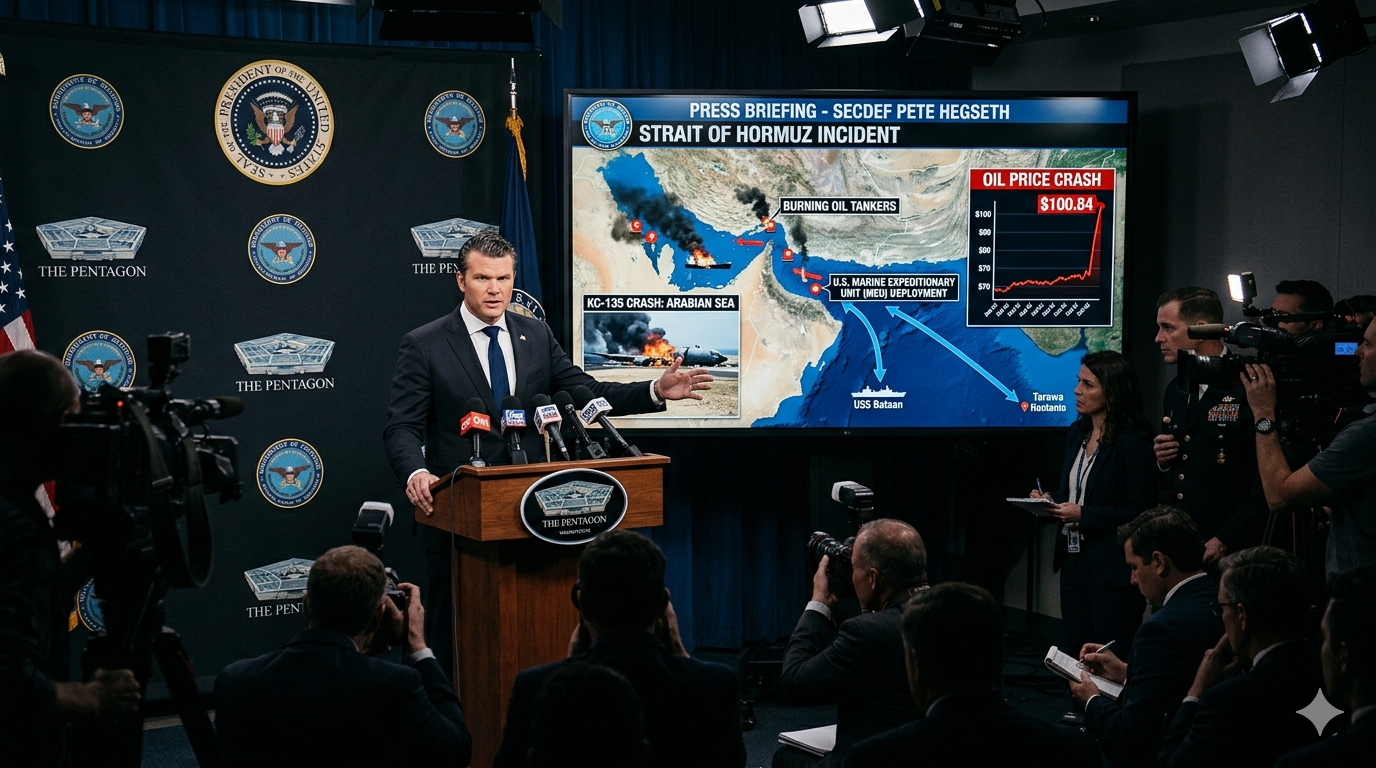
Defense Secretary Pete Hegseth has approved CENTCOM’s urgent deployment request, sending Marine Expeditionary Unit 2 – 5,000 Marines – into the Persian Gulf aboard an amphibious ready group led by the USS Bataan, two destroyers, and a submarine tender. The fleet departed Diego Garcia and is expected to reach Gulf waters within 96 hours, marking the largest U.S. naval build‑up in the region since the early Iraq War.
CENTCOM describes the mission as defensive – mine‑clearance, tanker escort, interdiction of IRGC drone boats, and protection of commercial shipping lanes. The language is careful, but the scale, speed, and combat readiness of the deployment suggest this is a clear signal that the United States will not allow the Strait of Hormuz to be effectively blockaded. The Gulf now hosts approximately 15,000 U.S. Marines, supported by three carrier strike groups, 28 destroyers, 12 Virginia‑class submarines, and 120 F‑35C fighters.
Mine‑warfare operations are already underway. Avenger‑class minesweepers operating from Bahrain, supported by dolphin drones, have neutralised 22 Iranian mines placed in commercial shipping lanes. The fact that these mines appeared so quickly after the tanker attacks suggests they were pre‑positioned, not improvised, as part of a broader blockade plan. The speed and precision of the clearance operation underlines the Pentagon’s readiness to conduct aggressive, high‑risk clearance operations along the Strait if Iran escalates further.
Operation Epic Fury: The Human Cost After 15 Days
The conflict, officially dubbed Operation Epic Fury, has already claimed 13 American lives in 15 days. Eight U.S. Navy personnel were killed in the tanker attacks and associated naval engagements, and five Air Force crew members died when the KC‑135 Stratotanker Ridge 41 went down over Iraq’s Anbar province. The tanker, carrying fuel for forward‑deployed forces, crashed at dawn with all six crew aboard – three pilots, two navigators, and one boom operator.
Preliminary investigations point to an Iranian MANPADS, a shoulder‑fired surface‑to‑air missile, as the suspected cause, though the investigation remains ongoing. The lead pilot, Major Sarah Kline (34), has been posthumously awarded the Air Force Cross, a rare recognition underscoring the gravity of the loss. Beyond fatalities, 47 American service members have been wounded, three U.S. destroyers have sustained missile damage, and two F‑35C stealth fighters have been lost to drone‑collision tactics — a way for Iran to neutralise America’s most advanced tactical aircraft without engaging in a full‑scale air battle.
Iran’s IRGC Navy Chief has responded to the Marine deployment by declaring U.S. Marines legitimate targets and threatening strikes on Abqaiq – Saudi Arabia’s critical oil‑processing facility handling about 7 percent of the world’s daily crude supply. The threat is not just symbolic; Abqaiq is a strategic node, and its loss would cause a global energy shock. The combination of drone swarms, sea mines, and long‑range missile systems shows that Iran is shifting from traditional naval tactics to asymmetric, networked warfare.
Iran’s Leadership Crisis: The Wounded Supreme Leader
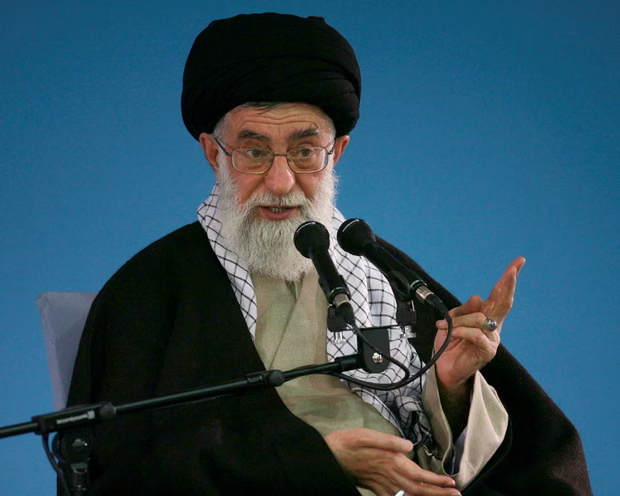
While the military escalation dominates headlines, the most dangerous development may be inside Iran’s leadership structure. Pentagon officials have revealed that Mojtaba Khamenei, the new Supreme Leader who replaced Ali Khamenei after U.S. strikes, is likely a burn victim from the February 28 B‑2 bombing of a bunker near Qom. He is undergoing skin grafts and heavy morphine‑based pain management, which visibly affects his public appearances and decision‑making capacity.
Audio clips from Iranian state television show his speeches as slurred and halting, a stark contrast to the authoritative tone expected from the country’s highest‑ranking cleric. Intelligence sources suggest hardline IRGC factions are effectively bypassing the weakened leadership and running operational decisions independently. This creates a situation where the civilian‑clerical moderating layer is absent, and military‑driven escalation becomes the default rather than a carefully weighed option.
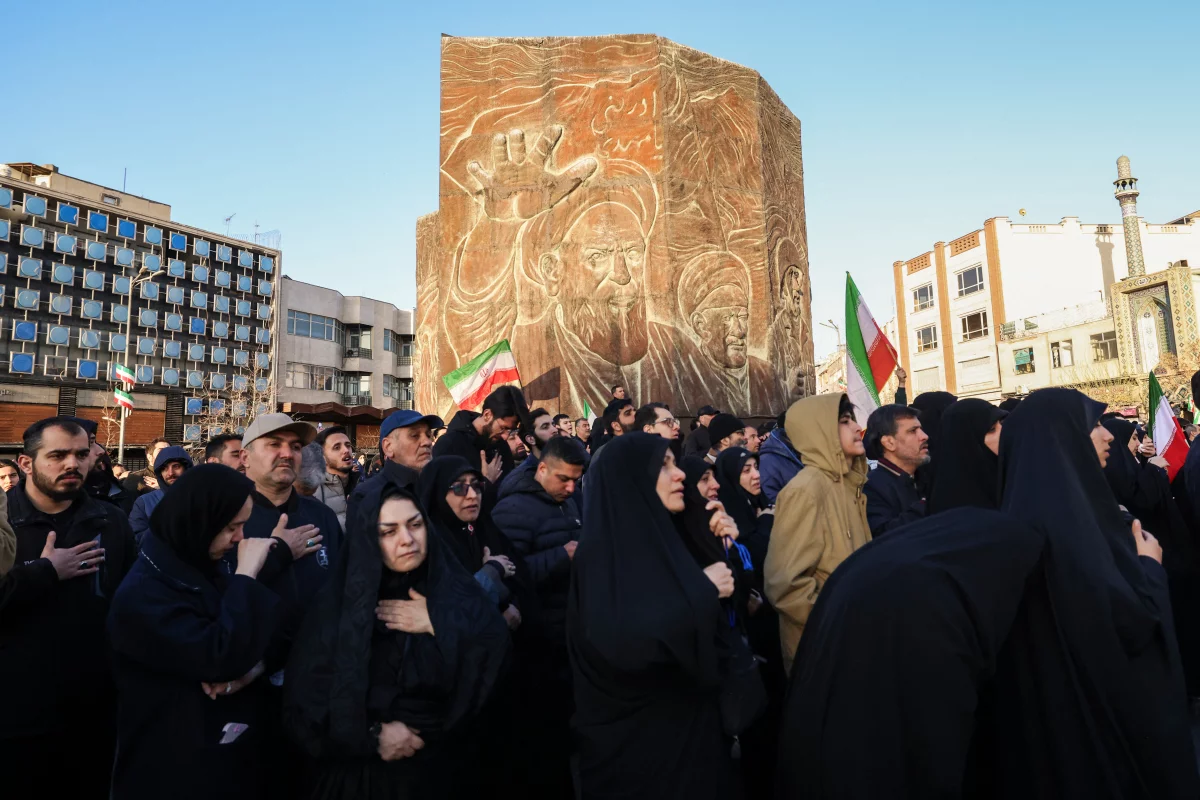
The IRGC has accelerated drone production, with satellite imagery showing 24/7 operations at facilities around Isfahan, producing an estimated 500 Shahed‑136 drones per week. On Quds Day, three Israeli airstrikes hit missile factories and drone hangars in Tehran, killing 42 people and wounding 180. The public anger, combined with hardline military control and a weakened supreme leader, creates a uniquely volatile command structure – precisely the kind that can misread signals and escalate into unintended war.
NATO Enters the Conflict: Turkey Shoots Down Iranian Missiles
The crisis crossed a new threshold when Turkish F‑16s shot down an Iranian Fateh‑360 ballistic missile fired toward Athens. This was the third missile interception in the same month, underscoring how far Iran’s long‑range missile arsenal can reach. Greece responded by activating its Iron Dome‑style air‑defence, NATO moved Standing Maritime Group 2 to the Eastern Mediterranean, and AWACS surveillance aircraft now patrol the region on 24‑hour rotations.
Patriot air‑defence batteries have been deployed to Athens and Izmir, sending a clear signal that attacks on NATO members will not go unanswered. Turkish President Erdogan stated bluntly that Iran is testing NATO unity and failing, underlining Turkey’s readiness to defend its airspace and that of its allies. The Article 5 of the NATO charter – where an attack on one member is treated as an attack on all – has not yet been triggered, but the pressure to invoke it grows with every new missile intercept.
Iran’s response to the NATO deployments was a Shahed‑136 drone swarm attack on Bahrain, where the U.S. Fifth Fleet is headquartered. American Patriot systems intercepted 87 percent of the incoming drones, demonstrating their effectiveness but also highlighting the sheer volume of munitions Iran is willing to expend. The pattern shows a calculated, asymmetric strategy: Iran uses drones and ballistic missiles to test Western defences while keeping the conflict just below the full‑scale war threshold.
Oil at $103: The Strait of Hormuz Breakdown
The real‑world impact of Persian Gulf on Fire 2026 is written in oil prices. Brent crude has reached $103.82 per barrel, a 2.1 percent single‑day jump, while West Texas Intermediate trades at $99.47. These numbers are not abstract statistics – they translate into higher fuel costs, shipping disruptions, manufacturing inflation, and shrinking margins worldwide. For Pakistan, the spike is already visible at petrol pumps, in power‑generation costs, and in the balance of payments.
The Strait of Hormuz remains the chokepoint at the heart of the crisis. Approximately 20 percent of the world’s daily oil supply passes through this narrow waterway between Iran and Oman. When mines, drone boats, and IRGC interdiction keep tankers from safely transiting, the global oil market tightens immediately and prices spike to reflect the blockade risk. The Trump administration has tried to soften the shock by allowing already‑chartered Russian Urals crude to reach markets, providing a partial cushion but not enough to fully neutralise the Strait‑risk premium.
India and China are absorbing 12 million barrels per day of discounted Urals crude at $85 per barrel, buying it off the spot at a steep discount. This inflow has helped keep the market from entering outright panic, but it is treated as temporary relief. Traders now price the risk that even if Russian oil is available, it may not reach markets if the Strait remains contested or if secondary sanctions limit where it can be delivered. The combination of physical risk, political uncertainty, and supply‑chain fragility creates a persistent upward bias in prices.
Pakistan’s Immediate Pain: Fuel, Flights, and Market Collapse
No country outside the Gulf itself is feeling the Persian Gulf on Fire 2026 crisis more acutely than Pakistan. Petrol prices have surged to Rs322 per litre, and CNG prices have risen to Rs225 per cubic metre, with queues stretching 2 kilometres outside major stations in Karachi, Lahore, and Islamabad. Load‑shedding has returned to 8 hours per day, as power generators struggle to absorb fuel‑cost increases, and three CNG‑LPG stations in Karachi were torched by angry crowds during riots.
Prime Minister Shehbaz Sharif extended his Riyadh visit by 48 hours, securing a 90‑day credit‑backed deal for 5 million barrels of oil per month from Aramco. The agreement provides short‑term relief for Pakistan’s oil‑import bill, but it does not remove the underlying risk that this Saudi supply must pass through the same vulnerable Strait. The KSE‑100 index fell 5.1 percent in a single day, its second‑worst performance this year, as investors priced in higher energy costs and supply‑chain disruptions. OGDC, a domestic energy producer, surged 18 percent as higher oil prices boosted its earnings outlook.
Pakistan International Airlines has cancelled 22 flights. Emirates has suspended the Karachi‑Dubai route, one of the busiest corridors for Gulf‑linked trade and remittances. Karachi’s economy, deeply dependent on Gulf‑bound labour, trade, and capital flows, faces a double shock: higher costs at home and reduced connectivity abroad. Pakistan’s military has deployed 15,000 troops to Gwadar and Karachi ports as a contingency, while JF‑17 fighters have scrambled to escort Iranian drones detected near Balochistan airspace. The situation reflects a country caught between its Gulf‑centric economic model and the escalating security risks of the region.
Global Markets in Freefall: What the Numbers Say
The financial impact of Persian Gulf on Fire 2026 has been swift and broad. Europe’s STOXX 600 index fell 3.4 percent on Friday, with the energy sector rising 8 percent as oil‑related companies benefited from higher prices, while the auto sector collapsed 12 percent due to the risk of demand destruction from rising fuel costs. India’s Nifty 50 dropped 4.2 percent, prompting the Reserve Bank of India to intervene in currency markets to stabilise the rupee against a strengthening dollar.
S&P 500 futures traded 2.8 percent lower in pre‑market activity, signalling that American investors expect a prolonged period of elevated risk and volatility. Safe‑haven assets have surged in response. Gold hit $2,850 per ounce, driven by war‑risk premiums and inflation fears. Bitcoin has climbed to $78,200, reinforcing its role as a geopolitical hedge. The Swiss franc appreciated 12 percent against the euro as investors sought a stable‑currency refuge.
The nuclear dimension adds a distinct layer of fear. The International Atomic Energy Agency reports that Iran has enriched uranium to 90 percent, just two weeks away from weapons‑grade material. Markets cannot price the uncertainty of whether this is a genuine breakout attempt or a high‑stakes negotiating signal, so they treat it as worst‑case risk. Every asset class absorbs a nuclear‑risk premium, and the fear of an accident‑driven escalation keeps spreads wide and volatility elevated.
Trump’s Signal: “Bones Know” Military Timing
President Trump’s comments on the Persian Gulf crisis reflect his unorthodox communication style. At an Ohio rally on March 11, he told supporters that Iran thinks it is winning, the Marines think otherwise, and he will know when the time is right because his bones never lie. On X, he added that an Iranian uprising was unlikely soon, but Marines were incoming. Analysts interpret this as a mix of political messaging and calibrated signaling.
Behind the scenes, Pentagon planners are working with two main scenarios. The first is a Hormuz clearance operation around April 15, where U.S. naval forces aggressively sweep mines and secure freedom of navigation through a mix of mine‑warfare assets and carrier‑based air power. The second, higher‑risk option is a regime‑decapitation operation around May 1, targeting key IRGC command structures to collapse the hardliner faction driving escalation. Both options are shaped by the nuclear shadow.
A large‑scale military operation that threatens Iran’s regime survival could accelerate rather than halt its nuclear breakout. The fear of losing control over nuclear assets may push hardliners to arm systems sooner, increasing the risk of an unintended nuclear incident. U.S. planners must balance the need to restore freedom of navigation with the risk of triggering a strategic escalation that could dwarf the current crisis. The outcome of this balancing act will shape oil prices, military posture, and regional stability.
Risk Matrix: Four Scenarios and Oil Price Implications
Analysts monitoring Persian Gulf on Fire 2026 are working with four main scenarios, each with distinct implications for oil prices and the global economy. The lowest‑risk scenario, currently considered most likely, assumes the U.S. maintains naval pressure but fails to fully clear Iranian mines and drone threats, leaving the Strait operating at 50 percent of normal traffic. Oil would stabilise around $120 per barrel, reflecting a significant but containable shock with moderate recessive effects for import‑dependent economies like Pakistan and India.
A medium‑risk scenario unfolds if Iran successfully strikes Saudi infrastructure, including storage terminals or pipelines. In that case, oil prices would likely surge toward $150 per barrel, triggering a broad‑based recession in most major oil‑importing countries. The impact on Pakistan would be severe: higher fuel costs, constrained power generation, and a collapsing rupee. European and Asian economies would also face a sharp slowdown.
The high‑risk scenario involves a direct strike on Abqaiq, which not only concentrates Saudi oil‑processing capacity but also serves as a critical node in global supply chains. If Abqaiq is knocked offline, even temporarily, oil prices could spike above $200 per barrel, turning the Persian Gulf crisis into a full‑scale global energy shock. The IRGC Navy Chief’s threat against Abqaiq suggests Tehran is using the facility as a bargaining chip. Western planners now factor in the risk that a single strike could trigger a cascade of price spikes and political instability.
The catastrophic scenario, treated with extreme caution, involves a nuclear exchange or indirect nuclear incident.