LIVE
Wednesday, Mar 18, 2026
24/7 News

Trump’s Board of Peace Pledges $7 Billion for Gaza Reconstruction

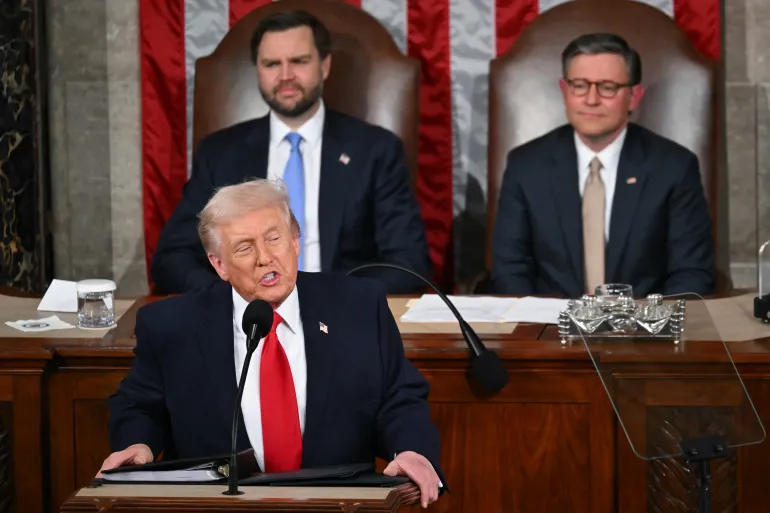
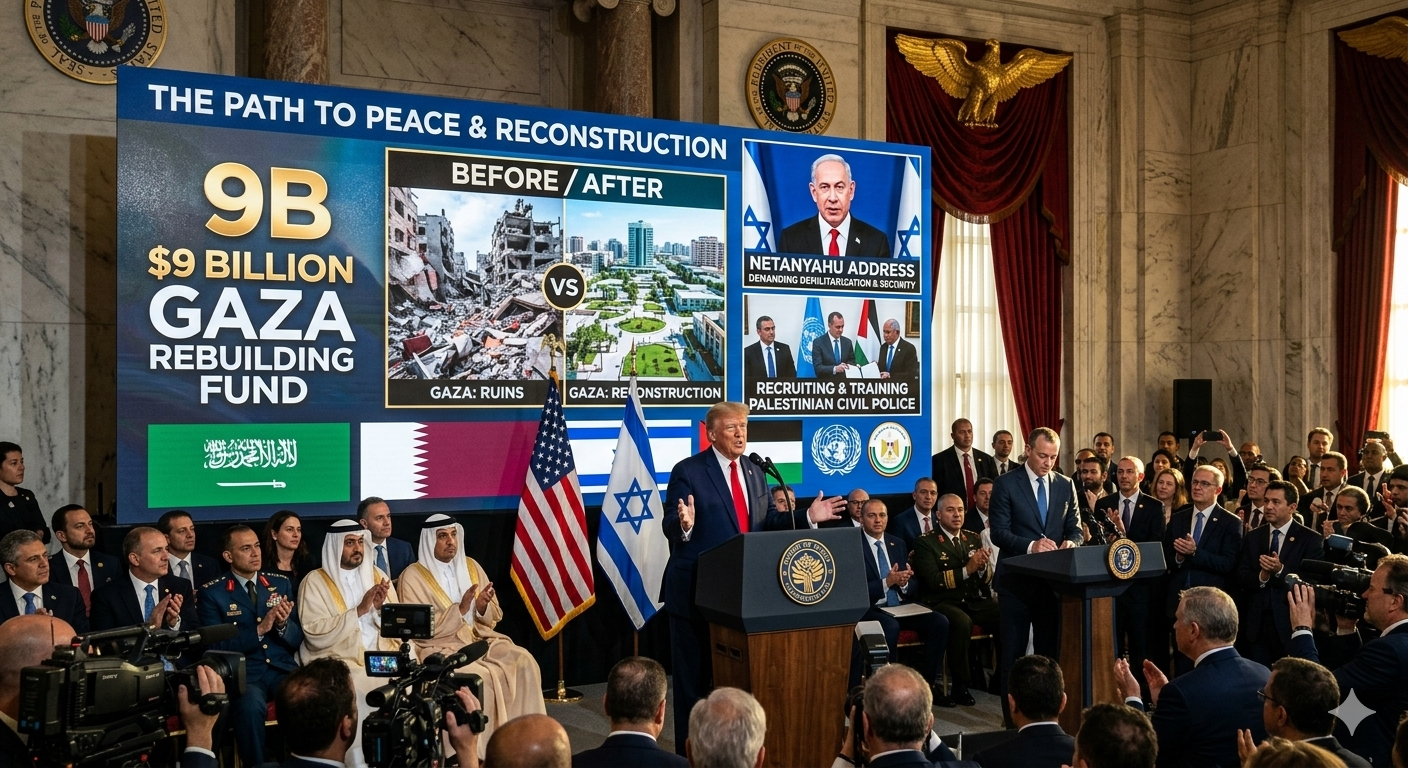
Donald Trump has spent his career turning financing announcements into events. The first meeting of what his administration calls the Board of Peace in Washington produced an announcement whose scale was genuinely significant — over $7 billion in pledges from a coalition of Muslim-majority states including UAE, Saudi Arabia, Qatar, Bahrain, Morocco, Kuwait, Kazakhstan, Azerbaijan, and Uzbekistan, supplemented by $2 billion in UN humanitarian assistance and a somewhat unexpected $75 million commitment from FIFA for football pitches. The total war chest approaching $9 billion was presented at the White House with the specific combination of real estate deal energy and geopolitical gravitas that the Trump administration produces at its most characteristic.

The gap between the announcement and the outcome is the substance of the story. Gaza’s reconstruction damage is estimated at $70 billion — meaning the current pledges represent approximately 13 cents of every dollar required to rebuild what the conflict has destroyed. Benjamin Netanyahu has stated with complete clarity that reconstruction will not proceed until Gaza is fully demilitarised. Hamas has not agreed to disarm. And the Western allies whose financial participation would give the reconstruction fund the scale to approach what the task actually requires — UK, Canada, France, and Germany — boycotted the meeting over what they described as concerns about the United Nations being sidelined in the process.

What Trump has produced in Washington is a plausible beginning to something that could eventually matter enormously, wrapped in an announcement that is considerably more impressive than the underlying situation warrants. Understanding both dimensions — the genuine achievement and the genuine obstacle — requires examining each element of the Board of Peace’s inaugural meeting carefully.


1. The $9 Billion in Context: What It Can and Cannot Buy

The Board of Peace’s total pledge of approximately $9 billion — combining the $7 billion plus in bilateral commitments from the Muslim world coalition with the UN’s $2 billion humanitarian component and FIFA’s $75 million — deserves to be assessed against the specific reconstruction requirements of a territory whose damage estimates are extraordinary in scope and character.

Gaza entered the conflict as one of the most densely populated territories on earth — 2.1 million people in an area roughly equivalent to a medium-sized city, with infrastructure already under strain from years of blockade and repeated conflict cycles. The 18 months of fighting since October 7, 2023 have produced damage that independent assessments estimate at $70 billion — 70 percent of buildings destroyed or damaged, water and electricity infrastructure essentially non-functional, healthcare facilities reduced from 36 hospitals to a fraction of that number still operating at minimal capacity, and the entire 2.1 million population effectively displaced into Rafah’s tent cities or sheltering in whatever structures remain standing.

Against this backdrop, $9 billion covers specific and important things while being fundamentally insufficient for the full reconstruction task. The immediate humanitarian priorities — temporary shelter that moves people from tents to more durable structures, water purification and distribution infrastructure, electricity generation capacity, and the schools and hospitals that make normal civilian life possible — can be meaningfully advanced with $9 billion if the money is effectively deployed. These are the priorities that address the most acute human suffering and create the physical conditions under which anything resembling governance can function.

What $9 billion cannot do is rebuild Gaza in any comprehensive sense. The destroyed housing stock, the obliterated commercial and industrial infrastructure, the port and border crossing facilities, the road and communications networks — these require multiples of the current pledge to reconstruct. The $70 billion total estimate implies that the current commitment funds approximately 13 percent of what full reconstruction requires, and even that percentage overstates the effective coverage because it does not account for the inflation in construction material costs that major regional reconstruction projects historically produce.


2. The Pledging Nations: Who Put Money On the Table and Why

The Board of Peace’s pledging coalition is not a random collection of willing donors — it reflects a specific geopolitical construction that the Trump administration has been building since taking office, whose logic is as important to understand as the dollar amounts involved.

Saudi Arabia’s position as the largest single contributor reflects its role in Trump’s Middle East architecture as the indispensable Arab partner whose financial capacity, regional credibility, and domestic legitimacy with Muslim populations globally makes it the anchor of any Gulf-led reconstruction initiative. Saudi involvement transforms the Board of Peace from a Trump real estate project with Muslim country participants into an initiative with genuine regional ownership — a distinction that matters for how the Palestinian population in Gaza receives the programme and how the broader Arab world’s governments position themselves relative to it.

UAE’s participation adds the operational expertise that large-scale Gulf reconstruction projects require. The UAE has executed some of the most ambitious urban development projects in the world over the past three decades, and its involvement signals that the Board of Peace has access to the project management, construction industry relationships, and logistical capacity that converting pledged dollars into built infrastructure requires. A pledge without operational capacity is a press release. UAE’s involvement makes execution at least plausible.

Qatar’s presence is the most politically complex element of the coalition. Qatar has been Hamas’s primary external financial patron and diplomatic enabler for over a decade — its government has hosted Hamas’s political leadership, its state media has provided the organisation with sympathetic coverage, and its financial flows have sustained Hamas’s ability to function as Gaza’s governing authority. Qatar’s participation in a reconstruction initiative explicitly premised on Hamas’s eventual disarmament represents either a genuine strategic shift in Doha’s assessment of its regional interests or an attempt to maintain influence over the reconstruction process while preserving its relationship with Hamas. Netanyahu has flagged Qatar’s involvement as a potential red line — a signal that Israel’s cooperation with the reconstruction framework may be conditional on Qatar’s role being limited to funding rather than governance.

The Central Asian participants — Kazakhstan, Azerbaijan, and Uzbekistan — represent a different kind of inclusion. Their involvement signals Muslim world breadth beyond the traditional Arab-world reconstruction coalition, providing geographic diversity that strengthens Trump’s framing of the initiative as representing a broader Islamic consensus rather than a Gulf Arab project.

The Western boycott — UK, Canada, France, and Germany — is the most immediately consequential gap in the coalition. These governments’ objection centres on the UN’s sidelining in the Board of Peace’s governance structure, which they argue removes the international legitimacy framework that large-scale reconstruction programmes require for accountability, anti-corruption mechanisms, and the kind of sustained donor confidence that multi-year reconstruction projects need. Their absence means the current $9 billion lacks the Western institutional participation that would both add financial scale and provide the governance credibility that the programme needs to function over the years its implementation will require.


3. Hamas Disarmament: The Obstacle That Threatens the Entire Architecture

The fundamental problem with the Board of Peace’s reconstruction vision is the same problem that has prevented Gaza from achieving sustainable peace through every previous internationally supported framework: the Hamas disarmament question has no resolution that all necessary parties can simultaneously accept, and without resolution, the reconstruction that the money is intended to fund cannot begin in any manner consistent with the security framework that Israel requires.

Netanyahu’s position is categorical and has been stated repeatedly with the kind of clarity that diplomatic hedging cannot easily reinterpret. Full demilitarisation of Gaza is the prerequisite for reconstruction — not a condition to be addressed in parallel with reconstruction, not a goal to be pursued progressively as reconstruction creates incentives, but a prerequisite whose satisfaction precedes rather than accompanies the physical rebuilding of Gaza’s infrastructure.

Hamas’s publicly stated position is the mirror image of Netanyahu’s. Israeli military withdrawal from Gaza is Hamas’s prerequisite — the organisation will not discuss weapons surrender in a context where Israeli forces maintain presence in the territory, and it characterises any disarmament discussion conducted under conditions of occupation as a negotiation without genuine Palestinian agency.

Trump’s characterisation of Hamas as looking like they will agree to disarmament lacks the specific evidence that would give it credibility as a factual assessment. Hamas’s public statements and the organisation’s internal political dynamics — in which armed resistance is the foundational legitimacy claim that no faction leader can voluntarily surrender without destroying their own political position — do not support the optimistic reading that Trump’s framing projects. Either Trump has access to private Hamas communications whose content is significantly more accommodating than public statements suggest, or the claim reflects wishful thinking rather than intelligence assessment.

The security chicken-and-egg that Nickolay Mladenov — the experienced diplomat installed as the Board of Peace’s operational coordinator — identified publicly is the most honest framing of the problem. No reconstruction without security. No security without reconstruction. No trusted police without governance. No governance without Hamas disarmament. The circularity is genuine and does not resolve itself simply because $9 billion is available.


4. The Palestinian Police Force: The Practical Alternative to Hamas Disarmament

The most operationally realistic element of the Board of Peace’s security framework is not Hamas disarmament — which remains in the category of aspirational goal rather than near-term achievable outcome — but the Palestinian police force whose recruitment has already begun with 2,000 applications in the first hours of the process.

The specific design choices that the Board of Peace has made about this force reflect the political constraints that make any security architecture for Gaza extraordinarily difficult. No Hamas members will be accepted unless individually vetted and assessed as having genuinely separated from the organisation’s command structure — a vetting standard whose application will be contested at every specific case. No West Bank Palestinian Authority importation — a design choice that reflects the Israeli and Gulf Arab assessment that the PA’s credibility in Gaza is insufficient to produce the legitimate governance that reconstruction requires, and that importing PA structures without popular legitimacy would simply replicate in Gaza the dynamics that have made PA governance in the West Bank a source of Palestinian frustration rather than confidence.

The International Stabilisation Force — backed by Egyptian muscle and Israeli border coordination — is the external security element whose deployment alongside the Palestinian police provides the coercive capacity that a newly formed local force cannot immediately provide. Egypt’s historical Gaza border management experience and its relationship with both Hamas and Israel gives it a specific operational capacity that no other external party replicates, and its willingness to deploy the ISF represents a significant diplomatic commitment that the Board of Peace’s security architecture depends on.

The 2,000 applications in the first hours of the police force’s recruitment represents genuine evidence of Gazan civilian desire for a security alternative to Hamas — people living under the conditions of Hamas governance and Gaza’s post-October 7 destruction who are willing to put themselves forward for a policing role whose risks are obvious. Whether the application volume translates into a deployable force of adequate quality depends on the training programme, the vetting rigour, and the institutional culture that the force’s international supervisors can establish in a compressed timeline.


5. Trump’s Real Estate Logic Applied to Geopolitics

The Board of Peace’s conceptual architecture reflects Trump’s instinct to apply real estate investment logic to diplomatic problems — an approach that produces both genuine insights and genuine blind spots that the Gaza context illustrates clearly.

The reframing of Gaza from a humanitarian crisis into a development opportunity — from “hotbed of terror” to “stability investment” — is not entirely wrong as an analytical move. Gaza’s pre-2007 economy was more functional than its post-Hamas trajectory produced, and its coastal location, young population, and proximity to Israel’s high-tech economy create the theoretical conditions for genuine development if security and governance allow it. The Board of Peace’s Muslim world coalition framework — positioning Gulf state investment expertise and capital as the development engine — is more practically viable than the UN committee structure that Western governments prefer, because Gulf states have demonstrated the capacity to execute large-scale construction projects rapidly when political will and capital align.

The blind spots are equally evident. Gaza’s reconstruction is not a real estate deal that can be closed once the financing is assembled. It requires political resolution of questions — Palestinian statehood, the right of return, Hamas’s political status, Jerusalem’s governance — that no amount of financing solves and that Trump’s framework explicitly avoids addressing. Mladenov’s warning that without trusted security, Gaza stays permanently oscillating between Hamas control and Israeli occupation with Palestinian state impossibility at the outcome is the acknowledgement that the real estate approach cannot substitute for the political process it has been designed to bypass.

The Trump Tower Gaza framing — satirical but not entirely unfair as a characterisation of the aesthetic sensibility underlying the initiative — is less damaging to the project’s prospects than the fundamental question it raises about whose interests are being served by the specific governance structure the Board of Peace has adopted.


6. The Western Boycott: Why It Matters More Than the Pledges Suggest

The decision by UK, Canada, France, and Germany to boycott the Board of Peace meeting — explicitly over concerns about the United Nations being sidelined in the reconstruction governance structure — is not a minor diplomatic inconvenience but a substantive signal about the framework’s long-term viability.

The UN’s role in large-scale reconstruction programmes provides functions that bilateral donor frameworks struggle to replicate: the international legal legitimacy that gives reconstruction programmes authority in contested political spaces, the anti-corruption monitoring mechanisms that multi-year multi-billion-dollar programmes require to maintain donor confidence, and the coordination infrastructure that prevents duplication, identifies gaps, and provides the common information platform that multiple donors working in the same space need to function efficiently.

Western governments’ UN sidelining concern is not purely about institutional prerogative — it reflects a practical assessment that reconstruction programmes operating outside UN frameworks have historically been more vulnerable to political capture, corruption, and the kind of programme deformation that occurs when implementation is driven by the priorities of bilateral donors rather than the needs of beneficiary populations. Iraq’s post-2003 reconstruction, which operated largely outside multilateral frameworks, provides the cautionary case that Western diplomats reference when discussing governance structure design.

The financial scale of the Western boycott’s impact is its most immediate practical consequence. UK, Canada, France, and Germany collectively have the financial capacity to multiply the current $9 billion pledge by a factor of two or more if they participate at the level their previous Gaza humanitarian commitments suggest. Their absence not only reduces the total available, it reduces the legitimacy of the programme in the eyes of international institutions and civil society organisations whose cooperation the reconstruction process requires.


7. Gaza’s Actual Condition: What $9 Billion Encounters on the Ground

Any assessment of the Board of Peace’s reconstruction framework must engage with the specific physical and human reality that the money will encounter when it is eventually deployed — a reality that the press conference optimism does not fully convey.

Gaza’s 2.1 million population is effectively entirely displaced, with the majority sheltering in Rafah’s tent cities or in whatever structures remain standing in the northern and central parts of the territory. The tent city conditions — overcrowding, inadequate sanitation, insufficient food and medical care, and the specific psychological toll of indefinite displacement — represent a humanitarian emergency whose urgency is independent of the reconstruction timeline.

The infrastructure destruction is so comprehensive that the basic preconditions for reconstruction — electricity to power construction equipment, water for concrete mixing, functioning road networks for material delivery, telecommunications for project coordination — must themselves be rebuilt before the reconstruction of housing and civic buildings can begin. This sequencing requirement means that the first years of reconstruction expenditure will be devoted to enabling infrastructure whose outputs are invisible to political communication but essential to any physical progress.

The Gaza economy’s condition — zero functioning private sector, no banking system, no commercial activity — means that the reconstruction cannot rely on market mechanisms to coordinate investment and production. Everything requires direct programme implementation, which in turn requires the governance capacity and local institutional infrastructure that the security vacuum and Hamas’s continuing presence complicate.


8. Pakistan’s Position: Watching, Claiming, Contributing Nothing

Pakistan’s engagement with the Board of Peace framework is the specific study in OIC-level diplomatic positioning that the Gulf crisis has produced across several policy domains — vocal support for the conceptual outcome, no financial contribution, and an active effort to claim relevance to a process whose major decisions are being made in capitals that do not particularly require Pakistani input.

Foreign Minister Ishaq Dar’s monitoring of the Saudi and Qatari-led reconstruction initiative reflects Pakistan’s genuine interest in the outcome — as an OIC member state with a large domestic Muslim constituency for whom Gaza solidarity is a significant political issue, Pakistan cannot be seen as indifferent to the reconstruction process. The Kashmir-Palestine linkage that Pakistani diplomacy has historically maintained provides a framing through which Pakistani officials can position their country’s Gaza engagement as part of a broader Muslim-world oppression narrative rather than simply as support for a specific conflict’s victims.

The OIC leadership play that the Board of Peace represents for Saudi Arabia — positioning the Islamic world as the primary financial and political driver of Palestinian reconstruction rather than Western-dominated UN frameworks — is broadly in Pakistan’s interest if it produces genuine Palestinian benefit, because it validates the OIC as a meaningful institution capable of organising collective Muslim-world responses to crises affecting Muslim populations. Pakistan’s vocal support for Muslim-world ownership of the reconstruction process costs nothing and provides domestic political credit regardless of whether Pakistan contributes to the funding.

The absence of a Pakistani financial pledge reflects both the obvious constraint — Pakistan’s economy is managing the Gulf war’s oil price impact, the Afghanistan border conflict’s costs, and the IMF programme’s fiscal constraints simultaneously — and the calculation that no-pledge diplomatic engagement is a viable position when Saudi Arabia and UAE are writing the large cheques.


9. The Phase 2 Ceasefire: What Actually Has to Happen

The Phase 2 ceasefire that the Board of Peace’s reconstruction framework is predicated on is currently a roadmap rather than a reality, and the specific steps required to move from the current position to the reconstruction-enabling security environment that the roadmap describes are each individually difficult and collectively daunting.

Hamas weapons surrender is the first step in Trump’s plan and the one that no party with knowledge of Hamas’s internal politics or public positions considers achievable in the near term. The organisation’s armed wing is not a policy choice that Hamas’s political leadership can voluntarily reverse — it is the foundational source of the organisation’s political legitimacy and its survival capacity in an environment where Israeli military action and Palestinian political competition both threaten its continuation. Disarming in exchange for reconstruction funding is a trade that Hamas’s leadership would not survive politically even if they were inclined to accept it strategically.

Palestinian police deployment — the more realistically achievable near-term security step — requires the training, vetting, and equipping timeline that international security sector reform programmes typically run over two to three years rather than months. The 2,000 initial applications are promising as an indicator of civilian desire for security alternatives, but the distance from applications to deployable professional police force is measured in years of institutional development.

The International Stabilisation Force’s Egypt-led implementation depends on Egyptian domestic politics and Israeli security coordination — both of which have their own dynamics that the Board of Peace’s Washington announcement cannot control. Egypt’s willingness to deploy forces in Gaza will be calibrated against its domestic Islamist political situation, its bilateral relationship with Israel, and its assessment of whether the reconstruction framework has sufficient political legitimacy to be worth the domestic political cost of involvement.


10. What Actually Happens Next: The Realistic Assessment

The Board of Peace’s $9 billion commitment is real money that will eventually produce real construction — the question is on what timeline, under what conditions, and toward what political endpoint.

The most realistic near-term scenario involves humanitarian assistance beginning to flow through the UN’s $2 billion channel while the larger bilateral reconstruction commitments remain in escrow awaiting the security conditions that all parties claim as prerequisites. The FIFA football pitches — genuinely useful for youth engagement in a population with enormous numbers of traumatised young people — are perhaps the most immediately deployable element of the current pledge, which is both an embarrassing commentary on the gap between the initiative’s ambitions and its near-term deliverables and an honest reflection of where the security conditions currently allow implementation.

The Palestinian police force’s development over the next twelve to eighteen months will be the most significant indicator of whether the Board of Peace’s security framework is generating real capacity or maintaining the appearance of progress. A police force of 5,000 to 10,000 trained, vetted, and equipped officers by the end of 2026 would represent genuine progress. A force of that scale would not resolve the Hamas presence question, but it would provide an alternative security option in areas where Hamas’s control is weakest and where reconstruction activity could theoretically begin.

The political resolution questions — Palestinian statehood, the West Bank’s governance relationship with Gaza, Jerusalem’s status — remain unaddressed by the Board of Peace framework and will eventually reassert themselves as the binding constraints on any reconstruction that aims to produce durable peace rather than simply rebuilt buildings in a contested territory.


Conclusion

Trump’s Board of Peace meeting has produced a $9 billion pledge, a governance framework built around Gulf Arab financial and political leadership, a Palestinian police recruitment process whose early application numbers suggest genuine civilian demand for security alternatives, and an announcement whose distance from resolution is measured in the 61-billion-dollar gap between current pledges and actual reconstruction costs.

The achievement is real. Muslim world financial commitment to Gaza reconstruction at the scale Saudi Arabia, UAE, and Qatar are proposing represents a genuine departure from the previous pattern of international declarations that generated limited concrete funding. The Trump administration’s instinct to organise peace around investment rather than institution-building has produced a coalition with genuine financial capacity and genuine regional credibility.

The obstacles are equally real. Hamas has not disarmed and will not disarm on any timeline consistent with the reconstruction beginning in months rather than years. Netanyahu’s demilitarisation prerequisite is a condition that the current security trajectory cannot satisfy. The Western boycott has removed the institutional legitimacy and additional financial scale that full international participation would provide. And the $70 billion damage estimate means that current pledges fund a fraction of what full reconstruction requires even if every implementation challenge were resolved tomorrow.

Gaza’s 2.1 million people in Rafah’s tent cities will measure the Board of Peace not by the press conference that announced it but by whether concrete eventually replaces canvas over their heads. That measure will be taken years from now, and the outcome will depend on decisions about Hamas, Israeli withdrawal, Palestinian governance, and the sustained engagement of Gulf donors that no Washington announcement can predetermine.

The $9 billion is on the table. The hard part has not yet begun.

Leave a Reply

Your email address will not be published. Required fields are marked *

News That Commands Truth — Without Filter

Independent journalism covering Pakistan and the world. Unfiltered reporting on politics, business, sports, and culture — delivered with clarity and purpose since 2024.

BREAKING LIVE EXCLUSIVE
f X in YT W
Contact Info
Email
info@sultannews.online
Editorial
editor@sultannews.online
Location
Karachi, Pakistan
Newsletter
© 2026 Sultan.News — All Rights Reserved. Karachi, Pakistan.