LIVE
Wednesday, Mar 18, 2026
24/7 News

An Afghan man walks past a damaged wall following airstrikes in Kandahan

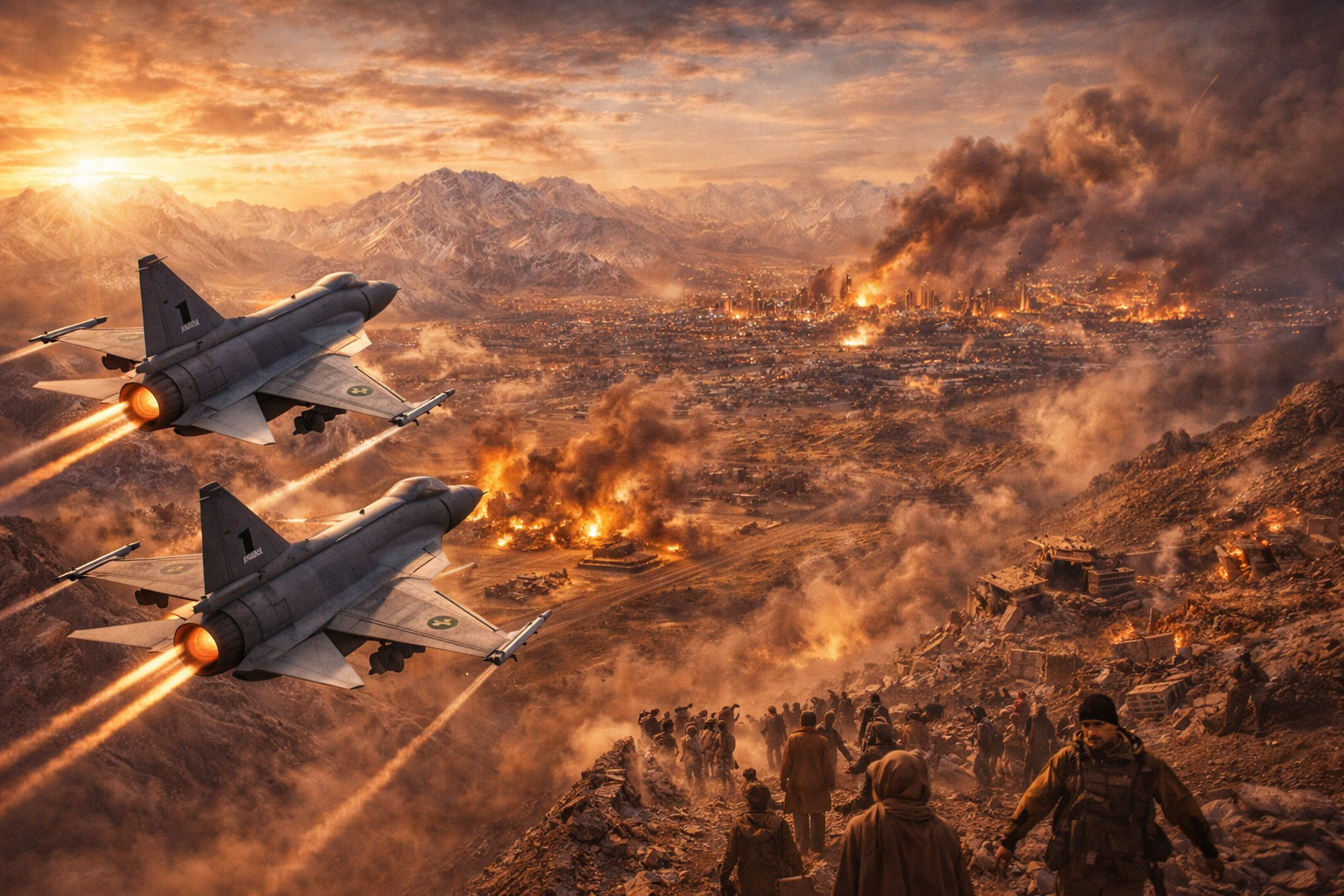
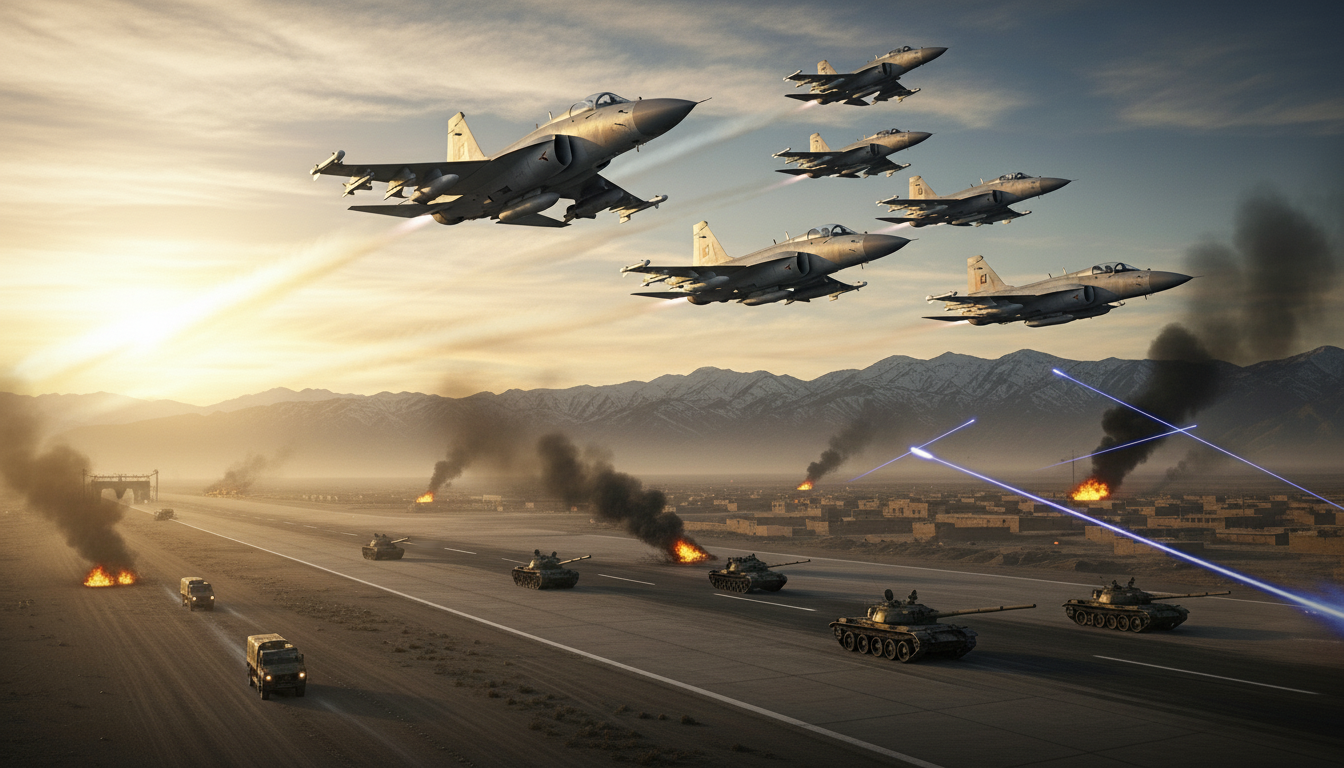
While the world’s attention has been fixed on burning oil tankers in the Persian Gulf, Iranian missile barrages across the Gulf states, and Israeli ground forces crossing into Lebanon, a conflict of potentially equal regional significance has been escalating along one of the world’s most contested and historically volatile borders. Pakistan and Afghanistan have been exchanging fire across the 2,600-kilometre Durand Line for six days. Pakistan’s JF-17 Thunder jets have struck Bagram Air Base — the massive facility that served as America’s primary military hub in Afghanistan throughout the twenty-year war. The UN has confirmed 42 civilian deaths and 104 wounded. Sixteen thousand four hundred households have been displaced.

This is not a border skirmish. It is a full-spectrum military confrontation between a nuclear-armed state and the Taliban government that controls Afghanistan, playing out against the backdrop of regional instability severe enough that the world’s attention is genuinely elsewhere. That combination — the conflict’s severity and its invisibility — makes understanding what is happening, why it is happening, and where it is going more urgent than the limited coverage it is receiving would suggest.


1. What Sparked the Confrontation: The TTP Sanctuary Question

The immediate trigger for Pakistan’s military escalation is a dispute whose underlying logic has been building for years — the question of whether Afghanistan’s Taliban government is providing sanctuary to the Tehrik-i-Taliban Pakistan, the militant organisation responsible for some of the most devastating terrorist attacks on Pakistani soil in the past decade.

Pakistan’s position is unambiguous and backed by intelligence assessments that its military has been sharing with international partners for months. The TTP — which the Pakistani state has been fighting since the organisation’s formation in 2007 and which has claimed responsibility for attacks including the 2014 Army Public School massacre in Peshawar that killed 132 children — has been reconstituting itself in Afghan territory following its expulsion from Pakistani border areas in previous military operations. The Torkham checkpoint attacks, suicide bombings in Balochistan and KPK, and the sustained insurgent pressure on Pakistani security forces all point, in Pakistan’s assessment, to coordination from Afghan soil.

The Taliban government’s response has been equally consistent and equally predictable: denial. Kabul’s position is that Pakistan is using the TTP pretext to justify attacks on Afghan civilians and infrastructure, that the targets Pakistan claims are militant training camps are in fact civilian settlements, and that Pakistan’s military operations constitute aggression against Afghan sovereignty. The Taliban’s political incentives for maintaining this position are straightforward — acknowledging TTP presence and accepting Pakistani demands to address it would require either action against an organisation with which the Afghan Taliban shares ideological roots and personal networks, or admission of an inability to control its own territory that would undermine the government’s domestic legitimacy.

Pakistan’s Information Minister Attaullah Tarar’s confirmation of the Bagram strike, and his characterisation of the base as having stored ammunition and equipment for militants alongside Taliban troops fighting against Pakistan, established the military’s public case for the operation while acknowledging its extraordinary political sensitivity. Striking Bagram — the facility where American forces operated for two decades, now repurposed by the Taliban government as a military installation — is a statement about the seriousness of Pakistan’s intent that goes well beyond anything a previous Pakistani government has been willing to publicly own.


2. The Bagram Strike: Significance Beyond the Military Target

The decision to strike Bagram Air Base represents a psychological and political escalation that the military targeting rationale alone does not fully explain. Pakistan has struck targets in Afghanistan before, in operations that have been publicly acknowledged only partially or denied entirely. The public confirmation of a Bagram strike by Pakistan’s Information Minister signals a deliberate choice to make the escalation visible — to send a message to the Taliban government, to Pakistan’s domestic audience, and to the international community about the seriousness of Pakistan’s security concerns and its willingness to act on them.

Bagram’s symbolic weight is impossible to separate from its military function. For twenty years, the base represented the most visible symbol of American military commitment to Afghanistan’s reconstruction — the facility from which F-16s and B-52s flew against the Taliban and Al-Qaeda, where tens of thousands of American troops rotated through, and where the infrastructure of the American presence in Central Asia was concentrated. Its fall to the Taliban following America’s 2021 withdrawal was one of the defining images of that withdrawal’s chaotic end. Pakistan’s JF-17s striking it in 2026 is a statement whose resonance extends far beyond the immediate military objective.

The Afghan police’s claim to have chased off Pakistani jets with anti-aircraft guns is almost certainly a face-saving narrative rather than an accurate operational account — the JF-17 Thunder’s performance characteristics and the quality of Taliban air defence assets make a successful interception highly implausible. But the counter-narrative serves an important function for the Taliban government: maintaining the domestic political appearance of resistance even when the military reality is one of considerable vulnerability to Pakistani air power.

The strike’s confirmation also establishes a precedent that Pakistan’s security establishment has been reluctant to create in previous border tensions — the precedent that Pakistani military action against Taliban-controlled territory is an acknowledged policy option rather than a covert activity requiring deniability. That precedent has implications for how future Pakistani governments, facing future TTP threats from Afghan soil, will feel constrained or empowered to respond.


3. The Durand Line: A Border That Afghanistan Has Never Accepted

Understanding why the Pakistan-Afghanistan border is so persistently explosive requires understanding the Durand Line’s specific history and the fundamental disagreement about its legitimacy that has never been resolved between the two states.

The Durand Line was established in 1893 through an agreement between British India and the Afghan Emirate under Abdur Rahman Khan, drawing a boundary that divided the Pashtun tribal areas between British and Afghan administration. Its colonial origin — drawn by a British diplomat named Mortimer Durand, after whom it is named — has been a source of Afghan grievance ever since. The central objection is that the line divided the Pashtun people between two states rather than recognising their geographic and cultural unity, and that the agreement was signed under conditions of British imperial pressure that make its voluntary legitimacy questionable.

Every Afghan government since Pakistan’s independence in 1947 has declined to formally recognise the Durand Line as an international boundary. The Taliban government, consistent with previous Afghan positions, maintains the same refusal. For Pakistan, the line is an internationally recognised border whose sanctity is non-negotiable. For Afghanistan, it is a colonial imposition whose implications for Afghan territorial claims remain open.

This foundational disagreement creates a border management environment in which routine incidents — cross-border fires, alleged violations, movement of armed groups — are interpreted through frameworks that the two governments cannot reconcile because they start from incompatible premises about the border’s nature. The current military confrontation is the latest and most serious expression of a tension that has been present since Pakistan’s founding, and that has periodically escalated into the kind of sustained military exchange currently occurring.

The 24 plus active frontline locations across the Durand Line where exchanges have been reported reflect the border’s geography — a 2,600-kilometre frontier crossing some of the most challenging terrain in Central Asia, with multiple crossing points, tribal areas that have historically recognised neither government’s authority, and a pattern of local alignments that shifts with the security environment on both sides.


4. The TTP Resurgence: Why Pakistan Felt Military Action Was Unavoidable

The Tehrik-i-Taliban Pakistan’s reconstitution as an operational threat has been one of the most significant and least internationally discussed security developments of the past three years. Following the Taliban’s return to power in Afghanistan in 2021, the TTP — which shares ideological and personal ties with the Afghan Taliban but is a distinct organisation with its own leadership, objectives, and operational area — exploited the changed security environment to rebuild the capabilities that Pakistan’s previous military operations, including Operation Zarb-e-Azb in 2014, had significantly degraded.

The scale of TTP’s recent operations has demonstrated a return to the capability levels that made the organisation Pakistan’s most dangerous domestic security threat a decade ago. The Torkham checkpoint attacks — targeting the most important border crossing between Pakistan and Afghanistan — represent a strategic statement about TTP’s ability to project force against symbolically significant targets. Suicide bombings in Balochistan and KPK have resumed at a frequency that Pakistan’s security establishment characterises as evidence of Afghan-based operational planning and logistics rather than purely domestic activity.

Pakistan’s military has described the current operation as potentially requiring a Zarb-e-Azb 2.0 — a reference to the 2014 operation that cleared significant TTP infrastructure from North Waziristan at considerable military and civilian cost. The comparison is instructive: Zarb-e-Azb was a major internal military operation that required years to produce sustained results. Applying equivalent strategic ambition to a cross-border situation involving a sovereign government — even a government Pakistan does not formally recognise as legitimate under international law — creates a fundamentally different operational and political challenge.

President Zardari’s parliamentary address, drawing a red line against any entity using neighbouring territory to attack Pakistan and implying that consequences would follow non-compliance, established the political framework within which the military is operating. The message was directed at both domestic and external audiences — reassuring Pakistan’s public that its government is responding to genuine security threats, and signalling to the Taliban that Pakistan’s patience with the TTP sanctuary situation has been exhausted.


5. The Humanitarian Disaster: UN Numbers and Pakistan’s Counter-Narrative

The UNAMA confirmation of 42 civilian deaths and 104 wounded across six days of conflict, combined with the displacement of 16,400 households, represents a humanitarian emergency that is receiving inadequate international attention given its scale and the vulnerability of the affected population.

Afghanistan’s humanitarian situation entering this conflict was already critical. The October 2025 earthquakes that killed over 1,400 people had damaged infrastructure, displaced communities, and strained the limited aid resources available to operate under Taliban governance restrictions. The border conflict has closed the routes through which humanitarian aid moves, trapped communities in areas of active fighting, and added fresh displacement to populations still recovering from natural disaster.

Pakistan’s counter-narrative, articulated by Information Minister Tarar, challenges the UNAMA figures on the grounds that TTP militants routinely dress in civilian clothing, making accurate casualty classification difficult, and that the UN’s relationship with the Taliban government introduces bias into its reporting. Both elements of this counter-narrative contain genuine complications — the militant use of civilian appearance is a documented tactic, and international organisations operating under Taliban restrictions do face information access challenges — but neither element eliminates the fundamental reality that military operations in populated areas produce civilian casualties regardless of targeting intent.

The aid access dimension adds urgency to the humanitarian picture that the casualty figures alone do not capture. Afghanistan’s population depends on food imports that cross through border points now closed by the conflict. Winter conditions in border areas add weather vulnerability to the displacement crisis. Medical facilities in conflict-affected areas are operating under supply constraints that make treating the wounded significantly more difficult than the casualty numbers suggest.


6. China’s Stake: CPEC Security and Beijing’s Constrained Response

China’s reaction to the Pakistan-Afghanistan border conflict is shaped by the same kind of competing interest calculus that defines its response to the Gulf conflict — genuine concern about a specific development’s impact on Chinese interests, constrained by the limitations of China’s ability to influence the situation without exacerbating the tensions that threaten those interests.

The China-Pakistan Economic Corridor’s physical infrastructure runs through exactly the areas most affected by the border conflict. The Gwadar-Chaman highway, the logistics routes connecting CPEC’s southern terminus to its northern reaches, and the security environment that Chinese workers and infrastructure require to function all depend on stability in Balochistan and KPK — the provinces that share the contested border with Afghanistan and that have historically been most affected by TTP activity.

Chinese workers on CPEC projects have been targeted by both TTP and Baloch separatist groups in previous attacks, and China has been increasingly direct in its demands that Pakistan provide adequate security guarantees for Chinese nationals working on its territory. The border conflict creates a situation where Pakistan’s security forces are simultaneously managing the Afghan border confrontation, the Baloch insurgency, and the CPEC security obligation — a combination that stretches any security apparatus’s capacity.

Beijing’s preference — stability for its $62 billion infrastructure investment — creates an incentive for China to pressure the Taliban government to accommodate Pakistan’s TTP demands, but also an incentive for China not to be seen as endorsing Pakistani military strikes against Afghan territory. The combination produces the same studied ambiguity that characterises Chinese responses to regional conflicts in which its interests are genuinely divided — quiet encouragement for diplomatic resolution, private communication with both parties through established channels, and public statements that express concern without taking sides.


7. The Refugee Dimension: Peshawar and Quetta Facing New Flows

Pakistan’s capacity to absorb additional refugee flows from Afghanistan is severely constrained by the existing burden of Afghan refugees — approximately 3 million registered and unregistered Afghan nationals currently living in Pakistan — and by the economic pressures that the Gulf conflict has simultaneously imposed on the country’s foreign exchange position and public finances.

Peshawar and Quetta, the two Pakistani cities closest to the most active border conflict zones, are the primary destinations for families fleeing the fighting. Both cities have experience managing refugee populations from previous Afghan conflicts, and both have infrastructure and community networks that provide some absorption capacity. But the combination of existing refugee populations, the economic strain of the Gulf oil crisis, and the security challenges that large refugee flows historically bring — including the movement of combatants within civilian populations — creates a management challenge that Pakistan’s provincial governments are ill-equipped to handle without significant international support.

The trade dimension of the border closure adds an economic layer to the refugee crisis that is sometimes overlooked in conflict reporting. Afghanistan imports approximately 30 percent of its goods from Pakistan, and the closure of Torkham and Chaman border crossings immediately creates supply shortages in Afghan markets for food, fuel, and consumer goods. Those shortages create economic pressure on Afghan households that will drive additional displacement toward Pakistan even as Pakistan is attempting to seal the border — the classic contradiction of border conflict creating the very refugee flows that border closure is intended to prevent.


8. President Zardari’s Political Tightrope: Domestic Imperatives and Regional Risks

Asif Ali Zardari’s parliamentary address drawing a red line on neighbouring territory being used to attack Pakistan was simultaneously a statement of genuine security policy and a carefully calibrated domestic political communication. Understanding both dimensions is necessary for assessing the constraints under which Pakistan’s civilian government is operating.

The domestic political context of the border conflict is complicated by the continuing tension between Pakistan’s civilian government and its military establishment that has characterised Pakistani politics throughout the current period. Zardari’s coalition government depends on military support for its stability, and the military has been clear about its assessment of the TTP threat and its preferred response. The parliamentary address was in significant part the civilian government aligning itself publicly with the military’s strategic direction — a political necessity given the coalition’s fragility and the potential for opposition forces to exploit any appearance of civilian-military disagreement on a security issue.

The coalition’s survival calculus intersects with the risk calculus of military escalation in ways that create real constraints on Pakistan’s options. An escalation that produces significant Pakistani military casualties, a sustained refugee crisis, or Chinese pressure about CPEC security would create the political conditions that could threaten the coalition’s stability regardless of the military operation’s strategic rationale. An escalation that is seen as decisively addressing the TTP threat and demonstrating Pakistani state capability against both the Taliban and the TTP would strengthen the coalition’s domestic political position.

The three-scenario framework that analysts are applying — Taliban compliance, limited war, or full invasion — reflects these constraints accurately. Taliban compliance, which requires the Afghan government to hand over or neutralise TTP leadership at Pakistan’s request, runs against every political and ideological incentive the Taliban faces. Limited war, involving sustained air strikes and border clashes without ground invasion, is the scenario that manages Pakistani risk while maintaining pressure. Full invasion, which would involve Pakistani ground forces occupying Afghan territory, creates strategic risks including ISIS-K expansion into the power vacuum and Chinese demands for security guarantees that Pakistan cannot easily provide.


9. The International Dimension: US, India, and Iran Watch From the Sidelines

The international response to the Pakistan-Afghanistan border conflict is shaped by the specific interests of each major party and by the broader context of a global security environment already consumed by the Gulf war’s demands on attention and resources.

The United States, which spent twenty years trying to stabilise Afghanistan and withdrew in circumstances that produced exactly the kind of Taliban sanctuary for Pakistan-focused militants that Pakistan is now confronting militarily, faces a complex set of incentives. American policymakers are broadly sympathetic to Pakistan’s assessment of the TTP threat and the Taliban’s failure to address it — the TTP attacked American-allied forces during the occupation and maintains ideological connections to Al-Qaeda that make it a continuing concern for American counter-terrorism priorities. But American support for Pakistani strikes on Afghan territory creates complications for the broader narrative of the 2021 withdrawal and for any residual American influence over Afghan political development.

India’s position — potentially providing intelligence to Pakistan in this specific security context, as some analysts suggest — would represent an unusual alignment of interests that the broader India-Pakistan rivalry makes politically difficult to acknowledge publicly. India’s assessment of the TTP as a destabilising force in the region is genuine, and information sharing that contributes to TTP degradation serves Indian interests even when the operational benefit accrues to Pakistan. The specific intelligence relationship that may or may not be occurring reflects the way security interests can create practical cooperation between adversaries that neither side wishes to publicise.

Iran’s border with both Pakistan and Afghanistan, combined with the Baloch minority populations that span all three countries’ border areas, gives Tehran a specific interest in the conflict’s outcome that is distinct from its interest in the Gulf conflict. Iranian intelligence monitoring of Baloch insurgent movements that cross between Pakistan, Afghanistan, and Iran has historically involved some degree of coordination with Pakistani security services, creating a practical working relationship that the current Gulf conflict tensions have complicated without eliminating.


10. What the Next Week Determines

Pakistan’s security establishment has outlined a three-phase escalation framework that the next week’s developments will advance or moderate. Phase one — striking militant camps — has been executed and publicly confirmed. Phase two — targeting Taliban military assets that are assisting TTP — represents the next threshold, one that Pakistan has moved toward with the Bagram strike and the Jalalabad and Nangarhar operations. Phase three — targeting senior Taliban leadership directly — would represent an escalation with consequences that Pakistan’s military acknowledges but has not yet ruled out.

The Taliban’s response options are constrained by the same asymmetry of air power that defines the conflict’s military dynamics. Pakistan’s JF-17s own the air over Afghan territory in a way that the Taliban’s limited anti-aircraft capability cannot meaningfully challenge. Taliban ground forces can conduct guerrilla raids against Pakistani border posts — Kandahar’s claimed capture of a Pakistani outpost, if accurate, represents the kind of tactical action that maintains the appearance of military resistance — but they cannot project significant force into Pakistani territory in the face of Pakistani air superiority.

The conflict’s resolution depends most immediately on whether China and Saudi Arabia, the two external parties with the greatest leverage over the Taliban government, choose to use that leverage actively. China’s CPEC interests create a genuine incentive to pressure Taliban compliance with Pakistani demands. Saudi Arabia’s religious and financial relationships with Taliban leadership provide a channel for communication that few other external parties possess. If either or both choose to engage seriously with the mediation opportunity that the conflict creates, the Taliban’s options narrow considerably.


Conclusion

The Pakistan-Afghanistan border conflict of March 2026 is a crisis that the world’s attention, absorbed by the Gulf war’s more spectacular developments, is inadequately registering. Forty-two civilians dead, 16,400 families displaced, Pakistan’s JF-17s over Bagram, Zardari’s red line drawn — these are the markers of a conflict with genuine potential to escalate into something significantly more destabilising than its current form.

The TTP question that underlies the conflict is not new, and its resolution requires something more durable than military pressure alone can deliver — it requires the Taliban government to make a choice that conflicts with its political interests and ideological affinities, or to demonstrate the security capacity to address Pakistan’s concerns through its own enforcement. Neither outcome is easily achievable in the short term, which is why Pakistan’s military has articulated a three-phase escalation framework that contemplates continued pressure for weeks or months rather than a decisive resolution in days.

For Pakistan, the conflict arrives at the worst possible moment — a country managing Gulf oil shock, remittance disruption, IMF programme pressures, and the Iran border heat simultaneously does not need an active military confrontation with a 2,600-kilometre frontier to its west. But the security assessment that permitted the TTP to reconstitute itself in Afghan territory, and that brought Pakistan to the point of publicly confirming strikes on Bagram, reflects a calculation that the cost of inaction exceeds the cost of the confrontation — a judgment that Pakistan’s military establishment has clearly made, and that President Zardari has publicly endorsed.

The border burns. The world is watching elsewhere. The question is whether that changes before the conflict produces consequences too large to ignore.

Leave a Reply

Your email address will not be published. Required fields are marked *

News That Commands Truth — Without Filter

Independent journalism covering Pakistan and the world. Unfiltered reporting on politics, business, sports, and culture — delivered with clarity and purpose since 2024.

BREAKING LIVE EXCLUSIVE
f X in YT W
Contact Info
Email
info@sultannews.online
Editorial
editor@sultannews.online
Location
Karachi, Pakistan
Newsletter
© 2026 Sultan.News — All Rights Reserved. Karachi, Pakistan.