LIVE
Wednesday, Mar 18, 2026
24/7 News

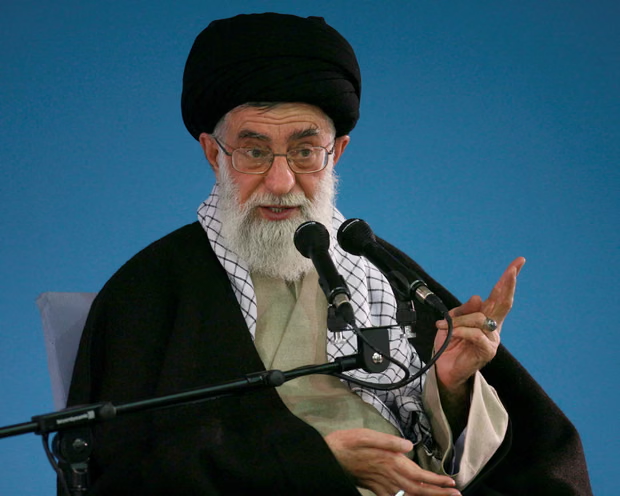
Ali Khamenei: The Iron Ayatollah Who Ruled Iran for 35 Years — and Died Under American Bombs

On the morning of his death, Ali Khamenei had been Iran’s Supreme Leader for 35 years, 10 months, and 22 days — longer than most of the Iranian citizens protesting in the streets below his compound had been alive. He had outlasted four American presidents who tried to contain him, one nuclear deal that briefly constrained him, sanctions regimes that crippled Iran’s economy without breaking his grip, and waves of domestic protest that he suppressed with a consistency that made the outcomes predictable even when the violence was shocking.

He did not outlast F-35s.

When American and Israeli aircraft turned his Tehran compound into rubble on Saturday morning, they ended not merely a life but an era whose beginning can be traced to the 1979 revolution that remade Iran, the Middle East, and the global security architecture in ways that the world is still living with. Khamenei did not start that revolution — Ruhollah Khomeini did — but he inherited it, consolidated it, and expanded it into a regional network of proxy forces, nuclear ambitions, and strategic patience that made him, by the time of his death, one of the most consequential and most consequentially dangerous figures in modern history.

This is the story of who he was, what he built, and what his death means for the region he shaped.


1. The Making of a Supreme Leader: From Mashhad to Khomeini’s Inner Circle

Ali Hosseini Khamenei was born in Mashhad in 1939, the second of eight children in a family whose religious identity was deep enough to send him to Qom for clerical education at a formative age. The journey from Mashhad to Qom placed him in the intellectual and spiritual environment of Shia Islam’s most important seminary city, and more specifically in the orbit of Ruhollah Khomeini — the cleric whose political theology would eventually produce the 1979 revolution and whose relationship with Khamenei would define the younger man’s entire public life.

The Shah’s secret police, SAVAK, arrested Khamenei multiple times during the 1960s and 1970s as his involvement in the revolutionary movement deepened. The arrests produced imprisonment and temporary exile rather than the kind of systematic destruction of revolutionary networks that might have altered the revolution’s eventual trajectory — a failure of counter-revolutionary intelligence that the Pahlavi regime would not survive.

The assassination attempt of 1981 produced the physical mark that Khamenei carried for the rest of his life. A bomb concealed in a tape recorder exploded during a speech he was delivering as the Islamic Republic’s president, paralysing his right arm permanently. The injury became part of his public identity — the visible evidence of the personal sacrifice the revolution had required of its leaders, deployed in official imagery and public narrative to establish his credentials as someone who had literally given part of himself to the cause.

His selection as Supreme Leader following Khomeini’s death in 1989 was not the obvious choice that subsequent decades of absolute power made it appear in retrospect. Khamenei was a mid-level cleric without the religious credentials — specifically, the rank of Grand Ayatollah — that Khomeini’s constitution had specified as requirements for the position. The Assembly of Experts, facing a succession crisis with no clearly qualified candidate, retrospectively elevated his clerical rank and appointed him to a position that most observers expected to be transitional or constrained. He proved them definitively wrong.


2. The Architecture of Absolute Power: How Khamenei Consolidated His Rule

The transition from Khomeini’s charismatic revolutionary authority to Khamenei’s institutional dominance took approximately a decade, and its mechanisms reveal the specific intelligence that made Khamenei more durable than his initial appointment suggested.

The critical insight that shaped his approach to power was the relationship between the Islamic Revolutionary Guard Corps and the clerical establishment. Khomeini had created the IRGC as a parallel military force loyal to the revolution rather than to the state — a counterweight to the regular military whose officers’ loyalty to the Islamic Republic was considered less certain in the revolution’s immediate aftermath. Khamenei transformed this parallel force into the central pillar of his personal power by deepening its institutional loyalty to the Supreme Leader’s office specifically rather than to the revolution’s abstract principles.

Under his guidance, the IRGC’s mandate expanded progressively from military and security functions into economic territory that eventually gave the organisation control over approximately 60 percent of Iran’s economy. Construction, telecommunications, oil and gas, banking, manufacturing — the IRGC built a commercial empire that generated the financial resources to sustain its military operations, fund its proxy network, and create the material interests that bound its senior officers to the continuation of the political system that protected their economic position. Khamenei turned soldiers into billionaires and billionaires into a reliable political base.

His veto power over electoral processes — expressed through the Guardian Council’s candidate disqualification authority, which eliminated reformist and moderate candidates from elections when their potential victory threatened the system’s fundamental direction — ensured that every president who served under him operated within parameters he defined. The presidents could negotiate within those parameters, sometimes achieve significant policy outcomes, and occasionally test the boundaries. They could not cross them. Every president was ultimately Khamenei’s instrument, and the instrument that most effectively served his purposes received the resources and political support to implement his agenda.


3. The Axis of Resistance: Khamenei’s Regional Empire

The most significant and most consequential achievement of Khamenei’s 35-year tenure was the construction of what Iranian strategic doctrine calls the Axis of Resistance — the network of proxy forces, allied governments, and ideologically aligned organisations spread across the Middle East that transformed Iran from a regionally significant state into a regional hegemon capable of projecting military force without deploying Iranian soldiers.

Lebanon was the Axis’s foundation and its most sophisticated expression. Hezbollah, which Iran created in the early 1980s following Israel’s first Lebanon invasion, became under Khamenei’s stewardship the most capable non-state military force in the world — an organisation with 100,000 rockets in its arsenal, social service infrastructure that rivalled the Lebanese state’s, political representation in Lebanon’s parliament, and combat experience accumulated across decades of operations against Israel and more recently in Syria’s civil war. Khamenei’s personal relationship with Hezbollah’s leadership was the operational expression of the broader strategic doctrine — the Supreme Leader’s office was the ultimate authority for Hezbollah’s major military decisions.

Gaza’s Hamas and Palestinian Islamic Jihad provided a second front capability against Israel that Iranian doctrine had always intended as complementary to Hezbollah’s northern pressure. The October 7, 2023 Hamas attack on Israel — the largest single-day massacre of Jews since the Holocaust — was framed by Israeli and American intelligence as an Iranian-orchestrated operation. Whether the specific timing and tactical details were coordinated from Tehran or represented Hamas’s independent decision acting on Iranian encouragement and funding, the attack’s occurrence was inseparable from the decade of Iranian investment in Hamas’s tunnel infrastructure, weaponry, and operational capacity.

Yemen’s Houthis developed from a domestic insurgency into a regional power projection tool of significant strategic value under Iranian guidance. Their ability to strike Saudi oil infrastructure, Red Sea shipping, and Israeli territory with drones and missiles demonstrated that the Axis of Resistance could reach across the Arabian Peninsula in ways that conventional military doctrine would have required significantly larger and more expensive forces to achieve. The Houthi drone and missile campaign against international shipping through the Red Sea, which preceded the current Gulf conflict and contributed to its escalation, was a Khamenei-era strategic investment paying its return.

Iraq’s Shia militia network — the Popular Mobilisation Forces and affiliated organisations — gave Iran effective political and military influence over the country that the American invasion had paradoxically delivered into Iranian strategic reach. Iraqi militias with Iranian training, funding, and equipment controlled enough political territory to prevent any Iraqi government from adopting a fully anti-Iranian foreign policy while maintaining the capacity to strike American forces in Iraq at operational moments of Tehran’s choosing.


4. The Nuclear Poker Game: 35 Years of Strategic Ambiguity

Khamenei’s management of Iran’s nuclear programme across 35 years represented the most sustained exercise in strategic ambiguity in the history of non-proliferation diplomacy — a decades-long maintenance of the threshold between civilian enrichment and weapons capability that extracted maximum leverage from the nuclear question without crossing the line that would have triggered the military response he was seeking to deter.

The programme’s trajectory under his leadership followed a consistent pattern: advance enrichment capability under civilian programme cover, absorb international pressure and negotiate diplomatically when pressure became unsustainable, extract sanctions relief in exchange for temporary constraints that preserved the technical knowledge required for eventual weaponisation, and resume advancement when diplomatic attention shifted. The JCPOA of 2015 was the most successful expression of this pattern — Iran accepted constraints on enrichment levels and centrifuge numbers in exchange for the sanctions relief that its collapsing economy required, while retaining the enrichment infrastructure and technical expertise that made rapid reconstitution possible when Donald Trump withdrew from the agreement in 2018.

The 2018 withdrawal proved, from Khamenei’s perspective, strategically beneficial. It allowed Iran to resume enrichment advancement under the cover of American bad faith in the agreement, rebuild its enrichment capacity significantly beyond JCPOA limits, and accumulate the near-weapons-grade material that by early 2026 had placed Iran within weeks of a deployable nuclear weapon’s worth of fissile material. The IAEA’s report of 90 percent uranium-235 enrichment — the threshold at which the technical gap between civilian enrichment and weapons-grade material effectively disappears — was the strategic position Khamenei had been manoeuvring toward for decades when Operation Epic Fury ended his ability to see it through.

His famous fatwa declaring nuclear weapons forbidden under Islamic law provided religious cover for Iran’s civilian programme claims while remaining carefully non-binding on the pragmatic military-strategic decisions that the IRGC and the Supreme Leader’s office would ultimately make about weaponisation. The fatwa was a diplomatic instrument. The centrifuges were the strategic reality.


5. The Presidents He Broke: Khamenei’s Management of Iran’s Political Theatre

The five presidents who served under Khamenei’s supreme authority each represented a different attempt to navigate the fundamental tension of the Islamic Republic’s constitutional structure — the formal separation between presidential authority over government and the Supreme Leader’s authority over everything that actually mattered.

Mohammad Khatami, the reformist who swept to power in 1997 on a wave of popular enthusiasm for political liberalisation, cultural opening, and improved relations with the West, represented the most serious challenge to Khamenei’s domestic authority of the pre-2009 period. Khatami’s election demonstrated that significant popular demand existed for a different kind of Islamic Republic — one that preserved the revolution’s formal structures while dramatically expanding civic freedoms. Khamenei’s response was to allow Khatami’s rhetoric while systematically blocking his legislative agenda through the Guardian Council, arresting journalists and intellectuals who gave voice to the reform project, and making clear to the IRGC and security services that their loyalty to the system took precedence over the president’s preferences. Khatami left office having demonstrated the limits of presidential power more effectively than any amount of constitutional analysis could have.

Mahmoud Ahmadinejad served as Khamenei’s bluntest instrument during the period when the nuclear programme required the most aggressive defence against international pressure. His Holocaust denial, his confrontational diplomacy, and his theatrical denunciations of Israel and the United States served Khamenei’s purposes precisely because their extremity made the regime appear maximally resistant to Western pressure — a posture that served Iran’s negotiating position even when it horrified Iranian reformists. The relationship eventually soured as Ahmadinejad developed independent ambitions, illustrating that even the most servile president eventually discovers the limits of his subordinate role.

Hassan Rouhani’s negotiation of the JCPOA was framed publicly as a triumph of Iranian diplomacy and was described by Khamenei as heroic flexibility — a temporary tactical concession in service of a strategic objective that remained unchanged. The characterisation was accurate. Rouhani’s achievement was real — the sanctions relief the JCPOA delivered provided Iran’s economy with breathing room that the alternative trajectory was not going to provide — but it operated entirely within parameters that Khamenei defined and could revoke, as Trump’s withdrawal and the subsequent Iranian enrichment resumption demonstrated.


6. The Domestic Repression: How Khamenei Managed Iran’s People

The most consistent thread running through Khamenei’s 35-year rule was the systematic suppression of domestic political opposition through a repertoire of tools that evolved from the blunt instruments of early post-revolutionary security to the sophisticated combination of internet blackouts, targeted arrests, and selective executions that characterised the 2022 Woman Life Freedom movement’s suppression.

The 1999 student protests were the first major test of Khamenei’s willingness to use force against the educated urban constituency that had been most enthusiastic about Khatami’s reform project. The security services’ violent closure of Tehran University dormitories and the subsequent crackdown on student political activity established that the Supreme Leader would not permit political mobilisation even from constituencies that operated within the system’s formal parameters.

The 2009 Green Movement — triggered by the evident fraud in Mahmoud Ahmadinejad’s re-election — represented the closest that domestic opposition came to threatening Khamenei’s hold on power before 2022. Millions of Iranians took to the streets under the slogan “Where is my vote?” in protests that lasted months and required sustained security force deployment to suppress. Khamenei’s explicit endorsement of the fraudulent result — his Friday prayer sermon declaring Ahmadinejad’s victory divine providence — made him personally responsible for the crackdown in a way that the system’s normal diffusion of accountability prevented in other contexts.

The 2022 Woman Life Freedom movement, sparked by Mahsa Amini’s death in morality police custody, was by every measure the most significant popular challenge to the Islamic Republic since 1979. The combination of women removing their headscarves publicly, young men joining them in direct confrontation with security forces, and the protests’ geographic breadth — reaching cities across Iran including in the conservative heartland — demonstrated that the revolutionary covenant had broken down across demographic groups that previous regimes of dissent had not fully mobilised. The security response that Khamenei authorised — live ammunition, mass arrests, executions of protesters — produced the 30,000 death toll that represents his bloodiest domestic legacy.


7. The Global Chess Player: Sanctions, Diplomacy, and Strategic Patience

Khamenei’s management of Iran’s relationship with the international community across 35 years demonstrated a consistent strategic intelligence that his domestic brutality and his inflammatory rhetoric sometimes obscured — the ability to identify and exploit the gaps in Western consensus, to extract value from negotiating processes while preserving strategic flexibility, and to build relationships with China and Russia that partially offset the sanctions pressure that would otherwise have been unsustainable.

The relationship with Russia, which deepened dramatically through the Ukraine conflict’s second phase, illustrated Khamenei’s opportunistic pragmatism at its most effective. Iran’s supply of over 50,000 Shahed drones to Russia’s Ukraine campaign transformed a bilateral relationship based primarily on arms purchases and diplomatic mutual support into a genuine strategic partnership with mutual military dependency. The drones-for-air-defence-systems exchange that the relationship implied gave Iran access to Russian military technology that Western sanctions had prevented it from acquiring through conventional channels.

China’s relationship with Iran was primarily economic — the discounted crude oil purchases that China’s manufacturing economy depended on, the dual-use technology flows that sustained Iran’s defence industrial base, and the diplomatic protection that China’s Security Council veto provided against the sanctions escalation that Western states periodically proposed. Khamenei’s management of the China relationship reflected an accurate assessment of Beijing’s priorities — China wanted Iranian oil and wanted to avoid being drawn into the military confrontation that direct weapons transfers would risk, and Khamenei calibrated Iran’s requests accordingly.

The 2023 Saudi-Iranian normalisation, brokered by China, represented the kind of diplomatic move that illustrated Khamenei’s continued strategic sophistication in the years before his death. Normalising with Saudi Arabia reduced the immediate risk of the Gulf confrontation that eventually erupted while providing Iran with diplomatic cover and partial sanctions relief that the isolation of the previous decade had denied it. The normalisation did not reflect a genuine change in Iranian strategic objectives — the Axis of Resistance continued operating, the nuclear programme continued advancing — but it demonstrated that Khamenei could modulate Iran’s international posture when tactical circumstances required it.


8. The Succession Crisis: Who Leads Iran Now

Khamenei’s death without a clearly designated and constitutionally qualified successor has created the leadership vacuum that the Islamic Republic’s constitutional designers anticipated but whose specifics they could not fully plan for. The Assembly of Experts — the body of senior clerics constitutionally empowered to select a new Supreme Leader — faces a situation in which the most obvious successor candidate, Mojtaba Khamenei, carries significant baggage that complicates his elevation.

Mojtaba, Khamenei’s second son, had been positioned by his father as the informal heir apparent through the accumulation of IRGC relationships, religious credentials, and political influence that such a succession requires. His reported injuries in the February 28th B-2 raid on a Qom bunker — burn wounds, morphine dependency, impaired decision-making — created a vulnerability in the succession plan that the IRGC hardliners who are currently dominating operational decision-making are managing around rather than through.

The transitional council comprising President Pezeshkian, the judiciary chief, and senior cleric Alireza Arafi represents a collective leadership mechanism whose durability is historically limited in revolutionary states. Collective leadership tends to be a transitional arrangement that resolves into individual authority as one faction or individual accumulates sufficient support to claim the supreme position. Whether that resolution produces a clerical successor who attempts to reconstitute Khamenei’s model of governance, an IRGC general who represents the security state’s complete absorption of clerical authority, or a reformist figure whose emergence reflects the kind of popular pressure that Trump’s bombing campaign was designed to create — these are the questions that the conflict’s trajectory will partly answer.

The IRGC’s consolidation of operational authority following the leadership decapitation of the opening strikes has created a military-dominated decision-making environment that the clerical establishment’s nominal authority cannot easily override. Whether this represents a temporary emergency arrangement or a permanent shift in the Islamic Republic’s power architecture is one of the conflict’s most significant unresolved questions.


9. Trump’s Revolution Bet: Will It Work?

The strategic theory underlying Operation Epic Fury — that destroying Iran’s military and clerical leadership would create the conditions for the popular revolution that Khamenei’s security state had suppressed across 35 years of protests — rests on a specific set of assumptions about Iranian society and political psychology that history both supports and complicates.

The evidence supporting the theory is real. Iranian public opinion surveys conducted through the conflict’s pre-history consistently showed majority opposition to the Islamic Republic’s governance among urban, educated, and younger Iranians. The 2022 Woman Life Freedom movement demonstrated that the willingness to risk physical confrontation with security forces extended beyond the liberal middle class to working-class communities, ethnic minorities, and conservative provincial cities where the revolution had previously retained genuine support. The 30,000 deaths in the 2026 protests — the bloodiest security response of Khamenei’s tenure — reflected the scale of the challenge the regime faced rather than its comfortable management of a contained dissent.

The evidence complicating the theory is equally real. Iranian nationalism, which is distinct from and sometimes in tension with support for the Islamic Republic, creates a dynamic in which foreign military attacks can consolidate public opinion around regime survival even among populations that would prefer a different government. The 1980-88 Iran-Iraq War — which Khomeini’s government survived despite eight years of devastating conflict and hundreds of thousands of Iranian dead — demonstrated that the Islamic Republic’s ability to mobilise nationalist sentiment in a defensive frame was substantial. American bombs over Tehran are being processed by Iranian citizens through both the framework of anti-regime relief and the framework of national humiliation, and the balance between those responses will shape whether Trump’s revolution bet pays off.

The IRGC’s continued operational capability — demonstrated by the scale and sophistication of Iran’s retaliation across multiple Gulf theatres — complicates the scenario in which a weakened security state faces a popular uprising without the tools to suppress it. The security services that killed 30,000 protesters in 2026 are the same security services that are simultaneously managing the military response to American and Israeli strikes. Whether they can sustain both operations without fracturing — whether the IRGC’s institutional coherence survives the combination of decapitation strikes and the demand to suppress domestic unrest while fighting a regional war — is the question that Trump’s gamble ultimately rests on.


10. The Legacy That Outlasts the Man

Ali Khamenei is dead. The structures he built — the IRGC’s economic empire, the Axis of Resistance’s regional network, the nuclear programme’s technical infrastructure — are damaged but not destroyed. The conflict that killed him was designed in part to degrade those structures permanently. Whether it succeeds will determine how his legacy is ultimately assessed.

The Axis of Resistance is under the most severe pressure of its existence. Hezbollah faces simultaneous pressure from the Lebanese government’s military operations ban and the IDF’s ground advance into its southern stronghold. Hamas’s Gaza operation was militarily crushed before the current conflict began. The Houthis continue operating but without the Iranian logistical support that their operations previously depended on. The Iraqi militias are managing the same tension between operational continuation and the political consequences of American responses to their attacks.

The nuclear programme — Khamenei’s most strategically significant legacy — faces the specific threat that the conflict’s stated objective is designed to permanently eliminate. American and Israeli strikes on nuclear sites have occurred repeatedly throughout the conflict’s progression. Whether they have achieved the destruction required to set the programme back by years, or whether Iranian technical resilience and redundancy have preserved enough infrastructure and expertise to reconstitute the programme relatively quickly after a conflict ends, is assessed differently by different intelligence services with access to different information.

The Iranian people — whose hatred of the regime Khamenei spent 35 years managing through alternating repression and co-optation — are the ultimate arbiters of the legacy question. If the combination of military decapitation and economic collapse produces the political transformation that Trump’s video message invited them to pursue, Khamenei will be remembered as the last Supreme Leader whose system was irreversibly broken. If the IRGC maintains control, installs a successor, and the Islamic Republic survives in some form — as it survived the Iran-Iraq War, the sanctions decades, and four previous waves of domestic protest — his legacy will be the durability of the system he built as much as the manner of his death.


Conclusion

Ali Khamenei ruled Iran for 35 years through a combination of political intelligence, institutional ruthlessness, strategic patience, and the willingness to use lethal force against his own people with a consistency that made the outcomes predictable even when the violence was shocking. He built the most sophisticated proxy network in the modern Middle East. He managed a nuclear programme through decades of international pressure without crossing the line that would have triggered the military response he was eventually unable to prevent. He outlasted every challenge — domestic and international — until the one he did not.

His death at 86, in his Tehran compound, under the bombs of the country he spent his career resisting, closes an era that began with Khomeini’s revolution and ends with F-35s overhead. What follows — whether Iran’s streets produce the revolution that Trump’s video invited, whether the IRGC consolidates a successor arrangement that preserves the Islamic Republic’s essential structure, or whether the nuclear programme produces the weapon that changes every calculation — will determine whether Khamenei’s death was the end of his system or merely the beginning of its most dangerous chapter.

The hornet’s nest has been kicked. The hornets are still flying. And the region that Khamenei shaped across 35 years of iron authority is now being reshaped by forces that even he, at the height of his power, could not have entirely anticipated or controlled.

Leave a Reply

Your email address will not be published. Required fields are marked *

News That Commands Truth — Without Filter

Independent journalism covering Pakistan and the world. Unfiltered reporting on politics, business, sports, and culture — delivered with clarity and purpose since 2024.

BREAKING LIVE EXCLUSIVE
f X in YT W
Contact Info
Email
info@sultannews.online
Editorial
editor@sultannews.online
Location
Karachi, Pakistan
Newsletter
© 2026 Sultan.News — All Rights Reserved. Karachi, Pakistan.