LIVE
Wednesday, Mar 18, 2026
24/7 News

Pakistan defence minister says country in ‘open war’ with Afghanistan after strikes

There are moments in a country’s security history when years of accumulated grievance, strategic patience, and diplomatic effort collapse into a single declaration. On Friday morning, Defence Minister Khawaja Asif stood before Pakistan’s media and said what Pakistan’s military had been building toward for months: our patience has run out.

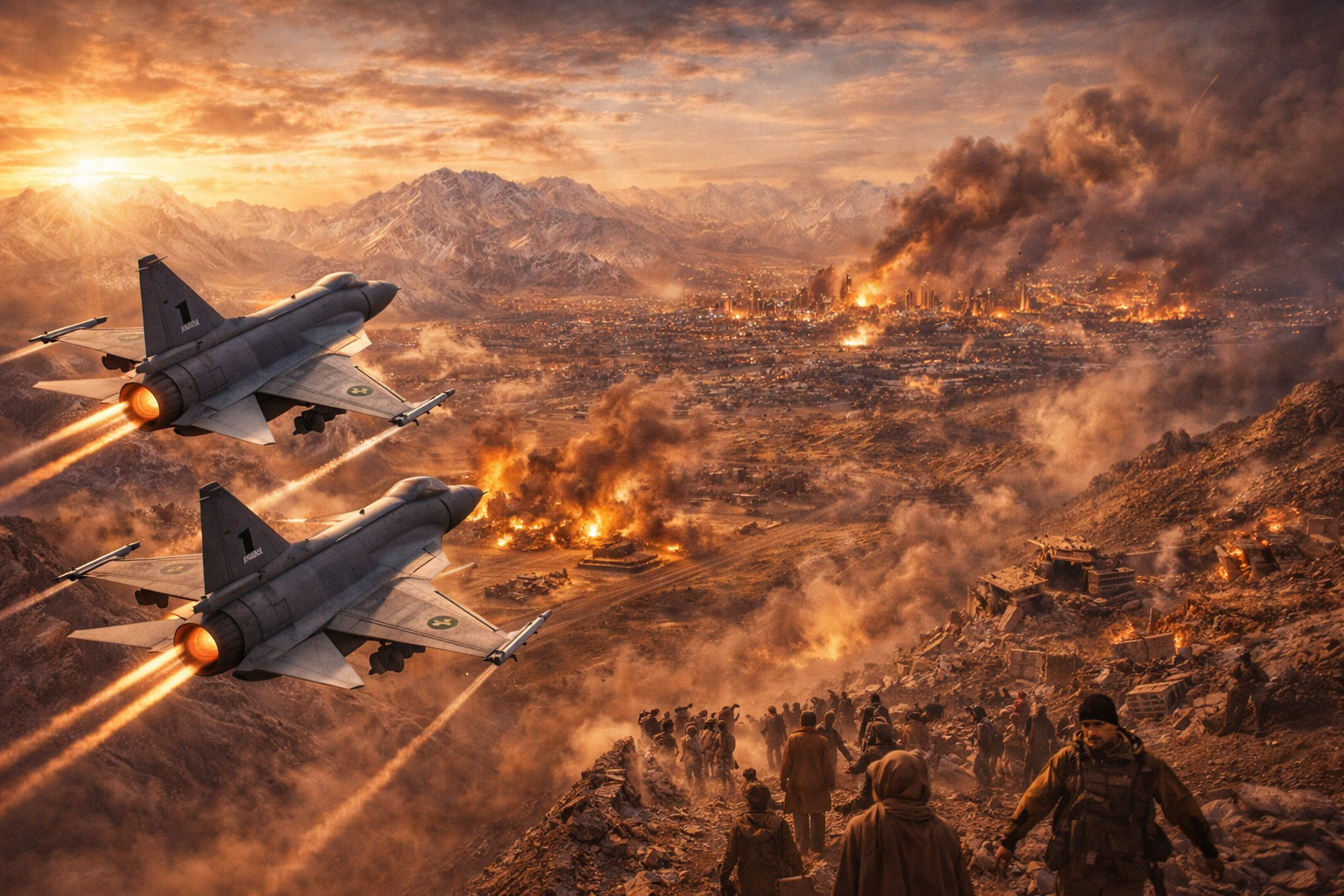
The statement was not metaphorical. Pakistani JF-17 Thunder jets had already struck 22 Afghan military targets across Kabul, Kandahar, and Paktika by the time Asif spoke. The strikes came hours after the Taliban launched what it described as a retaliatory offensive along the 2,600-kilometre Durand Line — a Thursday night operation that claimed 19 Pakistani border posts and two bases captured, 55 Pakistani soldiers killed, and the largest single territorial gain by Afghan forces against Pakistan since the two countries’ independence.

Pakistan confirmed 12 of its soldiers dead and claimed over 200 Taliban fighters killed in the subsequent airstrikes. The Taliban confirmed 13 of its fighters dead and 22 wounded while simultaneously claiming its drones had struck Swabi, Nowshera, and — most provocatively of all — Abbottabad, the city that houses the Pakistan Military Academy, the institution that trains Pakistan’s army officers and whose targeting represents the most direct challenge to military prestige that the Taliban has yet made.

The October ceasefire lasted four months. It is over. Pakistan and Afghanistan are at war.


1. The Collapse of the Ceasefire: What Finally Broke the Patience

The October ceasefire that preceded Friday’s open conflict was always described by analysts who had been following the Pakistan-Afghanistan relationship as fragile — built on mutual exhaustion rather than genuine resolution of the underlying disputes that have periodically produced military exchanges since Pakistan’s founding. Four months of relative calm were sufficient to allow both sides to rearm, reorganise, and prepare for what the deteriorating trajectory of their relationship made increasingly likely.

Pakistan’s specific triggers for the decision to declare open war rather than continue with the limited strike operations that had characterised its earlier response to TTP cross-border attacks were the accumulation of three developments whose combined effect exceeded the military leadership’s tolerance threshold.

The suicide bombing of a mosque in Islamabad — an attack whose planning and logistics were attributed by Pakistani intelligence to militants operating from Afghan territory — represented the kind of domestic political consequence of Afghan-based terrorism that Pakistan’s government could not absorb without response. Mosque bombings in the capital carry a symbolic weight that attacks on border posts, however militarily significant, do not produce in the same way. They arrive in the homes of Pakistan’s urban middle class and political establishment in a manner that creates immediate demand for response from constituencies that might otherwise be more patient with the strategic diplomacy of cross-border terrorism management.

The drone strikes on Abbottabad — and specifically on the Pakistan Military Academy — crossed a threshold that the army could not characterise as anything other than a direct challenge to its institutional authority and prestige. The PMA is the foundational institution of Pakistan’s officer corps, the place where every generation of army leadership has been trained, and its targeting communicates that the Taliban considers Pakistan’s military establishment itself a legitimate target rather than a party to be managed through calibrated pressure. For Army Chief Asim Munir, allowing that provocation to stand unanswered was not a strategic option.

The Taliban’s Thursday night border offensive — the scale of which, if the claim of 19 posts and two bases captured has any accuracy, represents the largest single Taliban territorial gain against Pakistan since the two countries have been in military confrontation — provided the immediate military justification for the strikes that the political and strategic grievances had been building toward. The offensive gave Pakistan’s response the character of a military necessity rather than a pre-planned escalation.


2. The Military Exchange: What Each Side Has and What It Means

The military balance between Pakistan and Afghanistan in the current conflict is asymmetric in ways that favour Pakistan decisively in conventional military terms while creating challenges that Pakistan’s conventional advantages cannot fully resolve.

Pakistan’s air superiority is essentially absolute. JF-17 Thunder jets operate against Taliban ground forces that have no meaningful air defence capability — the anti-aircraft guns that Afghan police claimed drove off Pakistani jets during earlier strikes represent at most a minor inconvenience to aircraft operating at altitudes and speeds that small-calibre anti-aircraft fire cannot reach reliably. Pakistan’s Burraq and Wing Loong drone inventory provides persistent surveillance and strike capability that allows targeting of Taliban command infrastructure, logistics routes, and concentrations of fighters without the political and financial cost of deploying manned aircraft for every engagement.

Pakistan’s artillery advantage extends beyond the quality and range of its systems to the training of its gun crews, the logistics that sustain ammunition supply, and the targeting intelligence that identifies Taliban positions with sufficient accuracy to make fire effective rather than merely loud. Taliban artillery capability, much of it derived from the American equipment captured during the 2021 withdrawal, is more substantial than Pakistan’s military planners anticipated at the conflict’s opening — the strikes on Swabi, Nowshera, and Abbottabad with drones demonstrate a capability to project force deep into Pakistani territory that earlier Taliban border operations had not revealed.

Taliban strengths are the mirror image of Pakistan’s conventional dominance. Home terrain knowledge across every mountain pass, valley, and cave system along 2,600 kilometres of frontier — accumulated through decades of fighting that predates the current conflict by generations — makes Taliban defensive positioning genuinely difficult to dislodge with airstrikes alone. The manpower available to the Taliban government, drawing from a population whose relationship with armed conflict is more intimate than almost any other on earth, provides a replacement capacity for casualties that Pakistan’s precision strikes cannot keep pace with across the full length of the Durand Line.

The captured American weapons that the Taliban inherited from the 2021 Afghan military collapse represent a qualitative upgrade from previous Taliban equipment that Pakistan’s military planners are accounting for differently than they did before the current conflict revealed its scope. M16 rifles and Humvees do not change the air power asymmetry. MANPADS, artillery pieces, and the drone capability that Thursday’s strikes on Abbottabad demonstrated create tactical challenges that require doctrinal adjustment.


3. The Propaganda War: Why the Casualty Numbers Tell You Almost Nothing

Both Pakistan and the Taliban are reporting casualty figures that serve their domestic political narratives rather than the operational reality of what is actually happening along the Durand Line, and understanding the gap between claimed and actual figures is essential for assessing the conflict’s true trajectory.

The Taliban’s claim of 55 Pakistani soldiers killed and 19 posts plus two bases captured in Thursday’s offensive is almost certainly inflated. The Taliban’s historical practice of reporting casualty figures in previous confrontations has consistently overstated Pakistani losses while understating its own — a pattern whose logic is straightforward. Domestic audiences in Afghanistan need to believe that the Taliban government is capable of confronting Pakistan effectively. International audiences whose sympathy the Taliban is attempting to cultivate need to understand the Taliban as a party facing aggression rather than as the aggressor. Both narratives are served by maximum enemy casualty claims and minimum self-casualty acknowledgement.

Pakistan’s claim of 200 plus Taliban fighters killed in Friday’s airstrikes is the inverse exercise. Pakistan needs its domestic audience to believe that the military action is producing results proportionate to its political cost — that the deaths of 12 confirmed Pakistani soldiers are being avenged at a meaningful ratio and that the strikes are degrading Taliban capability rather than simply destroying empty buildings. Pakistan’s government also needs to signal to the international community that its military operations are producing measurable results that justify their continuation.

Pakistan’s confirmed figure of 12 soldiers killed is the data point with the highest credibility — confirmed deaths of named individuals whose families are being notified is the category of military information that governments cannot falsify without immediate exposure. The Taliban’s confirmed figure of 13 fighters killed is plausible as an absolute minimum — the actual Taliban deaths from 22 targets struck by JF-17s are almost certainly higher, but how much higher is genuinely uncertain.


4. Pakistan’s Strategic Dilemma: Victory, Stalemate, or Quagmire

The strategic options available to Pakistan as it prosecutes open war with Afghanistan are bounded by constraints that the military’s tactical advantages do not eliminate and that historical precedent — both Pakistan’s own experience in previous border operations and the broader record of conventional militaries fighting in Afghan terrain — makes sobering to contemplate.

A Pakistani victory — defined as Taliban compliance with demands to expel or neutralise TTP leadership and cease providing sanctuary for anti-Pakistan militant operations — requires either the Taliban’s rational conclusion that the cost of non-compliance exceeds the political and ideological cost of compliance, or a military defeat so comprehensive that the Taliban has no alternative. The first scenario requires Pakistan to impose costs that the Taliban’s strategic culture makes it genuinely difficult to accept. The second scenario requires military operations of a scope that Pakistan’s domestic political economy, its international relationships, and its economic capacity under current Gulf war conditions make genuinely challenging to sustain.

The stalemate scenario — the most likely outcome according to most analysts, estimated at approximately 50 percent probability — involves sustained skirmishing along the Durand Line that neither side can resolve into decisive military or political victory. Pakistan’s air superiority allows it to impose costs on Taliban military infrastructure. Taliban’s home terrain advantage and manpower depth prevent Pakistan from converting air superiority into ground control. The result is an economically and politically costly equilibrium that erodes both sides’ capacity for other priorities without producing the security outcome that Pakistan’s military leadership has described as its objective.

The quagmire scenario — Pakistan becoming drawn into a ground operation that Afghanistan’s terrain, Taliban fanaticism, and potential TTP fifth-column activity inside Pakistan’s own military and security services transforms into a sustained drain on resources and political capital — is assigned the lowest probability but the highest risk-adjusted cost. The history of every outside power that has attempted to impose its will on Afghanistan through military force provides abundant cautionary material. Pakistan’s military leadership is acutely aware of this history and is designing its operations around air and artillery power precisely to avoid the ground engagement that has proven most costly for previous combatants.


5. The TTP Dimension: The Enemy Within the Enemy

The Tehrik-i-Taliban Pakistan’s role in the current conflict is simultaneously the clearest justification for Pakistan’s military operations and the most challenging aspect of the conflict’s resolution — because unlike the Afghan Taliban’s territorial army, TTP is a network whose nodes are distributed across both Pakistani and Afghan territory and whose elimination requires a different approach than defeating a conventional military force.

TTP’s resurrection following the Afghan Taliban’s 2021 return to power has been one of the most consequential and least internationally discussed security developments of the past three years. The ideological and personal ties between Afghan Taliban and TTP leadership — many TTP figures fought alongside Afghan Taliban during the American occupation and share the same networks of religious education, tribal connection, and operational experience — make the Afghan Taliban’s claimed inability to address TTP presence in Afghanistan a statement whose credibility Pakistan’s intelligence community has consistently rejected.

The mosque bombing in Islamabad that directly preceded Pakistan’s escalation to open war is the most recent and most politically impactful in a sequence of TTP operations that Pakistan attributes to Afghan-based planning and logistics. The operational pattern — suicide bombers recruited in Afghanistan, trained in facilities that Pakistan’s intelligence identifies on Afghan territory, and dispatched across the border with tactical support from TTP networks inside Pakistan — is what Pakistan’s military has been demanding the Taliban government disrupt. The Taliban’s consistent denial that it has either the will or the capability to do so has produced exactly the military response that Friday’s strikes represent.

The insider threat dimension — the possibility of TTP sympathisers within Pakistan’s own security services — is the aspect of the conflict that Pakistan’s military leadership discusses least publicly and worries about most privately. The drone strikes on Abbottabad required targeting information whose accuracy suggests either sophisticated intelligence collection capability on the Taliban’s part or access to information from sources with knowledge of Pakistani military locations and schedules. Whether the latter possibility reflects actual penetration of Pakistani security services or is simply the product of social media intelligence and long-term surveillance is being actively investigated.


6. The Refugee Crisis: A Humanitarian Disaster Within a Humanitarian Disaster

Pakistan’s 2023 deportation of 500,000 plus Afghan refugees — described at the time as the largest forced return of refugees in recent history — removed a population whose presence had been managed, however imperfectly, across decades of Pakistani-Afghan coexistence and whose abrupt removal left both the deportees and the communities they had built in Pakistan in conditions of severe disruption.

The deportation’s consequences are now arriving in the conflict’s most direct humanitarian expression. The Nangarhar refugee camp hit in Friday’s exchanges — a facility housing recently deported Afghans — represents the specific tragedy of a population that Pakistan expelled from its territory now being caught in the crossfire of Pakistan’s military operations against the territory it expelled them to. The nine confirmed injured from the camp are the initial data point in a casualty series that will grow as the conflict continues in areas where refugee settlements are located near Taliban military positions.

The new displacement flows heading toward Peshawar and Quetta — the Pakistani cities that have historically been the primary destinations for Afghan refugees — are arriving into a reception capacity already strained by the existing Afghan population and by the economic conditions that the Gulf war has imposed on Pakistan’s border provinces. Peshawar’s economy, which has historically absorbed refugee populations through the informal employment and commercial networks that cross-border trade sustains, is operating under the additional pressure of Torkham’s closure — the border crossing whose shutdown has eliminated the economic activity that provided both employment for Pakistanis and income for the Afghan traders and workers who might otherwise contribute to their own support.

The $2 billion in annual border trade that Torkham and Chaman together facilitated — now at zero with both crossings closed indefinitely — represents a bilateral economic relationship whose disruption affects Pakistani traders, Afghan exporters, and the border communities whose livelihoods depend on the commerce the crossings generate. The refugee crisis and the economic crisis are arriving simultaneously in the same geographic locations, creating a humanitarian management challenge that Pakistan’s provincial governments are facing without adequate resources and under the additional pressure of the Gulf war’s own economic consequences.


7. Pakistan’s Political Crisis: Shehbaz Sharif’s Most Dangerous Test

The open war declaration arrives at the worst possible moment for Pakistan’s coalition government — a political arrangement whose fragility was already being tested by the Gulf war’s economic consequences and that faces an open war’s additional demands on political cohesion, fiscal resources, and public confidence.

Prime Minister Shehbaz Sharif’s first experience of managing an open military conflict involves a set of competing imperatives that resist coherent resolution. Pakistan’s army wants decisive military victory — the elimination of TTP safe havens and the Taliban’s acknowledgement that Pakistan’s security demands must be accommodated — and Army Chief Asim Munir’s political influence within the current power arrangement gives military preferences effective veto power over government decisions that conflict with them. Sharif’s personal preference is likely a ceasefire achieved quickly enough to prevent the conflict from permanently damaging the coalition’s electoral viability — a ceasefire that the army will resist unless it comes with genuine Taliban compliance on TTP.

The PTI opposition’s response — characterising the conflict as the government’s creation — is the predictable political framing of an opposition that needs the government to fail. Its accuracy is contested, but its political effectiveness does not depend on accuracy. Pakistani voters experiencing Rs400 petrol, returning Gulf workers, border war casualties, and incoming Afghan refugees are a constituency whose frustration will find political expression in the direction of whoever is governing when the accumulated pressures reach their peak.

The coalition’s parliamentary arithmetic — already fragile given the political circumstances of its formation — creates the specific vulnerability that a sustained military conflict whose costs become visible before its benefits materialise typically produces. If Pakistan’s military operations produce early, visible results that the government can present as victories, the coalition survives. If the conflict settles into the stalemate scenario while the economic pressures continue accumulating, the pressure on individual coalition partners to reassess their participation becomes difficult to manage.


8. China’s CPEC Anxiety: The $62 Billion Stake in Pakistan’s Stability

China’s response to Pakistan’s open war declaration with Afghanistan is being shaped by the specific vulnerability that the China-Pakistan Economic Corridor’s physical infrastructure creates — a $62 billion infrastructure investment whose security depends on precisely the kind of stability that an open border war with Afghanistan threatens.

The CPEC corridor runs through Balochistan and KPK — the two provinces that share Pakistan’s border with Afghanistan and that have historically been most affected by the TTP insurgency and cross-border militant activity. Chinese workers on CPEC projects in these provinces have been targeted previously by both TTP and Baloch separatist groups, producing the Chinese demand for security guarantees that Pakistan has struggled to fully satisfy under normal conditions. An open war context multiplies the security challenge by adding Taliban drone capability — demonstrated in the Abbottabad strikes — to the existing threats against CPEC infrastructure.

Beijing’s communications to both Islamabad and Kabul reflect the CPEC anxiety directly. The Chinese demand for stability, expressed through the diplomatic channels that China maintains with both the Pakistani government and the Taliban — China was one of the few governments to maintain diplomatic engagement with Taliban-controlled Afghanistan — is backed by the implicit leverage of CPEC investment continuation and the more explicit leverage of China’s role as one of the Taliban government’s most important international economic relationships.

Whether China’s pressure on the Taliban produces the kind of compliance that Pakistan’s military operations are attempting to force through kinetic means — TTP leadership handover, sanctuary denial, border stability — is the central question of the diplomatic dimension of the current conflict. If Beijing concludes that its CPEC interests are better served by actively brokering an arrangement between Pakistan and the Taliban than by watching the conflict degrade the stability its investments require, the diplomatic intervention that Turkey’s foreign minister is attempting and Saudi Arabia is supporting could acquire the weight that China’s involvement would provide.


9. The Regional Context: Pakistan Surrounded

Pakistan’s open war with Afghanistan is not occurring in a vacuum — it is the latest and most acute crisis in a security environment that has placed Pakistan under simultaneous pressure from multiple directions in a configuration that has no recent precedent in the country’s history.

To Pakistan’s west, the Iran-US Gulf War has placed the Iran-Pakistan border under the kind of spillover risk that Balochistan’s existing security challenges amplify into a genuine threat. Iranian missiles striking targets near the Pakistan border, IRGC drone operations whose flight paths traverse Pakistani airspace, and the possibility of conflict spillover creating additional displacement flows toward Pakistan’s western provinces — these are active management challenges for a security apparatus simultaneously directing a major military operation to the north.

To Pakistan’s east, India’s observation of the conflict’s trajectory is being characterised in Pakistan’s security establishment as opportunistic intelligence gathering at minimum and potential military option development at maximum. Army Chief Asim Munir’s concern about demonstrating military weakness in the context of the Afghan operation — weakness that India might interpret as an opportunity to pressure Pakistan on other fronts — is a real factor in the Pakistani military’s calculation about the pace and decisiveness of its Afghan operations.

The Gulf’s ongoing crisis has eliminated the economic buffer that Pakistan’s foreign exchange reserves and Gulf remittances normally provide against domestic economic shocks. An open war with Afghanistan, under normal economic conditions, is a costly but manageable challenge for Pakistan’s economy. An open war with Afghanistan while petrol approaches Rs400 per litre, remittances are disrupted, LNG supply is reduced, and the IMF programme is under stress is a combination of pressures that Pakistan’s economic stability has never been tested against simultaneously.


10. The 48-Hour Scenario: What Analysts Are Watching

The conflict’s immediate trajectory over the next 48 hours will establish whether Friday’s exchange represents the opening of a sustained military campaign or the kind of intense but brief escalation that previous Pakistan-Afghanistan border crises have sometimes produced before both sides’ calculations converge on temporary de-escalation.

Pakistan’s likely military priorities — additional airstrikes on targets in Ghazni and Spin Boldak, total Torkham trade blockade, preparations for potential limited ground operations to retake any posts the Taliban claims to have captured, and 11 Corps mobilisation toward the frontier — reflect a military establishment that has made the decision to prosecute this conflict at a level of intensity that produces results rather than the sustained low-level strikes that had characterised the previous phase.

Taliban’s counter-options — guerrilla raids on Pakistani border posts, additional drone strikes on Pakistani cities, TTP activation of suicide bombing networks inside Pakistan, and the international victim narrative that UN sympathy for civilian casualties in Afghanistan tends to generate — represent a combination of kinetic and political pressure that is designed to raise the cost of Pakistan’s military operations while building the international pressure for ceasefire that might produce a negotiated outcome the Taliban can present domestically as a victory.

Turkey’s Foreign Minister Fidan’s mediation role and Saudi Arabia’s active encouragement of diplomatic de-escalation through Ishaq Dar represent the external diplomatic circuit that Pakistan’s government needs to produce a face-saving off-ramp if the military calculus shifts from operations achieving their objectives to operations creating costs that exceed their benefits. The ceasefire possibility is real, but it requires both sides to conclude simultaneously that the conflict’s continuation serves their interests less well than a negotiated pause — a convergence that is more likely after both sides have demonstrated military capability and political resolve than in the conflict’s opening days.


Conclusion

Pakistan’s open war declaration against Afghanistan is the culmination of years of accumulated grievance, strategic patience exhausted by TTP bombings and Taliban arrogance, and a specific set of provocations — the Islamabad mosque bombing and the Abbottabad drone strikes on the Pakistan Military Academy — that Pakistan’s army could not absorb without a response that matched their symbolic gravity.

The conflict’s military balance favours Pakistan decisively in conventional terms. JF-17 air superiority, drone capability, and artillery range create a force projection advantage that the Taliban’s home terrain knowledge and fanatical manpower cannot eliminate. But the history of every military that has projected conventional dominance into Afghanistan’s terrain — from Alexander the Great to the Soviet Union to NATO — provides a cautionary record that Pakistan’s military planners are aware of and are designing their operational approach to avoid repeating.

Defence Minister Asif’s “our patience has run out” is both a sincere description of Pakistan’s security establishment’s emotional state and a strategic communication designed to signal the credibility of Pakistan’s military commitment to the current operation. Whether that commitment is sustained long enough and at sufficient intensity to produce the Taliban compliance that Pakistan demands — or whether it settles into the stalemate that most analysts consider the most likely outcome — will determine whether Friday’s open war declaration marks the beginning of Pakistan’s Afghan problem’s resolution or the beginning of its most acute manifestation.

Shehbaz Sharif is navigating his first war under conditions that no previous Pakistani Prime Minister has faced — a border conflict to the north, a Gulf war to the west, an economic crisis at home, and an army whose strategic objectives and political patience set the parameters within which his government must operate.

Pakistan’s patience ran out on Friday. The question is what running out of patience actually produces when the opponent is Afghanistan.

Leave a Reply

Your email address will not be published. Required fields are marked *

News That Commands Truth — Without Filter

Independent journalism covering Pakistan and the world. Unfiltered reporting on politics, business, sports, and culture — delivered with clarity and purpose since 2024.

BREAKING LIVE EXCLUSIVE
f X in YT W
Contact Info
Email
info@sultannews.online
Editorial
editor@sultannews.online
Location
Karachi, Pakistan
Newsletter
© 2026 Sultan.News — All Rights Reserved. Karachi, Pakistan.