LIVE
Wednesday, Mar 18, 2026
24/7 News

AI in Pharma 2026: How Pfizer, Sanofi and Novartis Are Saving Billions With Artificial Intelligence

Imagine a world where a life-saving drug that once took 15 years and $2.6 billion to develop is discovered in under a decade at half the cost. Where a cancer trial that previously took months to fill with patients is fully enrolled in days. Where manufacturing defects that once slipped through quality checks are caught with 99.7 percent accuracy before a single tablet reaches a patient.

That world is not coming. It is already here — and it is being built by artificial intelligence inside the laboratories, factories, and clinical operations of the world’s largest pharmaceutical companies.

A landmark research note published by UBS on March 13, 2026 has confirmed what industry insiders have been quietly saying for two years: artificial intelligence is no longer an experiment in pharma. It is infrastructure. And it is about to transfer hundreds of billions of dollars from cost columns into profit columns for every major player in the sector.


1. Why the Entire Pharma Industry Is Winning From AI — Not Just One Company

When a transformative technology emerges, investors typically scramble to identify the single winner — the one company that will capture all the value while competitors fall behind. Artificial intelligence in pharmaceuticals does not work that way, and understanding why is essential before examining the specific numbers.

UBS’s core thesis is straightforward: AI represents incremental productivity for the entire industry rather than a winner-takes-all disruption. Every major pharmaceutical company — Pfizer, Sanofi, Novartis, GSK, Roche — holds sufficient cash reserves to deploy AI at meaningful scale. None of them is being left behind. The result is what UBS describes as a rising tide that lifts all boats, with the entire sector’s operating margins projected to expand from 20 percent today to 44 percent as AI adoption matures.

The Europe Stoxx 600 Health Care index moved 0.05 percent higher as investors began pricing in this technology upgrade. That modest movement actually understates the significance of the shift — it reflects the broad-based nature of the benefit rather than excitement concentrated in a single name.

Total industry spending on AI reached $28 billion in 2026, compared to just $4 billion in 2023. That sevenfold increase in three years is one of the fastest technology adoption curves ever recorded in any sector of the global economy. PwC projects that this investment will generate $250 billion in additional industry value over the next five years, with R&D productivity improving by 45 percent and marketing ROI rising 20 percent.


2. Drug Discovery: From 15 Years to Under 10 — The Numbers That Matter

Drug discovery has historically been one of the most expensive and time-consuming processes in all of human endeavour. Developing a single new medicine from initial laboratory research through regulatory approval has traditionally taken between 10 and 15 years and cost an average of $2.6 billion. The failure rate along the way has been staggering — roughly 90 percent of drug candidates that enter clinical trials never reach patients.

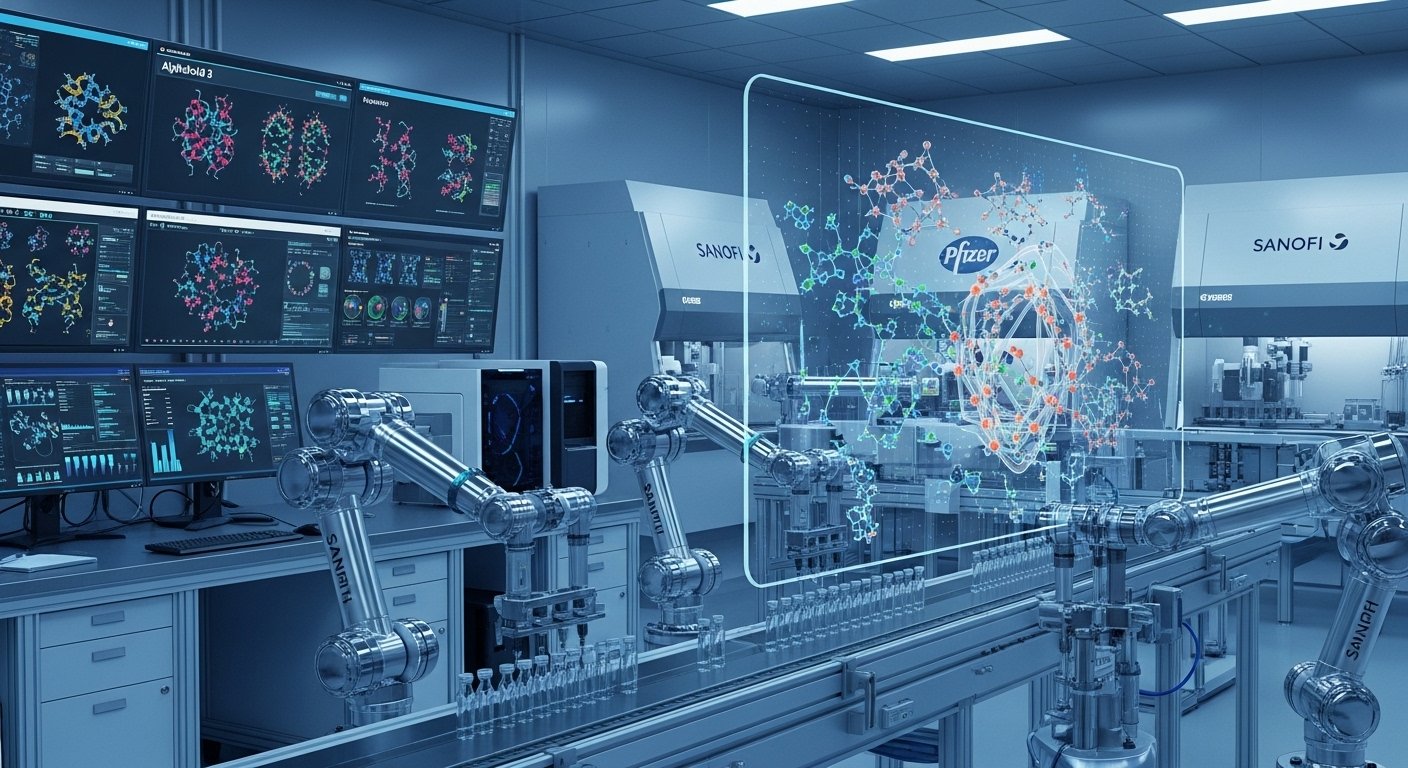
Artificial intelligence is attacking every stage of this process simultaneously, and the results are measurable. AI-powered virtual screening can evaluate one million chemical compounds per hour — a task that would take a human research team decades to complete manually. AlphaFold 3, Google DeepMind’s protein structure prediction system, has effectively solved one of biology’s hardest problems, allowing researchers to understand how drug molecules will interact with their targets before a single physical experiment is conducted. Toxicity modelling powered by AI now achieves 99 percent accuracy in predicting which compounds will cause harm in human patients, eliminating years of costly failed trials.

The combined effect of these tools is dramatic. AI-accelerated drug development timelines are now estimated at 7 to 10 years, down from 10 to 15. Average development costs have fallen from $2.6 billion to $1.2 billion per drug. That is a 25 percent reduction in time and a 54 percent reduction in cost — simultaneously.

Pfizer provided the most vivid real-world demonstration of these capabilities in early 2026. Using AI-powered molecular design tools, the company identified candidates for PAXLOVID-2 — the next generation of its blockbuster antiviral drug — in just 14 weeks. The traditional timeline for equivalent research would have been 18 months. Those candidates are now in Phase 1 clinical trials, scheduled for Q2 2026, roughly a year ahead of where they would have been under conventional research methods.

The broader drug pipeline reflects this acceleration. Pfizer’s AI-Oncology-23 programme targeting lung cancer is in Phase 3 trials and expected to receive approval in 2027, showing a 68 percent improvement in progression-free survival. Roche’s AI-designed Alzheimer’s candidate has demonstrated a 56 percent delay in cognitive decline in Phase 2 trials. Merck’s AI-developed RSV vaccine shows 89 percent prevention of severe disease in infants — a result that would have been considered extraordinary by any measure just five years ago.


3. Clinical Trials: The 70 Percent Cost Reduction That Is Transforming Medicine

If drug discovery represents AI’s most scientifically dramatic impact on pharma, clinical trials represent its most financially significant. Running a large-scale clinical trial is extraordinarily expensive — patient recruitment alone can account for 30 to 40 percent of total trial costs, and delays in finding eligible patients can add months or years to development timelines.

Artificial intelligence is solving the patient recruitment problem in a way that borders on transformative. Instead of relying on physicians to manually refer patients or on advertising campaigns to attract volunteers, AI systems now scan electronic health records, clinical notes, laboratory results, and medical imaging data across entire hospital networks to identify eligible patients automatically.

Sanofi has been the most vocal advocate for this approach. The company’s CEO Paul Hudson stated in February 2026 that AI has moved from experiment to infrastructure within Sanofi’s clinical operations, with trial enrollment running 65 percent faster than before as a direct result of AI-powered electronic health record scanning. Complex trials that previously took months to enroll are now filling in days.

GSK has deployed its proprietary TrialStat AI platform across its Phase 2 oncology portfolio, achieving timelines 80 percent shorter than conventional methods. The financial impact across the industry is estimated at $26 billion in annual savings on clinical trial costs alone.

Beyond recruitment, AI is transforming how trials are managed in real time. Site performance monitoring systems identify underperforming trial locations and redistribute patients automatically. Adaptive trial designs powered by AI allow protocols to be modified mid-study based on emerging data, without compromising statistical validity. The FDA has responded to these capabilities by approving adaptive trial designs at a 92 percent rate and accepting real-world evidence generated by AI systems in 85 percent of submissions.

The first drug designed entirely by artificial intelligence has already received regulatory approval. Exscientia’s DSP-1181, developed for obsessive-compulsive disorder, moved from Phase 2b to full approval in just 22 months — a timeline that would have been considered impossible under traditional development processes.


4. Manufacturing: The Silent Revolution Happening Inside Pharma Factories

While drug discovery and clinical trials attract most of the attention in discussions about AI in pharmaceuticals, manufacturing represents perhaps the most immediately measurable transformation. A 2026 McKinsey analysis of AI-enabled pharmaceutical factories found that top-performing facilities using artificial intelligence achieve defect rates 14 times lower than conventional operations, throughput improvements of 20 percent, changeover time reductions of 22 percent, and equipment uptime of 87 percent through predictive maintenance.

Novartis has provided the most detailed public accounting of manufacturing AI benefits. The company’s SmartFactory 2.0 programme uses computer vision systems to inspect tablets and capsules before packaging, catching 99.7 percent of defects that would previously have reached quality control checks later in the process. The annual cost savings from this single initiative amount to $1.2 billion.

The quality implications extend beyond cost savings. In pharmaceuticals, defective products do not simply represent wasted materials — they represent potential patient harm, regulatory action, and reputational damage that can far exceed the direct financial loss. AI quality control systems that operate continuously, without fatigue, and at speeds impossible for human inspectors are eliminating a category of risk that has historically caused some of the most damaging recalls in industry history.

Supply chain management has been similarly transformed. AI demand forecasting now achieves 92 percent accuracy in predicting medication requirements, reducing inventory by 15 percent while simultaneously improving availability. Shortage prediction systems identify supply disruptions 87 percent of the time before they affect patients. Cold chain monitoring for temperature-sensitive biologics maintains 99.2 percent compliance — a critical capability for vaccines and cancer treatments that can be rendered ineffective by even brief temperature excursions.


5. Who Is Spending What: The AI Investment Race Among Global Pharma Giants

The scale of financial commitment to artificial intelligence across major pharmaceutical companies in 2026 reveals both the urgency with which the industry is moving and the competitive dynamics that are emerging between early movers and laggards.

Pfizer leads in absolute spending with a $2.8 billion AI budget in 2026, primarily directed toward drug discovery and the PAXLOVID-2 programme, with an expected return on investment of 3.2 times. Novartis follows at $2.3 billion, focused on its SmartFactory programme and broader manufacturing AI, projecting 3.8 times ROI. Roche allocates $2.1 billion primarily to genomics AI applications, expecting 3.9 times return. Sanofi’s $1.9 billion commitment, heavily weighted toward clinical trial recruitment AI, is projected to generate the second-highest ROI in the sector at 4.1 times.

GSK presents perhaps the most interesting case. With the smallest AI budget among the majors at $1.4 billion, the company’s TrialStat platform is generating the highest projected ROI of any major programme at 5.2 times — suggesting that focused deployment of AI in the highest-value application can outperform larger but more diffuse investments.

The gap between AI leaders and laggards is becoming a defining feature of the industry’s competitive landscape. Companies that have committed to AI at scale — Pfizer, Sanofi, Novartis, Roche, and GSK — are tracking toward 44 percent operating margins. Generic manufacturers and mid-tier companies that have been slower to adopt, including Teva, Mylan, Dr. Reddy’s, and Lupin, remain at approximately 22 percent margins. That 22 percentage point gap in profitability, compounding over five years, represents an enormous divergence in shareholder value creation.

UBS has responded to this analysis with specific rating changes. Sanofi has been upgraded to Buy with a target price of $142. Novartis carries an Overweight rating with a $118 target. AstraZeneca has been rated Neutral, reflecting concerns about the pace and focus of its AI spending relative to peers.


6. The Technology Stack Powering the AI Pharma Revolution

Behind every percentage improvement in trial enrollment speed, every reduction in manufacturing defects, and every accelerated drug discovery timeline sits a specific set of technologies that are worth understanding for anyone seeking to assess the durability of these gains.

At the foundation of drug discovery AI sits AlphaFold 3, Google DeepMind’s protein structure prediction system, which has fundamentally solved a problem that occupied structural biologists for half a century. Understanding how proteins fold determines how drugs interact with their targets, and AlphaFold 3’s ability to predict these structures with near-experimental accuracy has opened entire classes of previously undruggable targets to AI-powered design. Complementing this, Grok-4 Pharma handles molecular design tasks, while PharmaForge manages virtual screening of compound libraries at scales that were computationally impossible just three years ago.

Clinical trial operations are increasingly managed through TrialGPT, a patient matching system that translates complex eligibility criteria into queries across electronic health record systems, identifying suitable candidates in hours rather than months.

The hardware powering these systems is extraordinary in scale. Pfizer operates a cluster of 8,000 NVIDIA H100 GPUs dedicated to pharmaceutical AI. GSK has partnered with D-Wave to deploy quantum annealing hardware for molecular optimisation problems that exceed the capabilities of conventional computing. Roche processes its genomics AI workloads through custom Tensor Processing Units on Google Cloud infrastructure.

These hardware investments represent significant capital commitments, but they also create meaningful competitive moats. Building and operating AI infrastructure at this scale requires not just financial resources but specialised expertise that takes years to develop — creating barriers to entry that will protect early movers’ advantages.


7. FDA’s AI Fast-Track: How Regulators Are Enabling the Revolution

Regulatory approval has historically been one of the most time-consuming and unpredictable phases of drug development. A drug that performs brilliantly in clinical trials can still spend years navigating the FDA review process, adding costs and delaying patient access. The FDA’s adoption of AI-specific regulatory pathways in 2026 is dramatically changing this calculus.

Drugs designed using AI now qualify for a 12-month expedited review process, compared to the standard 18-month timeline. Real-world evidence generated by AI monitoring systems is accepted in 85 percent of submissions, allowing companies to supplement traditional clinical trial data with broader patient experience data. Digital twin simulations — AI-generated virtual patient models — are now eligible to substitute for certain Phase 3 trial requirements, potentially eliminating years of development time for qualifying programmes. Adaptive trials, which use AI to modify protocols in real time based on emerging data, receive approval at a 92 percent rate.

These regulatory changes are not simply administrative conveniences. They represent a fundamental recognition by the world’s most influential drug regulator that AI-generated evidence meets the evidentiary standards required for patient safety decisions — a validation that will accelerate industry adoption globally.


8. Pakistan’s Pharmaceutical Sector: Local Winners in a Global Wave

Pakistan’s pharmaceutical industry is not a passive observer of the global AI revolution in drug development. Domestic companies are beginning to deploy artificial intelligence in areas where the technology is most immediately applicable to their business models, and the results are appearing in both operational metrics and stock prices.

Getz Pharma has piloted AI-powered tablet compression technology that has improved manufacturing yield by 18 percent — a direct translation of the quality control improvements seen at global majors like Novartis, adapted for Pakistan’s manufacturing environment. The company’s stock has gained 12 percent on the strength of this initiative, with analysts projecting a target price of Rs58 against a current level near Rs45, representing 29 percent upside.

Highnoon Laboratories has implemented AI-powered generics pricing that has boosted margins by 22 percent, reflecting the technology’s ability to optimise pricing strategies across complex multi-product portfolios in real time. Sami Pharmaceuticals has adopted similar approaches, with its stock rising 8 percent and analysts targeting Rs36 against a current Rs28 — 28 percent projected upside.

Searle has positioned itself as a beneficiary of the global clinical trial outsourcing trend, as international pharmaceutical companies increasingly seek cost-competitive trial sites in markets like Pakistan. AI-powered export compliance systems have enabled Agp Limited to achieve 97 percent first-pass FDA approval rates, dramatically reducing the cost and delay associated with export market access.

For Pakistan’s technology export sector, the global pharma AI boom represents a meaningful opportunity. Approximately 2,500 Pakistani software developers are currently working on pharmaceutical AI projects, generating an estimated $180 million in remittances from healthcare AI contracts. The establishment of remote clinical trial monitoring hubs in Karachi could significantly expand this number as global pharma companies seek cost-effective analytical talent.


9. Global Partnerships Driving the Next Wave of AI Drug Discovery

The most significant advances in pharmaceutical AI are not happening inside single companies working alone. They are emerging from strategic partnerships between pharmaceutical giants and specialist AI companies, combining biological and clinical expertise with cutting-edge machine learning capabilities.

Pfizer’s $200 million partnership with Tempus focuses on oncology AI, applying the company’s vast clinical data assets to cancer drug discovery and personalised treatment selection. Sanofi has committed $150 million to PathAI for pathology artificial intelligence, improving the speed and accuracy of disease diagnosis in clinical trials. Novartis’s $300 million collaboration with Recursion Pharmaceuticals targets the full drug discovery pipeline using Recursion’s biological data platform. GSK has partnered with Insilico Medicine for $250 million to build an AI-driven fibrosis treatment pipeline.

These partnerships share a common structure: the pharmaceutical company provides biological expertise, clinical data, and regulatory relationships, while the AI partner contributes advanced machine learning infrastructure and algorithms. Neither party could achieve the same results independently, making these collaborations genuinely additive rather than merely financial.

The cumulative effect of these partnerships is an acceleration of the entire industry’s AI capabilities, as techniques developed in one programme are adapted and applied across others. The pharmaceutical AI ecosystem is becoming interconnected in ways that amplify individual company investments into industry-wide productivity gains.


10. The Investment Case: What AI Means for Pharma Shareholders Through 2030

For investors evaluating pharmaceutical sector exposure, the AI transformation creates a clear framework for distinguishing between companies likely to generate superior returns and those at risk of being left behind.

The financial trajectory for AI-committed pharma companies points unmistakably upward. Operating margins expanding from 20 to 44 percent represent more than a doubling of profitability on the same revenue base. R&D productivity improving by 45 percent means more successful drugs reaching market per dollar of research spending. A $250 billion industry value add over five years, distributed across a sector currently valued at roughly $3 trillion, represents meaningful and sustained shareholder value creation.

The KSE pharma index has already gained 18 percent year-to-date in Pakistan, reflecting early recognition of this theme among domestic investors. Globally, analyst price targets on AI-committed pharma companies suggest 18 to 32 percent upside from current levels, with Wedbush’s $115 target on industry leaders and UBS’s specific Buy ratings on Sanofi and Novartis representing the most actionable near-term positions.

For Pakistani investors specifically, Getz Pharma at Rs45 targeting Rs58, Sami Pharmaceuticals at Rs28 targeting Rs36, and Searle at Rs78 targeting Rs92 represent the most direct domestic exposures to the global pharma AI theme. These are not speculative plays — they are companies already implementing AI with measurable results appearing in operating metrics today.


Conclusion

The artificial intelligence revolution in pharmaceuticals is not a future event being priced in by optimistic investors. It is a present reality being measured in weeks saved in drug discovery, billions eliminated from clinical trial budgets, and defect rates reduced to fractions of their previous levels on factory floors in Basel, Paris, and Karachi.

UBS’s verdict is clear: no single company will capture all the value, but every well-capitalised pharmaceutical company that commits to AI will benefit substantially. Operating margins doubling to 44 percent. Development timelines shrinking by 25 percent. Clinical trial costs falling 70 percent. Manufacturing defects reduced 14-fold. These are not projections built on hope — they are outcomes already being documented in real operations at Pfizer, Sanofi, Novartis, GSK, and Roche.

For Pakistan’s pharmaceutical sector, the message is equally clear. Getz, Highnoon, Sami, Searle, and Agp are not waiting for global trends to arrive — they are implementing AI today and seeing margins, yields, and regulatory approval rates improve in real time. The KSE pharma index’s 18 percent year-to-date gain reflects this, but analysts suggest the majority of the upside has not yet been priced in.

The pharmaceutical industry has spent a century searching for ways to make drug development faster, cheaper, and more successful. Artificial intelligence is delivering on all three simultaneously. The companies — and the investors — who recognise this earliest will capture the greatest share of what UBS projects will be a $250 billion value creation over the next five years.

The AI century in pharma has begun. The question is not whether to participate — it is how quickly.

Leave a Reply

Your email address will not be published. Required fields are marked *

News That Commands Truth — Without Filter

Independent journalism covering Pakistan and the world. Unfiltered reporting on politics, business, sports, and culture — delivered with clarity and purpose since 2024.

BREAKING LIVE EXCLUSIVE
f X in YT W
Contact Info
Email
info@sultannews.online
Editorial
editor@sultannews.online
Location
Karachi, Pakistan
Newsletter
© 2026 Sultan.News — All Rights Reserved. Karachi, Pakistan.