Britain’s pubs are dying at one a day, and the loss is happening so slowly that most people only notice it in hindsight. In 2025, 366 pubs closed across the United Kingdom – one every single day. That number is not just a statistic. It is the slow, quiet erosion of a social world built around corner boozers, sticky carpets, and bar‑staff who know your order before you say it. Rising energy costs, crushing business rates, changing drinking habits, and the lingering debt‑burden of the pandemic have combined to put immense pressure on the very institutions that have traditionally held British social life together.
In response, a new wave of creators has emerged on Instagram and TikTok. These are not just lifestyle influencers chasing trends. They genuinely love traditional British pubs – the kind that serve bitter, not craft cocktails, and where the only “theme” is the passage of time. Accounts like Proper Boozers and London Dead Pubs have turned faded carpets, velvet booths, and old-school jukeboxes into viral content, using the algorithm to do something unexpected: draw attention back to the pubs that mainstream marketing has long ignored.
What Makes a Proper Boozer – And Why It Matters
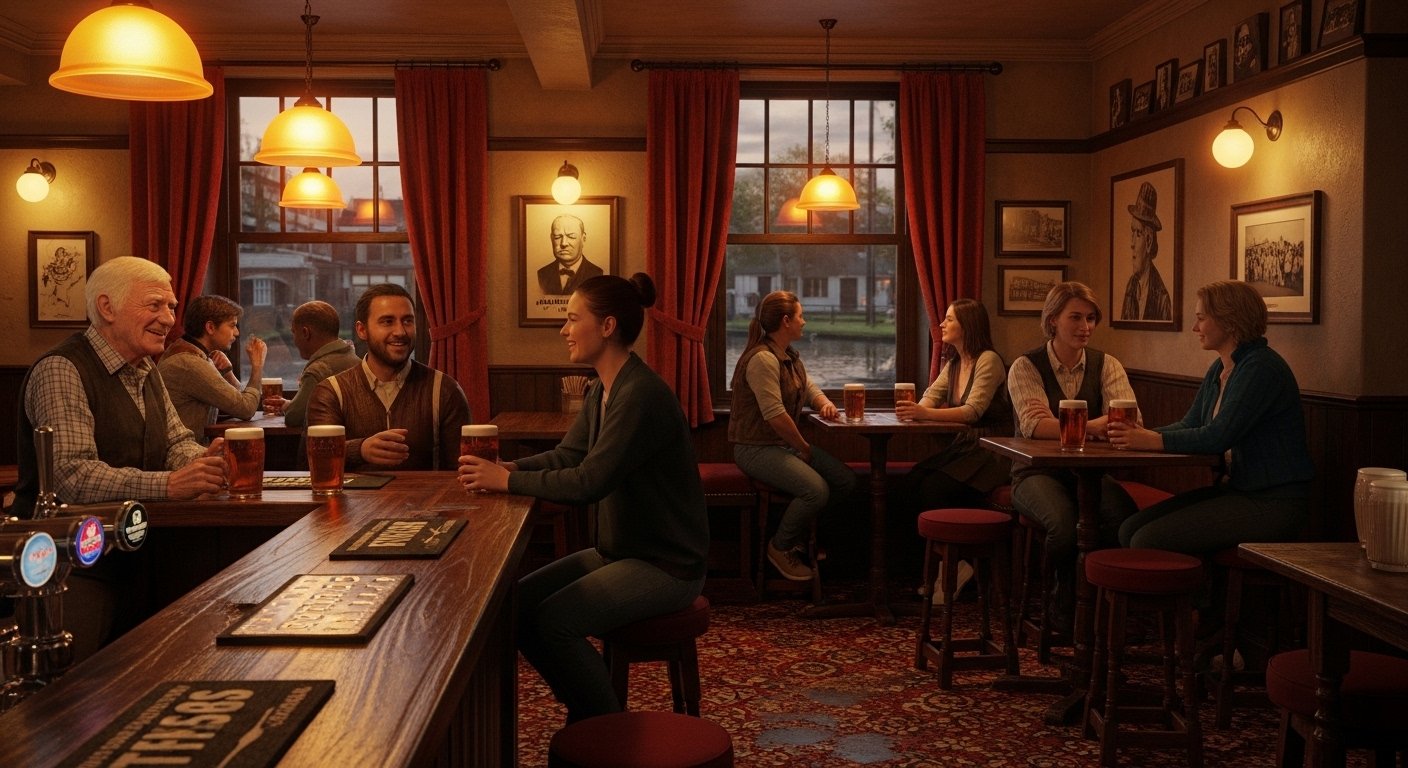
Before understanding what is being lost and what is being saved, it helps to be precise about what a proper pub actually is. The word “pub” has been stretched to cover everything from sterile gastropubs to bottle‑bar‑style cocktail lounges. A real boozer is different. It is the place where beer is the main product, not the side‑act for a food menu. A few crisps and maybe a pie are usually enough. The décor is worn, not curated. The carpet carries the memory of decades of spilt pints. The barman remembers your face, your usual drink, and the way you like it poured.
The social atmosphere of a proper boozer is hard to manufacture and impossible to standardise. It is where conversations about football turn into heated arguments that dissolve into laughter within minutes. It is where complaints about the weather slip into stories that have been retold so many times their details have blurred into something closer to folklore. The same people keep coming back, and the same jokes get recycled, not because they are boring, but because they are the threads that hold the community together. In a world where attention is fragmented across screens, the pub offers a rare kind of continuity — a place where the social life of a neighbourhood is lived and rehearsed over years.
Social Media Creators Changing the Equation
The creators who film traditional British pubs are using the attention economy’s tools to rebel against its core assumptions. Pubs are the opposite of curated, screen‑first environments. People go to them to talk, to drink, and to be present – not to scroll. The irony of saving them through viral videos is that these creators are broadcasting the appeal of a space that explicitly resists being turned into content.
Proper Boozers has built a substantial following by posting unpolished, no‑ring‑light footage of ordinary pubs that would never make it onto polished lifestyle channels. The camera moves slowly, the lighting is natural, and the sound is the real‑world hum of conversation and clinking glasses. The focus is on the people, the atmosphere, and the small, unscripted moments that define a pub — not on presenting it as a “perfectly framed aesthetic.” The result is a kind of authenticity that performs extremely well on platforms built around emotional engagement.
London Dead Pubs, run by Jimmy McIntosh, takes a slightly different angle. It documents pubs that are at risk of closure or have already shut for good, creating a visual record of what is being lost. In some cases, the account’s attention has helped keep struggling pubs open by attracting new customers and reminding regulars why these places matter. The magic, McIntosh says, is in the unscripted conversations – the way strangers who have no reason to talk to each other end up in the same room, with a shared pint as the reason for staying.
Case Studies: Pubs Saved by Viral Videos
The proof that this movement works can be found in specific case studies where a single video changed a pub’s fortunes. The Palm Tree in East London, a Victorian‑era boozer that had survived the Blitz, demographic change, and gentrification, became the subject of a viral video that attracted around 1.2 million views. The next day, the pub was full. The landlord said the video introduced the place to a new generation of Londoners who had never heard of it. Many of them became regulars, turning a quietly surviving pub into one that was genuinely thriving again.
The Wheatsheaf in Romford experienced a similar effect. The family who ran it thanked Proper Boozers online after a video of their pub caused trade to boom. Bills that had been a source of anxiety became manageable, and the regulars welcomed a new wave of customers drawn in by the social‑media attention. In Birmingham, several pubs facing genuine financial difficulty saw their situations turn around after fan‑created clips went viral. The Anchor Inn in Digbeth, a building still marked by wartime damage, is often cited as a place that might have disappeared into the 2025 closure statistics had it not been for a viral video that reminded people it was worth saving.
The mechanism is simple: these pubs are not lacking in quality or character. They are lacking visibility among younger drinkers whose spending power can now make the difference between staying open and shutting down. A viral video bridges that gap in a way that no local newspaper ad or community noticeboard message ever could.
Birmingham’s Pub Culture
Birmingham, with its canal network and industrial history, is a perfect example of how traditional pub culture is built. The city grew on metal‑working and engineering, and the pubs that surrounded factories and waterways became essential social institutions. They were places where workers gathered after shifts, where neighbourhood disputes were settled, and where information about jobs and housing was exchanged. The canals concentrated people and activity, and the pubs reflected that density of life.
Many of these pubs still exist, even though the industries that created them have faded. The Old Joint Stock in the city centre, housed in a former bank building, has grand ceilings and ornate woodwork, but it still feels like a genuine boozer. The contrast between the formal architecture and the casual, sometimes rowdy, social life inside is part of its charm. The Anchor Inn in Digbeth, with its Blitz‑damaged walls and unvarnished authenticity, sits at the other end of the spectrum. It is a place where steel workers and artists, long‑time locals and recent arrivals, share the same stools because the pub has enough history to accommodate them all without forcing it.
The Barton Arms in Aston, with its Victorian tiling, and the Woodman on the canal network, anchored by the Old Crown — one of the oldest surviving pubs in the city — together show how Birmingham’s pub culture is both historically rooted and dynamically alive. Video tours of these establishments, filmed by creators who understand what a proper boozer is, have drawn enough attention to keep several of them open despite the pressure of rising business rates.
Financial Pressure and 2026 Rates Hike
The social media movement is powerful, but it cannot on its own solve the financial pressure these pubs face. Business rates in the United Kingdom are scheduled for a 30% increase in 2026, adding hundreds of millions of pounds to the industry’s collective tax burden. For a traditional pub operating on slim margins, that increase can be enough to tip it from barely viable to completely unviable. The British Institute of Innkeeping and the Campaign for Pubs have been lobbying for a different‑rates regime that recognises pubs as community infrastructure, not just commercial premises. So far, success has been limited, but the rising public attention may give the argument new weight.
Already, the Birmingham and London‑based creators have been drawn into the political conversation. Jimmy McIntosh, for example, has spoken directly to MPs about the social impact of pub closures, arguing that the loss of a local boozer is more than a business‑closure statistic — it is the erosion of a place where folk music is maintained, local history is kept alive, and community identity is forged. The pubs that survive on social‑media‑driven trade may not be enough to offset the broader crisis, but they show that public interest in saving them is not only genuine but growing.
The Human Story Behind the Statistics
The 366 pubs that closed in 2025 are a stark number, but the real loss is in the individual stories. A Manchester publican preparing to close his pub, after months of falling revenues and rising costs, became the subject of a video focused on the pub’s original 1970s jukebox and the music it had been playing for decades. The video went viral, the pub stayed open, and the jukebox kept playing. The story is simple, but the meaning is not.
A freehouse in Sussex, flooded by severe weather and facing the combined burden of repairs and ongoing losses, received unsolicited donations from people who had only ever seen it through social media. The support was not organised or promoted – it grew organically from a sense of connection to a place that many had never visited in person. In the Scottish Highlands, a pub that had already closed and seemed destined to remain a ghost was brought back to life when a social‑media campaign generated enough interest and investment to justify reopening. The people who care about what it represented put their money where their attention had already been.
Young People Rediscover the Traditional Pub
The most surprising part of this movement may be its demographic impact. The dominant narrative assumes that younger generations have moved on from the traditional pub, that the appeal is fading as people choose chain bars, coffee shops, or night‑out‑oriented venues. The comments sections on accounts like Proper Boozers and London Dead Pubs tell a different story. People in their twenties and thirties often say the videos make them want to seek out the kinds of pubs being filmed. Some of them are discovering the idea of a proper boozer for the first time through social media, in areas where the local pub had already closed.
The appeal is largely about authenticity. The gastro‑pub, with its curated ale list and reclaimed‑wood furniture, feels like a version of pub culture that knows it is being watched. The proper boozer feels like it has no audience at all – it just exists, accumulated over time in a way that cannot be faked. The algorithm rewards emotional resonance, and the authenticity of a real‑life pub, with its worn‑out carpets and long‑time regulars, performs better than many polished, manufactured “content spaces.”
That effect reinforces itself. The young people who visit a pub for the first time because of a video often come back, and some even start posting their own content. The creator’s audience becomes a community of advocates, spreading the word organically and widening the pool of customers who understand what is at stake when the lights go off for the last time.
What Needs to Happen Beyond Social Media
The most thoughtful creators in this movement are clear that viral videos are not a long‑term solution. They are a powerful tool for drawing attention, generating short‑term trade, and reminding people what they stand to lose. The deeper structural issues – business rates, planning rules, and the conversion of pub buildings into flats or retail spaces – require political and policy solutions.
Differentiated business rates that recognise pubs as community infrastructure could preserve many establishments that are otherwise unviable in 2026. Planning policy changes could prevent the easy conversion of pub buildings into other uses without meaningful community consultation. The integration of social media creators into the formal advocacy ecosystem – working alongside the British Institute of Innkeeping and the Campaign for Pubs – combines grassroots popularity with institutional credibility and political access.
Already, the anecdotal evidence suggests that public willingness to support pubs is real. The jukebox video in Manchester, the flood‑relief donations in Sussex, and the successful reopening campaigns in the Highlands show that people are ready to back up their affection with money and action when they know what is happening. The task now is to channel that willingness into the policy‑making and planning processes that will decide which pubs survive and which do not.
What You Can Do – A Practical Guide
The most direct way to preserve traditional pubs is also the simplest: go to them. Every visit matters. Every pint poured, every crisps packet opened, and every conversation over a pint contributes to the revenue that keeps the doors open. Choosing a local boozer over a chain pub, bringing a friend who has never been, or becoming a regular instead of an occasional visitor all add up.
Social media offers another, equally simple, contribution. Filming a visit to a pub, using the same low‑polish, authentic aesthetic that the creators in this movement have perfected, and sharing it with accounts like Proper Boozers or London Dead Pubs costs nothing and takes minutes. The best‑known creators have already demonstrated that well‑made, genuine content can reach far larger audiences than individual follower counts would suggest.
On the political side, contacting local representatives about business rates, paying attention to planning applications for the conversion of pubs, and engaging with local councils or licensing authorities can all make a difference. The Birmingham canal‑side pubs – the Tap and Spile, the Woodman, and the network of boozers that line the waterways built during the Industrial Revolution – are more than heritage. They are living infrastructure, still holding together the social life of their neighbourhoods one pint at a time.
Conclusion
Three hundred and sixty‑six pubs closed in 2025. The rate is alarming, and the pressure is mounting. The 2026 business‑rates increase threatens to accelerate the closures further, testing the resilience of establishments that have already survived decades of economic and social change. In the middle of this crisis, the social media pub‑preservation movement is not a solution, but it is a clear sign that the demand for what traditional pubs offer has not disappeared. The 1.2 million people who watched the video of The Palm Tree were not clicking on heritage‑tourism footage. They were responding to something that felt real about a way of life that has been declared obsolete far too many times.
The carpets are still sticky. The velvet still smells faintly of history. The regulars are still in the same corners, having the same conversations, and arguing about the same things. The only real question is whether enough people understand that those moments are not replaceable – and whether enough will decide that they are worth saving before the doors close for the last time.