LIVE
Wednesday, Mar 18, 2026
24/7 News

Multan Sultans Are Back: How a Financial Crisis, a CEO From South Punjab, and One Brilliant Decision Rewrote PSL History

Pakistani cricket has always had a talent for the dramatic, and the Pakistan Super League has consistently matched that talent at the franchise level. But even by the standards of a league that has produced its share of ownership controversies, last-minute transfers, and season-defining surprises, what happened on March 3rd, 2026 stands in a category of its own.

In a single announcement, PSL chairman Salman Naseer confirmed what cricket fans across South Punjab had been desperate to hear: Multan Sultans were back. The Sialkot Stallionz — a franchise that had existed for barely two months in its current form — had been rebranded, restructured, and reborn as the most beloved name in the league’s recent history. PSL 11, beginning March 26th, would have its Sultans.

The story of how this happened, why it matters, and what it means for the league is one of the most compelling franchise narratives that professional T20 cricket has produced anywhere in the world.


1. The Financial Drama That Made Everything Possible

To understand the Multan Sultans’ return, you first need to understand the crisis that preceded it — because without a financial wobble at exactly the right moment, the rebrand never happens and South Punjab’s PSL voice remains absent for another season.

OZ Developers acquired the Sialkot franchise in January 2026 for 1.85 billion Pakistani rupees, entering the PSL ownership landscape with the ambition and the branding of the Sialkot Stallionz. The franchise name was new, the ownership was new, and the intention appeared to be building something from the ground up in a city that had never previously had PSL representation.

The plan lasted weeks. One of OZ Developers’ major financial partners withdrew from the arrangement, creating a funding gap that made the franchise’s immediate viability genuinely uncertain. In the fast-moving world of professional sports franchise ownership, where pre-season preparation timelines are compressed and squad commitments require reliable financial backing, uncertainty of this kind requires rapid resolution. OZ Developers could not provide that resolution on their own.

CD Ventures moved decisively. Acquiring a majority stake in the franchise with the kind of speed that only becomes possible when a motivated buyer and a motivated seller find each other at the right moment, CD Ventures brought both the financial stability the franchise needed and a leadership perspective that would prove decisive in determining what happened next. Gohar Shah, the incoming CEO, is from South Punjab himself — and that biographical detail shaped the most significant decision the new ownership would make.


2. Gohar Shah’s Case to the PCB: The Argument That Changed Everything

The conversation that Gohar Shah had with the Pakistan Cricket Board following CD Ventures’ acquisition of the majority stake was the pivot point around which the entire story turns. His argument was simple, grounded in both commercial logic and cultural understanding, and the PCB found it compelling enough to approve what is, in franchise cricket terms, an unusual mid-cycle rebrand.

Shah’s case rested on two pillars. The first was the straightforward commercial argument: the Multan Sultans brand represents five seasons of accumulated equity, four finals appearances, a championship, and a supporter base whose loyalty is among the most passionate and commercially valuable in the league. Building the Sialkot Stallionz brand to an equivalent level of supporter engagement and commercial recognition would require years and significant investment. The Sultans brand already exists, already resonates, and already generates the kind of emotional connection that translates directly into ticket sales, merchandise revenue, and television viewership.

The second pillar was cultural and regional, and it was arguably the more important one. When Multan Sultans were removed from the PSL — a consequence of ownership difficulties in an earlier cycle — South Punjab lost its representative voice in the league in a way that the Sialkot Stallionz, despite the genuine cricket passion of that city, could not fully replace. Multan is the cultural and historical heart of South Punjab in a way that gives its cricket team a regional significance extending well beyond the city’s boundaries. Restoring that representation was not merely a branding exercise — it was an act of cultural restoration that the PCB understood and endorsed.

Shah’s formulation of the argument — that a stallion alone cannot win the PSL, that to move forward a stallion needs a sultan — was the kind of well-constructed soundbite that works because it contains genuine meaning rather than mere rhetoric. The PCB approved the rebrand. The franchise valuation moved from 1.85 billion to 2 billion rupees in the process, which is itself a measure of how much the Sultans name adds to the underlying asset.


3. Why the Sultans Brand Is Worth What CD Ventures Paid For It

The commercial logic of franchise sport rests on the relationship between brand equity and revenue generation, and the Multan Sultans brand has accumulated equity across five PSL seasons that would take a new franchise considerably longer to build independently.

Four finals appearances in five seasons is a record of sustained competitive excellence that establishes a team’s identity as a genuine contender rather than an occasional participant in knockout rounds. Fans invest their emotional energy most deeply in teams they believe can win, and the Sultans’ finals record gave their supporters a sustained reason for that investment. The 2020 championship, delivered in the unique circumstances of a biosecure bubble tournament, validated that investment with a tangible achievement that remains part of the Sultans’ institutional identity.

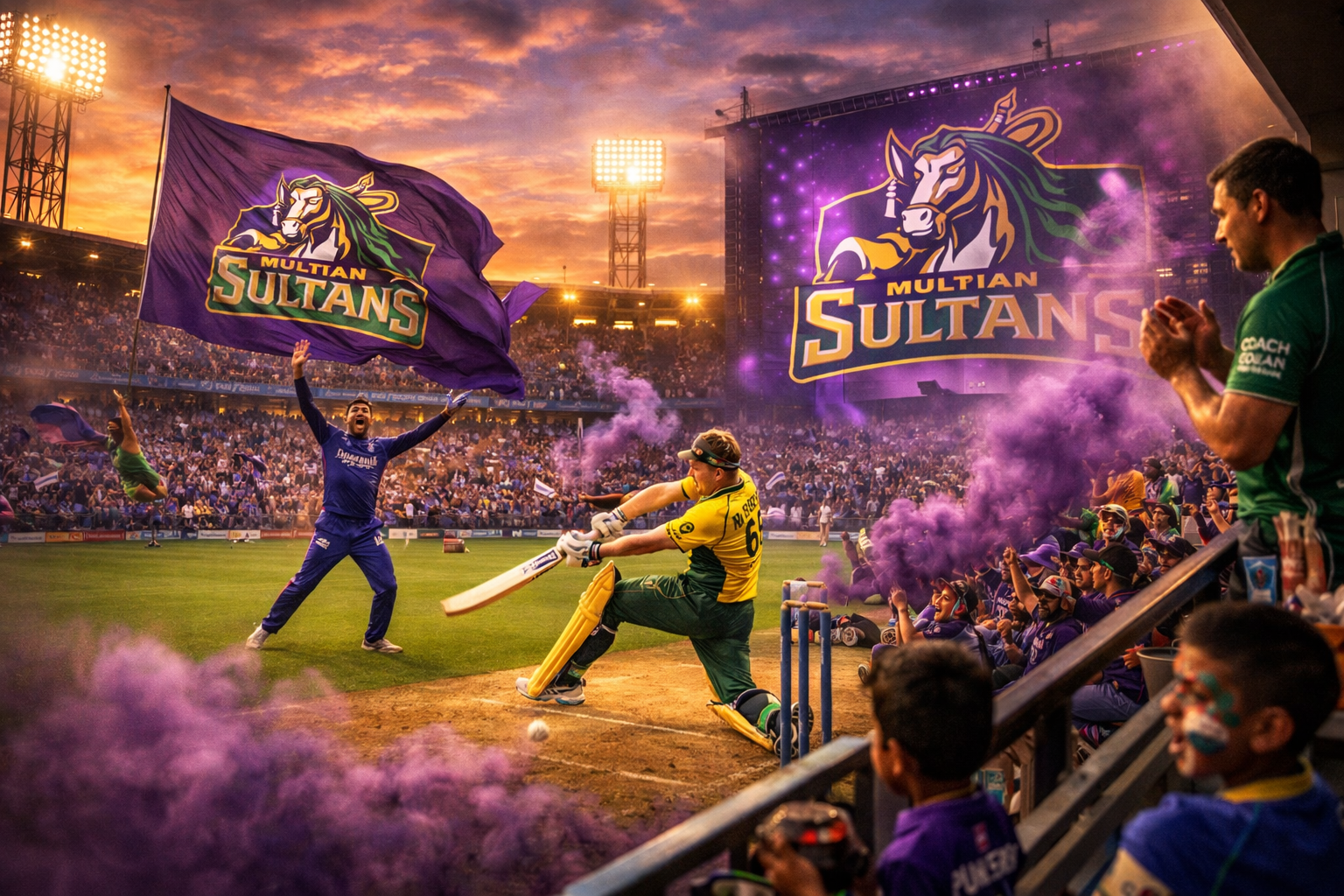
The visual brand — the iconic purple that has become synonymous with South Punjab cricket passion, the Sultan aesthetic that combines regional pride with the swagger of genuine champions — required no reinvention. Purple-clad fans filling Multan’s Gaddafi Stadium, chants rolling across the stands before the first ball is bowled, the specific atmosphere of a ground where the home team carries genuine historical weight: these are commercial assets that no amount of rebranding expenditure can manufacture from scratch on a PSL season’s timeline.

The merchandise implications alone justify significant attention. Faded 2022 Sultans kits are still worn in Multan’s streets — testament to the depth of supporter attachment that survived the franchise’s absence. The returning team will find a market primed for new merchandise purchases by fans who have been waiting through seasons of absence for a reason to update their wardrobes. Combined with the international profile that the squad’s overseas signings will generate — particularly Steve Smith’s PSL debut — the commercial projections for Sultans merchandise in 2026 are compelling.


4. The Squad: What Sialkot Built and Sultans Inherited

One of the more satisfying ironies of the rebrand story is that OZ Developers, in their brief tenure as Sialkot Stallionz owners, assembled a squad whose quality was entirely worthy of the Sultans name that would ultimately grace the players’ shirts. The transfers of contracted players to the new ownership structure were confirmed without complication, meaning Gohar Shah and CD Ventures inherited not just a famous name but an immediately competitive playing group.

Tim Paine’s appointment as head coach brings a perspective shaped by the combination of Australian Test cricket’s tactical rigour and the Big Bash League’s specific demands. Paine’s captaincy career was defined by difficult circumstances as much as straightforward success, and that experience of managing complex situations under significant pressure is precisely the quality most valuable in a PSL coaching role, where squad dynamics, player availability, and match conditions can shift unpredictably within a single tournament. His understanding of the overseas players in the squad — several of whom he would have encountered through Australian domestic and international cricket — gives him a relationship foundation that reduces the new-coach adjustment period.

Steve Smith at 36 brings the kind of calibre that transforms a franchise’s international profile instantaneously. His batting technique — unorthodox enough to have generated significant analysis from every major bowling attack in the world, and effective enough to have survived that analysis for a fifteen-year international career — is built for the kind of pressure situations that T20 knockout cricket produces. His experience across IPL franchises and Big Bash stints means the PSL environment, while new, is not categorically different from contexts he has navigated before. The prospect of Smith anchoring an innings or shifting gears to accelerate in the final overs represents match-winning value that most franchises across the world’s T20 leagues cannot access.

Tabraiz Shamsi’s wrist-spin is the bowling acquisition that most directly addresses the specific demands of PSL pitches, where the middle overs often determine match outcomes and where left-arm wrist-spin of the quality Shamsi delivers creates genuine problems for batters who are more accustomed to facing conventional spin. His ability to turn the ball both ways from the same action, combined with the deceptive pace variations that characterise elite wrist-spin, makes him a match-winner in conditions that suit his attributes.

Josh Philippe as a wicket-keeper batsman provides the kind of explosive top-order option that T20 teams require when the powerplay needs to be attacked regardless of early wickets. His Big Bash record demonstrates consistent ability to score quickly against quality bowling in conditions that challenge even the most technically accomplished batters. Ashton Turner’s reputation as a death-overs finisher — the specific skill of manufacturing boundaries in the final four overs against field restrictions and yorker-heavy bowling — addresses the match-defining phase where PSL contests are most regularly decided. Peter Siddle at 41 brings something qualitatively different: the knowledge accumulated across an international pace bowling career that enables specific, targeted execution rather than relying on the physical attributes that diminish with age. Death bowling mastery built on experience and craft rather than raw pace is an asset of specific value in T20 cricket.


5. Sialkot Supporters: The Commitment That Could Have Been Forgotten

The ownership’s handling of the Sialkot supporter base in the wake of the rebrand is worth examining carefully, because it represents a model of franchise transition management that addresses a genuine ethical and commercial tension that the rebrand created.

Sialkot fans who had invested emotionally in the Stallionz — attending early team announcements, buying initial merchandise, developing the attachment to a new franchise that cricket fans develop quickly when a team plays in their city — faced a situation through no fault of their own in which the franchise they had begun to support was renamed and its primary home moved to a different city. The commercial logic of the rebrand was sound. Its human cost to Sialkot supporters was real.

CD Ventures’ response addressed this cost directly rather than dismissing it. The commitment to incorporate Stallionz elements — potentially in alternate kits or logo acknowledgements — into the 2026 campaign maintains a connection to the franchise’s brief Sialkot identity that honours the supporters who invested in it. The practical arrangement of free transport for Sialkot fans attending Multan home games reduces the financial barrier to continued engagement with the team they had begun to follow. The “Sialkot spirit lives on” messaging in launch events signals an ownership that understands the PSL’s regional character — that the league’s strength comes from the genuine local passion of its supporters rather than the abstract commercial appeal of its franchises.

The response does not fully resolve the disappointment of supporters who wanted a PSL franchise in their city. But it represents a genuine and thoughtful acknowledgement of their stake in the situation, which is considerably more than franchise transitions in professional sport typically deliver.


6. South Punjab’s PSL Identity: What the Return Actually Means

The cultural significance of Multan Sultans’ return extends beyond cricket fandom into the broader question of regional representation in Pakistan’s most prominent domestic sports competition. South Punjab — a vast, densely populated region with a distinct cultural identity, a deep cricket tradition, and an agricultural and industrial base that sustains tens of millions of people — had been without a franchise that genuinely represented its heartland since the original Sultans’ exit from the league.

Sialkot’s cricket passion is genuine and its stadium facilities have been developing, but Sialkot is culturally and geographically a different region from South Punjab’s heartland. The argument that the Sultans represent South Punjab in a way that the Stallionz could not was not simply about city names or stadium locations — it was about whether the franchise’s identity connected to the cultural wellspring that makes South Punjab cricket support so intense and so commercially valuable.

Gohar Shah’s background as a South Punjab native gives the new ownership’s claim to regional authenticity a credibility that a commercially motivated statement alone could not achieve. His understanding of what the Sultans brand means to the region — the local heroes who have played under the banner, the communities that have treated Sultans success as a source of collective pride, the junior cricket pathways that a strong PSL franchise can support and develop — is the understanding of someone who shares that identity rather than someone who has studied it from the outside.

The academy and scouting infrastructure implications of a strong South Punjab franchise are long-term but significant. PSL franchises that invest in regional talent development create pipelines that serve both the franchise and Pakistan cricket’s broader development goals. Multan Sultans in their previous incarnation had begun developing those pathways. The return of the franchise under ownership with genuine regional commitment creates the conditions for that development to resume and accelerate.


7. PSL 11’s Wider Landscape: How Sultans’ Return Reshapes the Competition

The return of Multan Sultans does not occur in isolation — it reshapes the competitive and narrative landscape of PSL 11 in ways that affect every franchise in the league.

Lahore Qalandars, chasing a second title after their 2022 championship, now face a resurgent Sultans with the specific motivation of restoration combined with a squad capable of delivering it. The Lahore-Multan rivalry — geographically the motorway derby of PSL, with the two cities connected by Pakistan’s most-travelled highway — is one of the league’s most emotionally charged contests. Its return to the 2026 season adds a fixture that carries meaning well beyond its points value.

Karachi Kings in their rebuild phase and Peshawar Zalmi with their enduring passionate support both face a competitive field that has become more challenging with the Sultans’ return. The quality of Smith, Shamsi, Philippe, Turner, and Siddle as overseas options represents a foreign player pool that elevates the squad well above replacement-level PSL foreign signings into genuine match-winner territory.

The opening fixture of PSL 11 — Lahore Qalandars versus Hyderabad Kingsmen on March 26th — sets the tournament in motion, but the narrative of the season will be substantially defined by the Sultans’ first home game, the homecoming reception at Multan’s Gaddafi Stadium, and whether Tim Paine’s squad can translate its talent and its story into early wins that establish them as genuine title contenders rather than sentimental favourites.


8. Tim Paine’s Coaching Challenge: Building a Team, Not Just a Squad

The distinction between a squad and a team is one of the most important in professional cricket management, and Tim Paine’s primary challenge in the weeks before PSL 11 begins is making the transition from the first to the second as quickly as possible.

The overseas players Paine is working with have not previously played together under his coaching. The local players who will form the squad’s backbone — details of whom are still being finalised through trades and the draft — will need to integrate with the overseas contingent in a compressed pre-season period that leaves limited room for gradual team development. The standard PSL challenge of building chemistry and understanding quickly is compounded, in the Sultans’ case, by the franchise transition itself, which means that even the institutional memory of how previous Sultans squads have operated is not available as a reference point for players new to the franchise.

Paine’s approach to this challenge will likely draw on his experience managing complex team dynamics during Australia’s Test cricket rebuild in the immediate aftermath of the 2018 ball-tampering scandal — a period in which he was required to establish both his own authority and a collective team identity under unusual pressure and scrutiny. The specific skills that period demanded — rapid relationship-building, clear communication of expectations, and the ability to maintain performance standards while managing significant off-field complexity — are precisely the skills most relevant to his current situation.

His specific focus on Josh Philippe’s keeping and batting in practice sessions signals the tactical priority of getting the wicket-keeper batsman’s game in shape for the powerplay conditions PSL pitches typically produce. Philippe’s Big Bash record suggests the talent is there. Paine’s job is to ensure that talent is fully prepared for the specific challenges of a PSL campaign rather than arriving in match conditions cold.


9. The Steve Smith Factor: What His PSL Debut Means Beyond Cricket

Steve Smith’s participation in PSL 2026 as a Multan Sultans player is a landmark moment for the league’s international profile, and its significance extends beyond the batting averages and match contributions that his performances will generate.

The international broadcast and media attention that accompanies a player of Smith’s calibre participating in a new league is a form of advertisement that the PSL’s commercial team cannot buy at any price. Every match preview that mentions Smith’s PSL debut, every social media post from cricket followers across Australia, England, and South Asia commenting on his performances, every highlights package that shows his innings in Multan as part of global cricket coverage — all of this extends the league’s reach into markets and audiences that previous PSL seasons may not have fully penetrated.

At 36, Smith is approaching the end of a career that has redefined the boundaries of Australian batting technique and productivity. His decision to participate in PSL at this stage of his career — rather than conserving himself for Australian domestic and international commitments — signals a genuine desire to experience one of cricket’s major leagues before retiring, and possibly a recognition that the PSL’s quality and profile have reached the level where participation represents a meaningful addition to a career legacy rather than a peripheral tournament commitment.

The possibility that this PSL campaign represents one of Smith’s final extended appearances in professional T20 cricket adds a specific weight to his Sultans tenure. South Punjab cricket fans who pack the Gaddafi Stadium to watch him bat will be watching one of the great modern batsmen at an advanced stage of a remarkable career — and that experience, independent of the match result, has a value that transcends the immediate competitive context.


10. The Road to March 26th and Beyond

With PSL 11 beginning on March 26th with the Lahore Qalandars versus Hyderabad Kingsmen opener, the Multan Sultans have days rather than weeks to complete their preparations, finalise their squad, and establish the team environment that their opening matches will require to be competitive.

The Gaddafi Stadium in Multan is reportedly receiving upgrades in advance of the homecoming fixtures — an investment in the venue that signals the new ownership’s commitment to making the Sultans’ return a properly staged event rather than simply a squad competing under a famous name. Multan’s ground has hosted international cricket and PSL matches with the kind of atmosphere that results from a genuinely passionate local supporter base treating the stadium as a communal gathering point rather than simply an entertainment venue.

Gohar Shah’s indication that trades and late acquisitions remain possible before the deadline — with suggestions that a Babar Azam, Shaheen Afridi, or Mohammad Rizwan addition would give the squad local star power to complement the overseas quality — reflects the ambition appropriate to a franchise that has returned not merely to participate but to contend. The foreign player core is strong enough to win matches. Local talent of the calibre Shah is targeting would give the Sultans the complete combination that PSL championship squads require.

The broader PSL picture — Lahore Qalandars chasing a second title, Karachi Kings rebuilding, the established rivalries reinvigorated by the Sultans’ presence — makes PSL 11 the most narratively rich edition of the tournament since the league’s early years. At the centre of that narrative, wearing purple and carrying the accumulated expectations of a supporter base that has been waiting through absences for exactly this moment, Multan Sultans will take the field on March 26th.


Conclusion

The return of Multan Sultans to PSL is a story that works on multiple levels simultaneously — as a business narrative about franchise ownership, brand equity, and the commercial logic of identity preservation; as a cultural narrative about regional representation, community identity, and the specific passion that South Punjab brings to cricket; and as a sporting narrative about a squad with genuine title ambitions, a coaching staff with the experience to deliver them, and a competitive context that makes the 2026 season one of the most anticipated in PSL history.

Gohar Shah’s argument to the PCB — that a stallion needs a sultan to win the PSL — was both a soundbite and a statement of genuine commercial and cultural understanding. CD Ventures’ acquisition of the majority stake and the subsequent rebrand has created a franchise with the brand strength, the squad quality, the coaching expertise, and the supporter passion to compete for the trophy from the opening match of the season.

Smith’s PSL debut, Shamsi’s wrist-spin in Multan’s evening air, Paine’s tactical intelligence from the coaching balcony, and the purple wave filling the Gaddafi Stadium for a homecoming that South Punjab has been waiting for through seasons of absence — these are the ingredients of the tournament’s defining story.

PSL 11 is going to be memorable. And Multan Sultans, risen from the ashes of a financial crisis and the pragmatic decision of a CEO who understood what his region needed, are going to be at the centre of it.

Sultan. Sultan. Sultan.

Leave a Reply

Your email address will not be published. Required fields are marked *

News That Commands Truth — Without Filter

Independent journalism covering Pakistan and the world. Unfiltered reporting on politics, business, sports, and culture — delivered with clarity and purpose since 2024.

BREAKING LIVE EXCLUSIVE
f X in YT W
Contact Info
Email
info@sultannews.online
Editorial
editor@sultannews.online
Location
Karachi, Pakistan
Newsletter
© 2026 Sultan.News — All Rights Reserved. Karachi, Pakistan.